
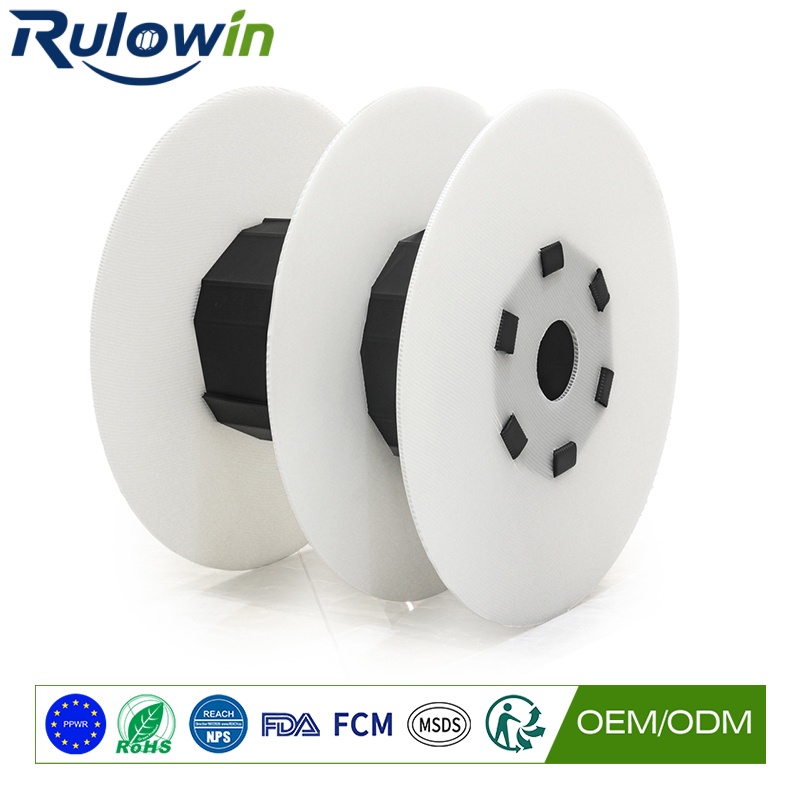
A cable reel on a flatbed is a heavy round object on a flat surface, and it wants to roll. Everything about securing it follows from that, and the most common mistake is treating it like a box.
What does not work
A strap over the top, tensioned down. It holds the reel down, which is not the problem – the problem is sideways and forward movement, and a downward strap provides almost no resistance to either. Reels secured this way roll out from under the strap.
Also inadequate: relying on friction. A plastic reel on a steel deck has modest friction and a loaded reel has a lot of mass behind it.
What works: chocks
Chocks either side of each reel, fixed to the deck, are the primary restraint. Timber or purpose-made chocks both work; the requirement is that they are positively located rather than just placed, because a placed chock moves.
For a single reel, chock both sides. For a row, chock the ends and the spaces between – a row of reels each needs restraining, not just the two at the ends.
Then straps
With chocks in place, straps over the top stop the reel lifting and add security. They are the secondary restraint and they are worth having, but they are not the primary one.
A strap through the hub, anchored to the deck, is better than one over the top for a single heavy reel, because it resists movement in every horizontal direction.
Orientation
Reels should travel lying on their flanges – flat – rather than standing on the rim. Flat is stable by itself; upright is not, and an upright reel only needs one hard brake to become a serious problem.
If reels must travel upright, they need a frame or a cradle. Do not attempt it with chocks alone.
Stacking on a trailer
Loaded reels should not be stacked. Empty reels can be, flange to flange, to a modest height, with the stack chocked. The storage guidance in stacking plastic cable reels on their flanges applies here too.
Checks before moving off
Push each reel firmly. If it moves at all, the restraint is not adequate – and it is much easier to fix in the yard than at the first roundabout.
Load distribution
Reels concentrated over one axle overload it, and a flatbed loaded with reels is heavy enough for that to matter legally as well as practically. Spread the load along the deck and keep the heaviest reels between the axles.
Check the axle weights if the load is substantial. It is the sort of thing that is fine right up until it is not.
And a re-check
Retension or re-check after the first few kilometres and again after any long stop. Loads settle early, and a check at that point catches a restraint that has gone slack before it becomes a problem.
One more caution
Never use the reel flange as a step or a load-bearing surface for anything else on the deck. It is a flange, not a platform, and it cracks reliably when treated as one.
What we can do
We supply plastic reels for FTTH deployment and will tell you what the flange can take and how reels should be restrained. Ask us for the transport guidance with the order – it prevents most of this.