
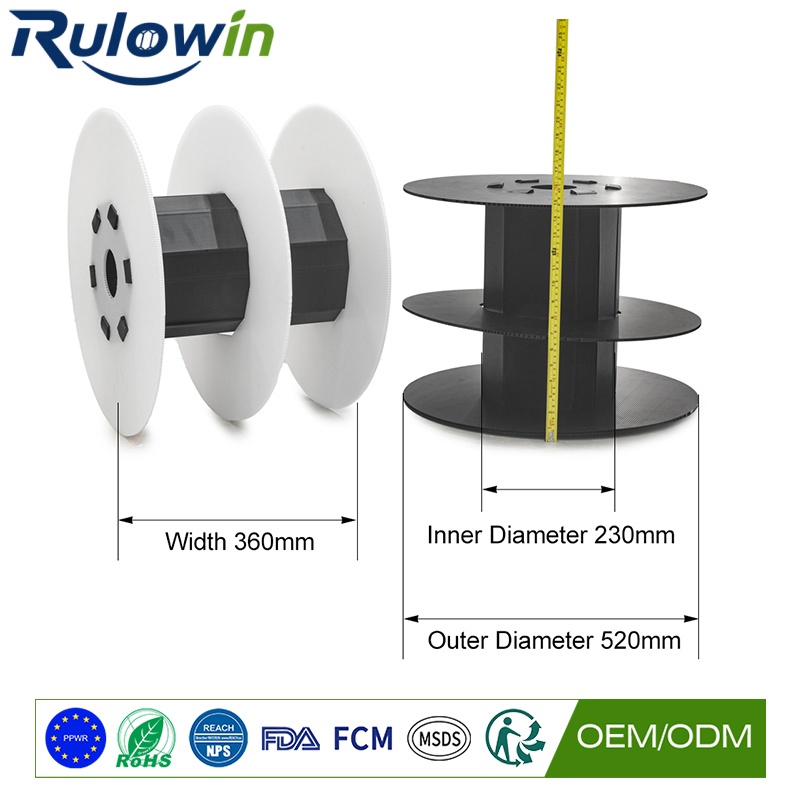
Empty cable reels take up a lot of space for their weight, and how they are stored is mostly a question of which orientation the flange can carry. There are two ways people stack them and only one is safe.
Flange to flange, lying flat
Reels lying on their side, stacked on top of each other, flange face to flange face. This is the good arrangement. The load goes through the flange into the hub, which is the strongest axis of the reel, and a stack of ten sits happily in a corner for months.
Two cautions. Keep the stack vertical – a leaning stack puts a bending load into the flanges they are not built for. And cap the height; a stack taller than about four times its diameter gets unstable for reasons that have nothing to do with the reel material.
Standing on the rim
Reels stood upright on the edge of the flange, like a wheel. This is the arrangement that damages reels. The entire weight sits on a narrow ring, and on anything but a perfectly flat floor that ring takes point loads it was never designed for. Flanges crack from this, and the crack pattern is distinctive – starting at the rim and running inward.
It is also unstable in a way that matters: a reel standing on its rim will roll if nudged, and a rolling reel with mass behind it is a genuine injury risk, not just a damaged product.
Storing them on the hub
Some operations thread empty reels onto a bar through the hub and rack them horizontally. That is fine and it is the best use of vertical space if you have the racking. The hub is the load path and it takes it well.
Check the bore against the bar diameter first. A bar that is much smaller than the bore lets the reel hang off-centre and the stack leans. The dimensional language is in reel terms: hub, flange and bore explained.
What actually gets damaged in storage
Mostly the flange rim, from being dragged rather than lifted. Dragging a reel across a floor on its edge does more damage in one move than a year of correct stacking.
And UV, if they are stored outside. A reel stored outdoors for a season without UV stabilisation loses surface strength, and the flange becomes chalky before it becomes visibly cracked.
How many fit where
Counts per pallet and per container vary a lot with diameter and whether the reel is one-piece or two-piece. The method for working it out is in how many cable reels ship per pallet, and the design difference in one-piece vs two-piece reel designs.
A note on loaded reels
Everything above is about empty reels. A loaded reel is a different object – heavy, and with its mass concentrated at the flange. Loaded reels should not be stacked at all beyond a very low count, and they should be chocked if there is any chance of movement.
The failure mode on a loaded reel is a flange cracking at the hub, and it happens when the reel is dropped even a short distance onto its rim rather than from stacking.
What we can do
We supply plastic reels for fiber drop cable and will tell you how they should be stacked and what not to do with them. Ask us for the stack height limit and the outdoor storage guidance – it is cheaper to hear it before the flanges crack.