
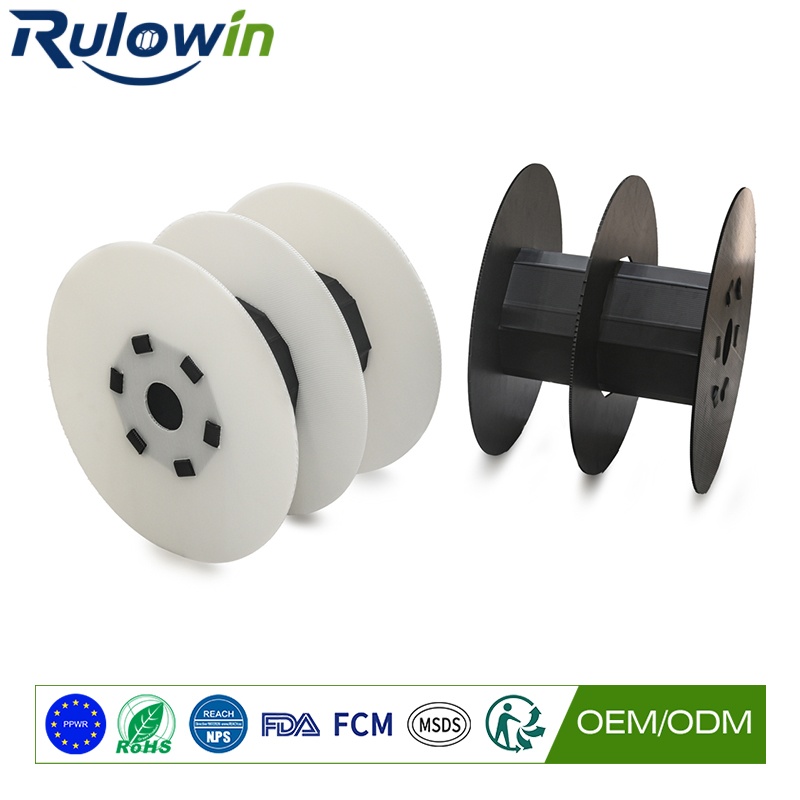
Two completely different answers depending on whether the reels are empty or wound, and people mix them up constantly. An empty plastic reel is light and bulky; a wound reel is heavy and dense. The pallet count is driven by different constraints in each case.
Empty reels
Empties are a volume problem. Reels are usually palletised lying flat, stacked in columns, with the count set by how many fit in the pallet footprint and how many layers you can stack before the column becomes unstable.
Flange diameter sets the footprint count. A larger flange means fewer per layer, and because it also means a taller stack per reel, it usually means fewer layers as well. The penalty for going up a flange size is therefore worse than it looks – it bites twice.
Empty reels stacked directly on each other scuff the flange faces. Separating layers with a sheet is cheap and prevents the cosmetic damage that shows up when the customer opens the pallet.
Wound reels
Now it is a weight problem. A pallet of wound reels reaches its weight limit long before it runs out of volume, and the count is set by cable weight per reel and whatever your handling equipment and road limits allow.
Wound reels should also be chocked. A round object on a flat pallet rolls, and a pallet of wound reels that has been braked hard in a truck has been subjected to more force than most strapping is specified for. Chocks or a purpose-made pallet with a recess are worth the cost.
Pallet type matters more than people think
A pallet with a solid deck distributes load; one with wide gaps between boards lets a reel hub sit in a gap and deform. For wound reels, deck board spacing should be tighter than the hub diameter, or the reels need to sit on a sheet.
Also worth checking: whether the pallet footprint works out to a whole number of reels. An awkward remainder means reels overhang, and overhanging reels get damaged in transit in exactly the way overhanging crates do.
What to ask a supplier
Reels per layer, layers per pallet, pallets per container – for the empty and for the wound case, separately. Any supplier shipping reels regularly has these numbers. And ask whether they ship on their side or standing; standing reels take far more space and are only worth it where flange damage is a real concern.
Empty-reel return volume is the number that decides whether a reuse scheme pays. We set that out in can plastic cable reels be reused.
Strapping and wrapping reels
A pallet of reels needs to be restrained, and the temptation is to wrap it tightly. Wrap pulls reels towards the centre of the pallet and can deform the top layer of flanges, particularly on a warm day when the reel is softer.
Strap over a top sheet instead, with edge protectors, and use just enough wrap to keep the column together. For wound reels, chocks matter more than either – a round load that can roll will find a way to.
Worth checking a pallet after a long haul before concluding that a reel is too weak. Deformed flanges on the top layer are usually a restraint problem, not a reel problem.
What we can do
We supply custom-size fiber optic cable drums and give packing counts for both empty and wound. Tell us the flange size and the cable weight per reel and we will work out pallets per container – and tell you if a different flange would improve it.