
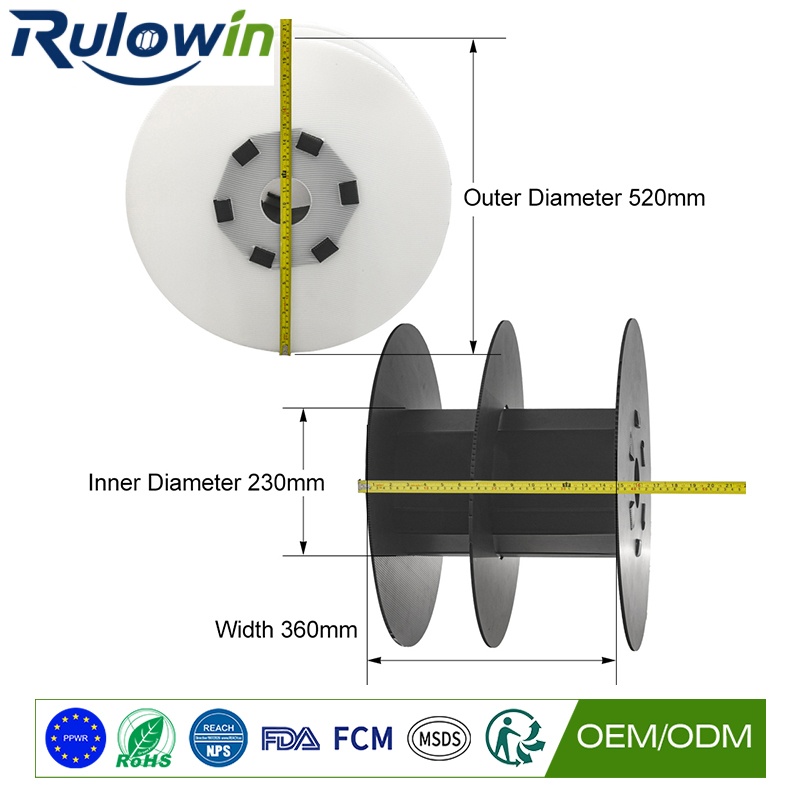
Plastic cable reels are structurally capable of many rewind cycles. That is not the question. The question is whether reels come back, and whether anyone checks them before they get reloaded – and in most operations the answer to one of those two is no, which is why reuse programmes fail.
What makes reuse work
A return lane. Reels are bulky relative to their value, so return freight has to be cheap or free – which usually means they go back on a vehicle that is already running the lane. A dedicated return trip for reels alone rarely pays.
Somewhere to put them. Empty reels that come back need a storage area, and if that area does not exist they end up outside, where ultraviolet does more damage than reuse saves.
Someone to check them. A reel should be inspected before it is rewound, and the inspection is quick: look at the hub-to-flange junction for hairline cracks, check the flange for a crack radiating outward, and check the bore is still round.
What should not be reused
A reel with visible hairline cracking at the hub should not be loaded to capacity. It may be fine for a short light length, and it is not fine for cable under tension. A reel with a bent flange will run out of true on a payout spindle. A reel with an out-of-round bore wobbles, and the wobble becomes tension variation on the cable – which on fine fiber matters.
These are all visible in a few seconds. There is no instrument required, which is the good news and also the reason there is no excuse.
The length question
If you reuse a reel, re-rate it. A reel’s length rating belongs to a specific cable diameter. Put a larger-diameter cable on it and the same volume holds fewer metres, but the radial pressure goes up. Over-winding is the main cause of flange failure, and reuse is when it happens, because the reel “held that much last time”.
We covered the failure in why cable reel flanges crack near the hub.
When reuse is not worth it
Long one-way legs, small reels with low unit value, and anywhere that a damaged reel reaching a customer costs more than the reels saved. There is a real argument for treating small reels as consumable and reusing only the large ones, because the value ratio is completely different.
Cleaning and storing empties
Empty reels arriving back dirty – mud, concrete dust, cable lubricant – should be cleaned before they go into storage. Grit left in the hub bore wears the spindle, and anything on the flange face transfers to the next length of cable.
Store them under cover if at all possible. Reels left outside for months accumulate ultraviolet damage that no amount of structural soundness compensates for, and a brittle flange fails without warning. If outdoor storage is unavoidable, ask for a stabilised resin and expect a shorter reuse life.
What we can do
We supply recyclable plastic fiber optic reels built for multiple rewind cycles, with the hub section reinforced. Tell us the cable, the length and how many cycles you want, and we will specify accordingly – and tell you honestly if, at your reel size and lane, reuse is not worth organising.