
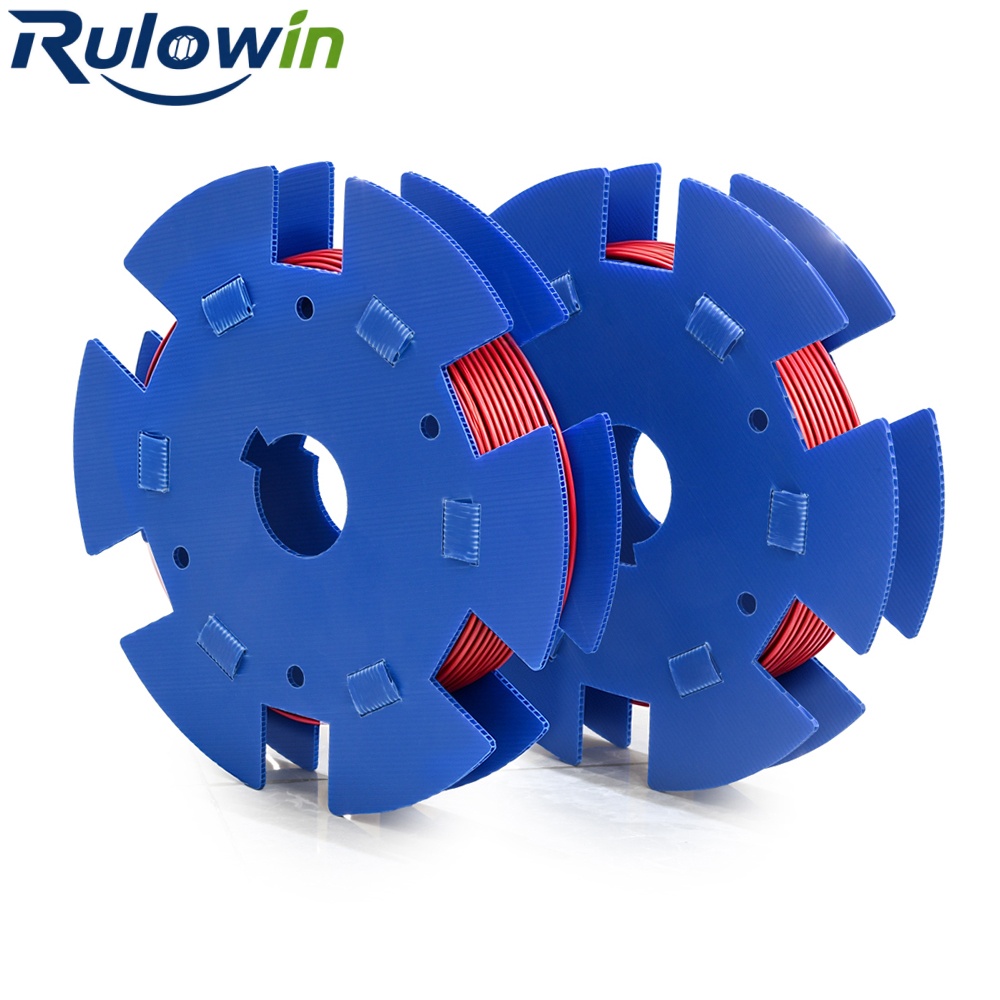
Cable destined for marine installation gets handled in ports, stored outdoors near salt water, and loaded by people working fast. It combines nearly every hostile factor covered elsewhere in this series: UV, moisture, impact, salt, and heavy mechanical handling.
What makes it different from ordinary outdoor storage
Outdoor yards are one thing — covered in our article on UV-stabilised spools. Marine environments add:
- Salt. Aerosol settles on everything. It is hygroscopic, so surfaces stay damp, and it accelerates corrosion of anything metallic on or in the spool.
- Persistent damp. Nothing dries out properly.
- Large mechanical handling. Cranes, spreaders, heavy loads moved quickly.
- Long dwell times. Cable spools often sit at ports for weeks.
Why this suits plastic better than most things
This is one area where polypropylene has a clear advantage, and it has nothing to do with strength:
- It does not corrode. Steel spools in a marine environment need coating and maintenance, and the coating is what fails first.
- It does not absorb water and does not rot, unlike plywood.
- Salt does not affect it directly in the way it affects metals.
- UV-stabilised grades exist specifically for this.
The trade-offs are all honest ones — lower stiffness than steel, lower temperature capability, and it will still degrade under UV eventually. But in this environment the alternatives have worse problems.
Where the damage happens
Ranked by how often we hear about it:
- Crane and spreader contact. Anything with that much momentum hitting a flange wins.
- Sitting on rough ground. Gravel, dock surfaces, embedded debris.
- Stacking without separation on uneven surfaces.
- Salt-laden dust working into the bore and into any joint.
- Sun exposure over months doing exactly what our UV article describes.
What to specify
- UV-stabilised grade. Non-negotiable for anything stored outdoors for months.
- Rim protection. This is the strongest case for reinforcement anywhere in this series — see the rim reinforcement discussion.
- Consideration for metal components. Any insert, fastener or joint hardware either avoid it or specify marine-grade.
- Drainage. Our piece on vent and drain holes is directly relevant to preventing standing salt water.
- Thicker section than pure load requires. You are specifying for abuse, not for calculated load.
Bore care specifically
Salt ingress into the bore is a combination problem: abrasive salt crystals accelerate exactly the wear described in our article on bore wear, and damp conditions make everything worse. Rinsing bores with fresh water as part of the return routine is cheap and effective.
Practical handling notes
- Separate spools from direct ground contact — even a simple bearer helps
- Cover where practicable, accepting that often it is not
- Lower stacks than you would use indoors, because surfaces are rarely level
- Rinse and inspect as part of turnaround rather than waiting for a problem
What we would not claim
We are not going to quote a service life for a marine environment, because the variables — how much sun, how rough the handling, how often they get rinsed — dominate the material properties. Anyone who gives you a number without asking about those is guessing.
What we can do is specify UV-stabilised material, reinforcement at the rim, and construction without corrodible components, and tell you that our hollow board spools generally hold up well where plywood and painted steel struggle. Test them in your actual port conditions before committing to volume.