
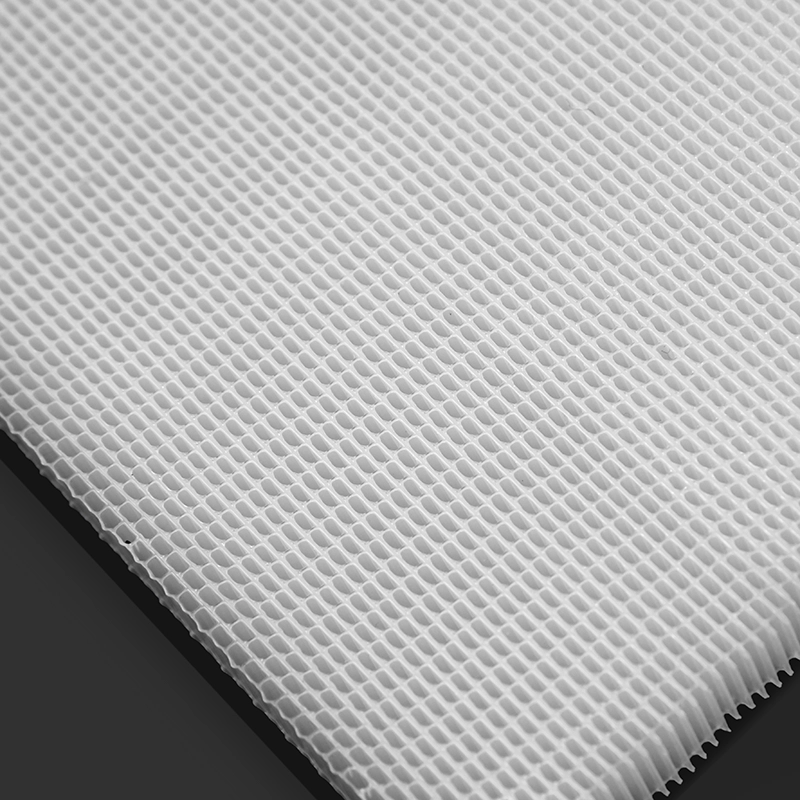
A cooler that has lost airflow is usually assumed to have dirty pads. Often it has scaled ones. The two look similar from outside, feel similar to a hand held at the outlet, and need completely different remedies – so telling them apart is worth two minutes before anyone orders anything.
How they differ
Dust loading is soft, dark and sits on the intake face. It rinses off, at least partly, and it concentrates where the air arrives fastest – usually the outer sections of the pad.
Scale is hard, pale and crystalline, and it builds where water evaporates rather than where dust arrives: at the dry edges of the pad, on the distribution surfaces, and on any screen that sits in the wetted zone. It does not rinse off. Weak acid will remove it, with all the handling care that implies.
What scale does to a screen
A screen in the wetted zone will scale in hard water areas, and the scale narrows the cells. Because the geometry depends on open cells, narrowing them raises resistance directly. The screen then looks clean – it may be clean – and still restricts.
The remedy is to keep the screen dry where that is possible, or to accept descaling as part of the washing routine. Where the screen sits upstream of the water distribution and stays dry, scaling does not apply and the screen only sees dust. That placement is worth choosing if the housing allows it.
Managing the water instead
Bleed-off – continuously draining a small proportion of the recirculated water – keeps the dissolved solids concentration down and slows scaling substantially. It costs water and it is usually the cheapest control available. Where water is expensive, a bleed controller that measures conductivity does the same job with less waste.
Neither replaces filtration. Dust and scale are independent problems that happen to share a symptom, and a cooler with clean air and hard water will scale anyway.
Telling them apart in two minutes
Look at the intake face of the pad. Dust is dark and soft, and it comes away on a finger. Scale is pale, crystalline and hard, and it does not. If you can scratch it off with a fingernail, it is dust; if you need something harder, it is scale.
Then look at where it is. Dust concentrates where the air arrives, generally the outer areas. Scale concentrates where water evaporates – the dry edges of the pad and the distribution surfaces above it. The location is often more diagnostic than the appearance.
Water-side controls
Bleed-off is the cheap one: continuously draining a small proportion of the recirculated water keeps dissolved solids from concentrating, and it works. It costs water, which matters where water is expensive or restricted.
A conductivity controller measures the concentration and bleeds only when needed, which does the same job with considerably less waste and pays for itself in metered areas. Where hardness is extreme, treatment or a water softener on the make-up is the next step, and it is worth getting a water test before spending on any of it.
What we can do
We supply washable PP honeycomb screens for evaporative coolers that tolerate both washing and descaling. Tell us whether your water is hard and where the screen sits – wet or dry side – and we will tell you what to expect and how often to service it.