
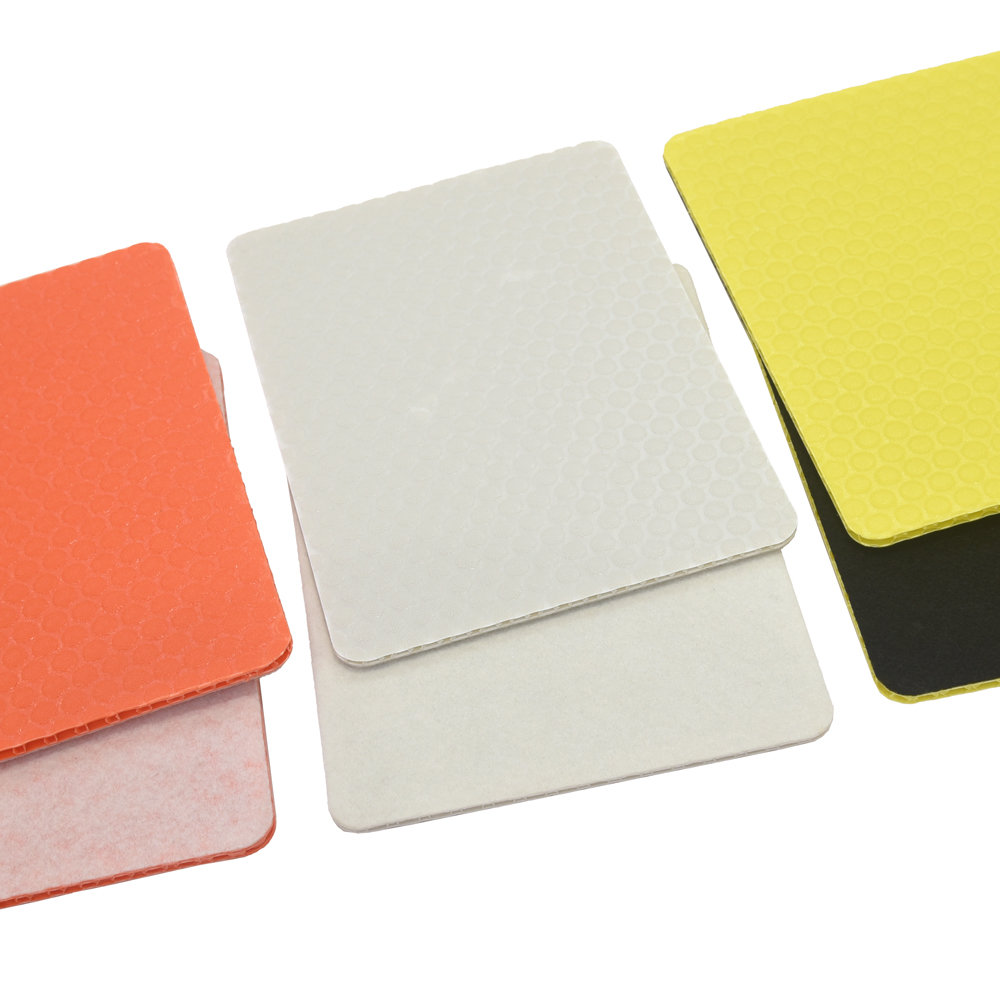
A protection panel rarely fails across its whole area. It fails where something concentrates load into a small patch – a pallet truck wheel, a scissor lift outrigger, the foot of a stillage. Once you know the contact patch and what the finished floor can take, choosing a construction is arithmetic rather than guesswork.
Start with the contact patch
A loaded pallet truck puts several hundred kilograms through two small wheels, and the contact area is a few square centimetres each. Divide load by area and the stress at the contact can be several times what the same load would apply if it were spread over half a square metre. That number is what the floor finish has to survive, and it is why a floor that happily takes foot traffic gets destroyed by one delivery.
What the panel actually does
A stiff panel spreads a concentrated input over a wider footprint as it bends slightly, converting peak stress into something nearer an average. Thicker skins and a thicker core both increase that spreading effect, but not linearly, and neither helps if the panel is sitting on a void. Support matters at least as much as panel construction – an unsupported edge over a floor void will be punched through by the same wheel that is fine mid-span. If you need the detail on how thickness changes behaviour, see what panel thickness actually changes.
The substrate sets the limit
Polished concrete will take a great deal. A soft vinyl or a newly laid resin in its early cure will not, and some natural stone is more sensitive than buyers expect because the load goes into the bedding rather than the slab. Ask the flooring subcontractor for a figure in kilopascals or kilograms per square centimetre; if they cannot give one, treat the floor as delicate and specify accordingly.
Test rather than model
A test costs almost nothing. Lay two or three panels over the actual floor, run the worst item of plant across the joint and the unsupported edge, then lift and look. Marks on the panel are information; marks on the floor are a variation order. Doing this during a mock-up stage is far cheaper than discovering it during handover week.
Where a panel is the wrong answer
Very heavy point loads from tracked plant, crane matting and outriggers under full load generally need plywood or steel plates, not polypropylene. We say this often. Selling a plastic panel into a job that needs a hardwood mat gets someone hurt and gets the product blamed for a specification it was never offered for.
Write it into the method statement
The common failure is not that the panel was inadequate – it is that nobody told the delivery driver which route to use. Include the allowable wheel loads, the permitted routes and the penalty for leaving it in the RAMS pack, and the expensive part of the equation usually disappears.
A worked example
A loaded pallet truck at roughly seven hundred kilograms puts about three hundred and fifty kilograms through each axle. If each wheel contact patch is around four square centimetres, that is close to ninety kilograms per square centimetre at the contact – an order of magnitude above what many resin and vinyl finishes tolerate as a sustained figure. Add a stiff panel that spreads that load over two hundred square centimetres and the stress drops by a factor of fifty.
The numbers do not have to be precise to be useful. Order-of-magnitude arithmetic is enough to establish that spreading matters far more than small differences in panel thickness, and that unsupported edges are the real risk rather than the middle of a span.
What we can do
We make honeycomb protection panels with a range of skin and core combinations, and we would rather size the construction to your worst load than sell you the thickest item in the catalogue. Send the heaviest item of plant and the floor type and we will tell you what we think, including when we think you need something other than polypropylene.