
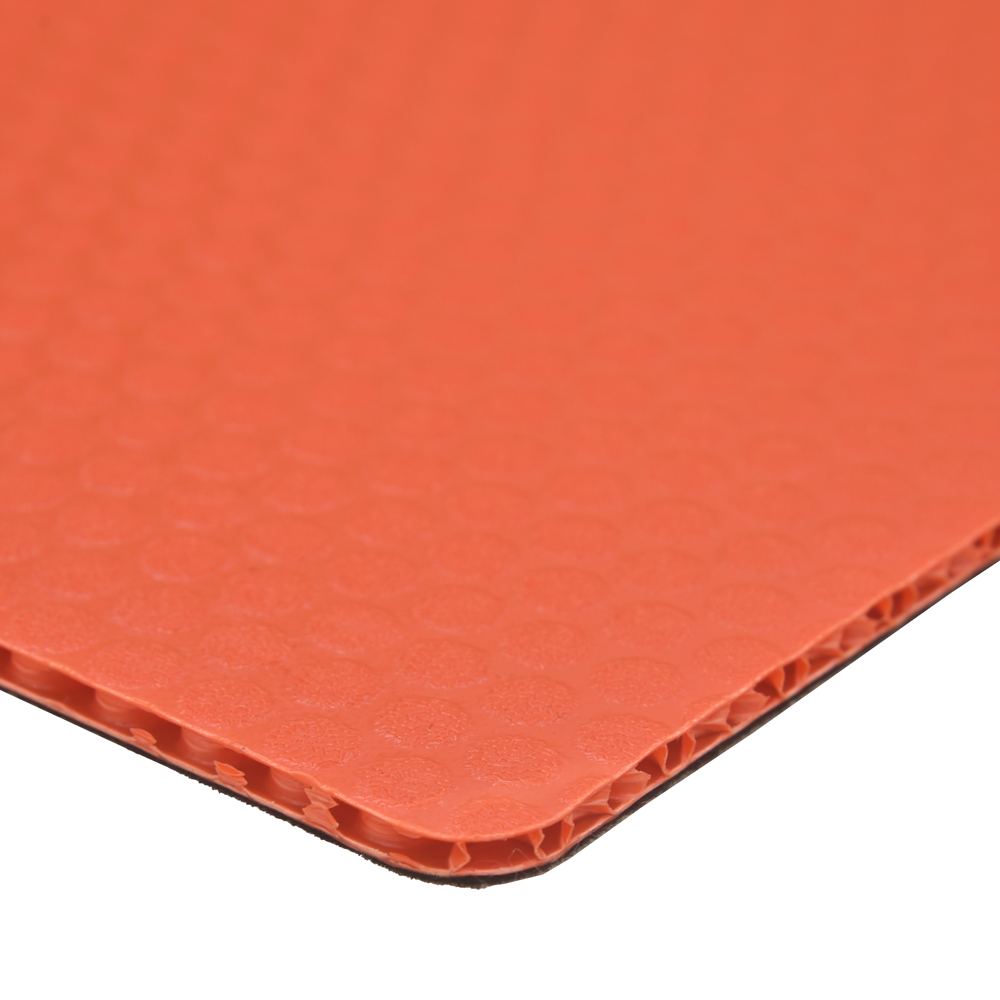
Thickness is the first figure anyone asks for and the one most likely to be quoted without context. On a honeycomb panel it does real work, but less than most buyers assume, and it interacts with two other numbers that are rarely written down.
What thickness genuinely controls
A honeycomb panel behaves a bit like an I-beam. The two skins carry the bending load and the core keeps them apart. Move the skins further apart and the panel gets stiffer quickly, because stiffness rises with roughly the square of the separation.
So thickness buys you resistance to bending. If your panel is spanning a gap, carrying a load across a rack, or being lifted at two edges with nothing underneath in the middle, thickness is the right lever.
What it does not control
Thickness does almost nothing for local crush. Put a point load on the face of a thick panel and you will dent it just as easily as a thin one, because what resists a dent is the skin, not the core. This is the single most common mismatch we see: someone specifies a thick panel to stop a part from punching through, and it does not help.
It also does not automatically buy edge strength. A cut edge on a honeycomb panel exposes open cells, and an unsupported open edge will crush under a strap or a fork. Thicker panels have more exposed cell to crush, which is why we usually recommend edge treatment on anything above about 10 mm.
The two numbers that matter as much
Skin thickness. Two panels can both be 12 mm and perform completely differently, because one has a 0.4 mm skin and the other 1.0 mm. The thicker skin will take far more abuse, resist denting, and hold fasteners better. It also costs more and weighs more.
Cell size. Smaller cells mean more cell walls per unit area, which spreads a point load across more material. Large cells are lighter and cheaper for the same thickness and feel stiff in bending, but they dent more easily and can telegraph their pattern through a thin skin.
Where the weight goes
Most of a honeycomb panel’s weight is in the skins, not the core. That means a panel with thick skins and a modest core can weigh more than a thicker panel with thin skins, while performing worse in bending. If weight matters for your freight or for manual handling, ask for the gram weight alongside the thickness.
How to specify it usefully
- Say what the panel has to survive. Bending span, point loads, strapping, stacking, washing.
- Give the real support conditions. A panel resting on a flat deck and the same panel spanning two rack beams are different problems.
- Ask for thickness, skin gauge and gram weight together. Any one of them alone is easy to meet in a way that does not help you.
- Say whether edges will be exposed. It changes the answer more than most people expect.
A note on tolerance
Honeycomb panel thickness is not a precision dimension. Extruded and laminated panels carry a tolerance of a few tenths of a millimetre at best, and it is normal for a stack to vary slightly sheet to sheet. If your panel has to fit into a machined slot or a fixed-width fixture, design to the tolerance rather than the nominal figure, and tell us the limit before we quote rather than after.
What we can do
We build PP honeycomb panels across a range of thicknesses, skin gauges and cell sizes, and the useful conversation is about the load rather than the dimension. If you tell us what the panel has to carry and how it is supported, we can usually say whether a standard build is comfortable or whether yours needs a heavier skin.