
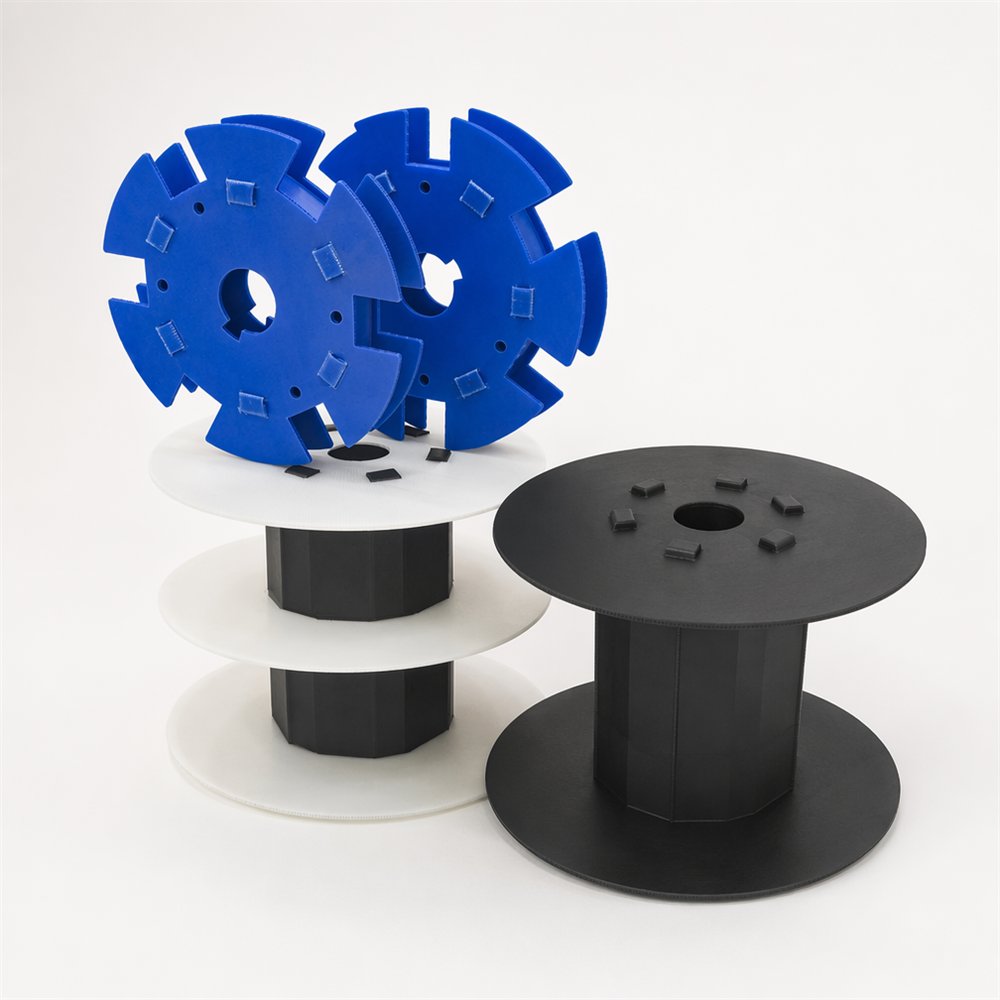
A lot of spools have holes in the flange. Sometimes they are there to let you see how much product is left, sometimes they are hand-holds, sometimes they are purely to save material and weight. The question that rarely gets asked properly is what they do to the strength of the flange — and the honest answer is that it depends entirely on where they are.
What a hole does structurally
Two things. It removes material from wherever it sits, obviously. And it creates a stress concentration at its edge — load that was flowing through that patch of board has to go around the opening, which means it concentrates along the sides of the hole.
How much that matters depends on where the load is flowing. In a flange under hoop load from the wound product, the stress is not uniform. It is higher towards the hub and lower towards the rim, and it flows radially outward.
Where holes are safe
Near the rim. Outboard, the flange is doing relatively little structural work. Holes here — inspection windows, hand-holds — cost very little stiffness and sit far from the high-stress region.
Radially aligned rather than bunched. Several smaller openings spaced around the flange are better than one large one, because each diverts less load. This is the same principle behind spoke patterns on anything.
Rounded corners. A square or slotted hole has corners, and corners concentrate stress dramatically more than curves. If a cut-out is needed with straight edges, generous radii at the corners matter more than the size does.
Where holes are a problem
Close to the hub. Everything funnels through the hub region. A hole there removes material from the busiest part of the flange and puts a stress concentrator in exactly the wrong place. If you see cracks radiating from cut-outs, they usually start at the inboard edge.
In the middle of the working radius on a heavily loaded spool. Mid-radius is where the bending from hoop load peaks.
Intersecting ribs. If the flange is ribbed for stiffness — see our article on flange ribbing — cutting through a rib cuts the member doing the work. Either route the hole between ribs or accept that the reinforcement is compromised.
The weight argument
Holes get specified for weight, and weight does matter on returnable packaging, because every kilo is freight on every trip. This is the arithmetic from our piece on spool weight and freight.
But the saving from a few cut-outs in a flange is usually small — a few per cent of a component that is not the heaviest part of the spool anyway. If weight is the real objective, thinning the board or reducing the flange diameter will usually deliver more, though both have their own consequences.
Holes are worth it when they do a second job: visibility, grip, drainage, ventilation. Those are real functions. Pure weight saving through cut-outs is usually the weakest justification.
The other failure mode: snagging
Cut-outs in the flange face can catch the product. If anything is being wound near the flange, an opening gives it somewhere to go that it should not — particularly soft product, or anything under low tension. Once a turn has entered a cut-out it will tend to jam.
This is why some apparently reasonable cut-out patterns do not survive contact with actual production. Worth testing with product on before committing.
Edges again
Any cut-out in hollow board exposes the flute structure at its edge — the same problem discussed at the rim in our piece on rim reinforcement. Unsealed edges fray, collect dirt and water, and give delamination somewhere to start.
If cut-outs are needed and the spool is going into service outdoors or gets washed, sealing the edges is worth specifying. It costs very little and it removes a maintenance issue later.
What to ask for
If you want cut-outs, tell the supplier what they are for and what load the flange sees. That is enough to place them sensibly. If you are copying somebody else’s spool with cut-outs copied along with it, it is worth knowing whether those openings were engineered or whether they were the shape the tooling happened to make.
Our spools can be produced with or without them depending on size, and we would rather discuss placement up front than discover a crack pattern eighteen months in.