
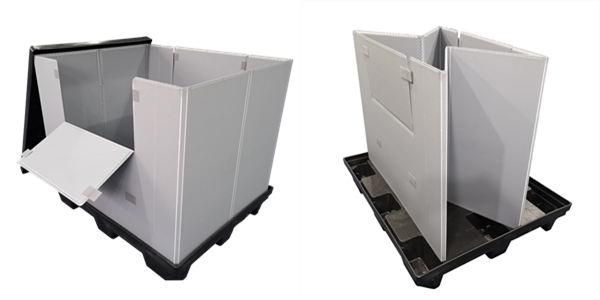
A pallet sleeve box is three parts: a base that sits on the pallet, a sleeve that forms the walls, and a lid. New crews get the sequence wrong often enough that it is worth stating plainly – the sleeve goes on before anything is loaded, and the lid goes on last. Attempting to drop a loaded sleeve over a stack of product is the single most common reason people decide sleeve boxes are awkward.
Build order
Set the base on the pallet first. It should locate on the pallet rather than float – a base that can slide will walk under load and take the sleeve with it. Then stand the sleeve on the base. Most sleeves fold flat for return, so this is a matter of opening it out and letting the corners come to ninety degrees, then dropping it down over the base lip.
Load. Then the lid. That is the whole assembly, and on a familiar line it runs well under a minute.
Getting the corners to hold
A sleeve that will not hold a corner is usually a sleeve with a crease that has been folded the other way at some point. Polypropylene hinges remember where they were creased. If a corner keeps springing open, run a hand along the crease line firmly, in the direction you want it to fold, before you build. On a new sleeve this is not necessary; on one that has made a return trip folded flat, it is.
Why the lid matters more than it looks
The lid is what makes the box stack. Without it, the sleeve’s top edge carries the pallet above, and a sleeve edge is not built for a point load from a pallet stringer. With the lid, that load spreads across the whole top face and then down into the sleeve walls. If your boxes are being double-stacked, the lid is not optional.
We have gone into this separately in whether you need a lid on a pallet sleeve box, because the answer changes with whether the box is stacked or just shipped.
Watch the base, not the sleeve
When a sleeve box fails in service, the sleeve is almost never what failed. It is the base – cracked at a corner, or split where it has been dragged across concrete with a load on it. Bases take the forklift, the pallet and the dragging. Inspect bases on the return leg and you will catch nearly every failure before it reaches a customer.
Collapsing it again
The return step is where sleeves get damaged. Fold along the existing corner creases, in the direction they already fold, and press the sleeve flat rather than forcing it. A sleeve folded the wrong way at a corner will crease against its hinge and lose stiffness there permanently.
Collapse it on a flat surface if you can. Doing it on the floor with a knee in the middle is how walls get punctured. Stack collapsed sleeves flat, not leaning – a leaning stack takes a set and the sleeves at the bottom come back curved.
What we can do
We supply reusable pallet sleeve container systems as a matched set – base, sleeve and lid sized to the pallet footprint you run. Give us the footprint, the load height and the product weight and we will specify wall thickness and base construction. If your loads are light enough that a lighter set will do, we will say that too.