
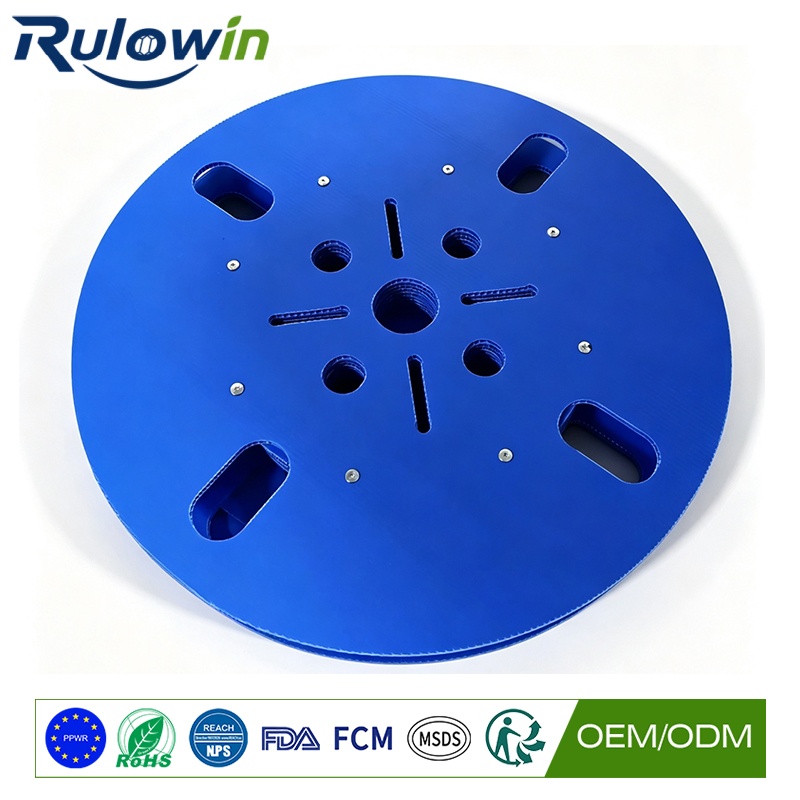
Ask a crew what causes overruns and bird nests on a fiber pull and you will hear about the cable. In most cases the cable is fine and the reel is being used wrong. The dominant mistake is pulling cable off a stationary reel instead of letting the reel turn, and everything else is detail compared with that.
Let the reel rotate
A reel lying flat on its side and dragged is a reel being asked to pay out through a twist. Every turn off the side of a stationary reel adds one twist to the cable, and by the time you are twenty metres out you have enough stored torsion to make the cable kink on its own.
Put the reel on a spindle, a shaft, a pair of rollers – anything that lets it turn. If you have nothing, a length of bar through the hub held by two people is already better than dragging. This single change removes most of the tangle reports we hear about.
Control the overrun
A plastic reel is light. Light reels keep spinning after the pull stops, and the cable that comes off during the coast is loose cable – it is the loose cable that tangles, not the tight cable. Either brake the reel lightly or have someone control it by hand. Nothing elaborate; enough resistance that the reel stops when the pull stops.
Which way the cable comes off
Cable should leave the reel from the top of the wrap when the reel is on a spindle, and the pull direction should be in line with the reel rather than at an angle. An angled pull walks the cable across the flange and into the gap between flange and hub, where it jams. On small-diameter drop cable this shows up constantly, because the cable is stiff enough to resist being pulled around a corner and soft enough to slip into the gap.
Before you start
Check the flange for a crack near the hub. A cracked flange will flex when the reel takes load, and a flexing flange pinches the cable at random intervals – the intermittent jam that makes people blame the cable. See why reel flanges crack near the hub for what causes it.
Check the hub bore too. A bore that has gone out of round wobbles on the spindle, which shows up as a periodic tight-spot in the payout. That one is easy to mistake for a cable defect.
Tension, and keeping it steady
Steady tension is worth more than low tension. A pull that surges stretches the cable on the surge and slackens it after, and the slack is what loops off the reel and catches. If you are pulling by hand, pull at a consistent rate and let the reel brake do the work of keeping the cable taut.
If you are pulling with a capstan or a winch, set it below the cable’s rated pulling tension and let it hold that rather than varying with the difficulty of the run. Most cable damage on a pull happens during a surge that nobody recorded.
What we can do
We supply plastic reels for fiber cable production and deployment, with the flange thickness and hub bore held to tolerances that keep a reel running true on a spindle. Tell us the cable diameter, the length per reel and whether it is being pulled or paid out, and we will specify the flange accordingly – and tell you if a lighter reel is going to give you overrun trouble.