
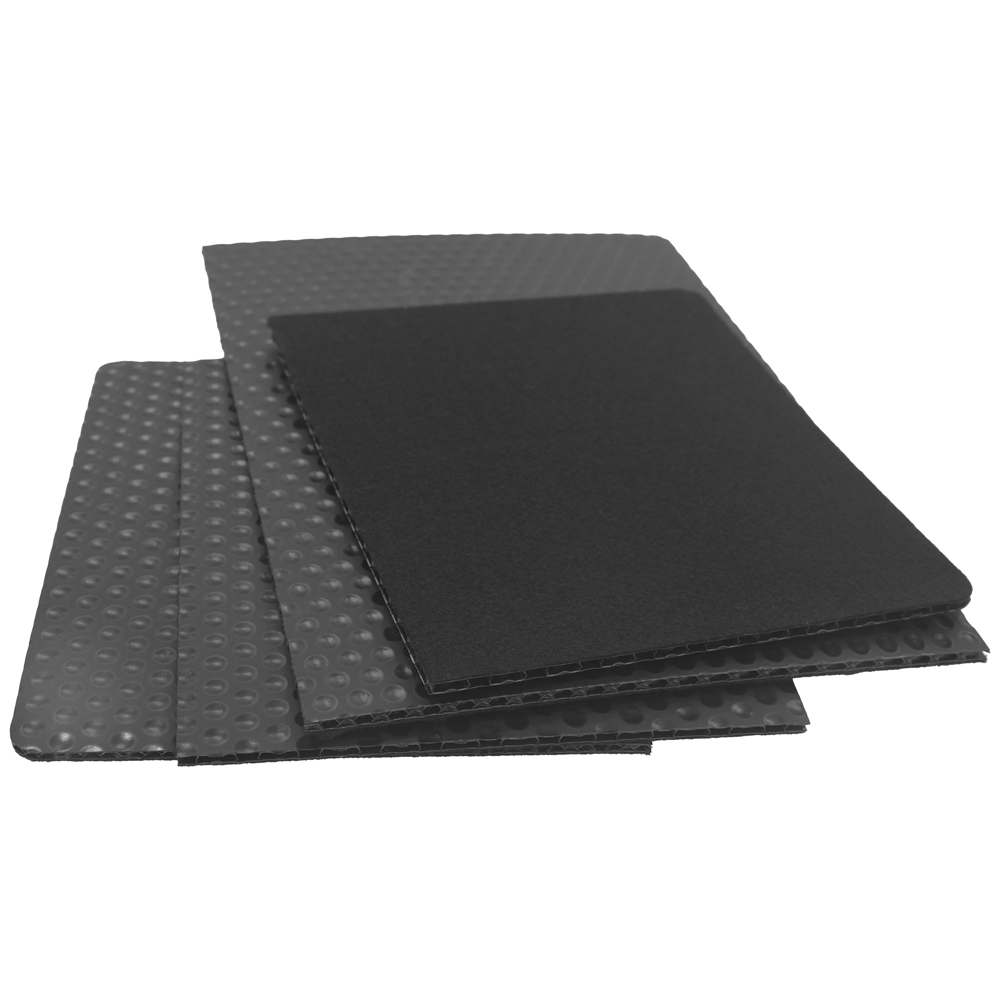
A honeycomb panel is a sandwich: two skins with a cellular core between them. How those three parts are made and joined determines almost everything about how the finished panel behaves, and it explains most of the specification questions buyers ask.
The core
The core is a cellular structure – typically hexagonal in shape, whatever the actual process. Two routes are common. It can be extruded as a continuous profile with the cell walls running in one direction, or formed from sheet that is folded, corrugated or thermally bonded into a cellular block.
The route determines the cell size range available, the orientation of the walls, and how consistent the geometry is. Extruded core tends to be very consistent along its length; formed core can vary more.
The skins
Skins are usually solid PP sheet or a thin laminate. Their thickness is the single most consequential specification for how the finished panel performs, because they carry the bending stress.
Skin thickness is also where cost concentrates, since the skins are most of the material. That is why a panel quoted at a thickness without a skin gauge is describing only part of itself.
The bond
This is the part that determines whether the panel performs as a sandwich or as three loose parts. Options:
Thermal bonding. The core and skins are fused by heat and pressure. No adhesive is involved, so the joint is the same polymer throughout, which gives good chemical and temperature performance. It requires the materials to be compatible, which in a single-polymer panel they are.
Adhesive bonding. An adhesive layer joins core to skin. It allows more freedom in material combinations and can be done at lower temperature, at the cost of introducing a layer that may be less resistant than the panel itself.
Continuous lamination. Core and skins fed together through a laminating line, which is how most large-volume panel is produced. Consistency depends on process control across the width and along the length.
The bond is rarely visible in a finished panel and it is the most common reason a panel that met its dimensional specification fails in service. A debonded panel can look perfect and have a fraction of the intended stiffness.
Cutting and finishing
Panels come off the line as a continuous sheet or in large formats, then get cut to size. Cutting exposes the cells at the edge, which is why edge treatment is a separate operation and why an untreated cut edge is the weak point.
Finishing may also include sealing, edge extrusion, routing, or the fitting of inserts for fasteners.
What this explains
- Why thickness has a tolerance that seems wide. It is set by the process, not by a machining operation.
- Why two panels of the same thickness differ. Skin gauge and cell geometry can differ independently of overall thickness.
- Why the bond matters more than the material. It is the joint that makes the panel a structure.
- Why cut edges are a problem. They interrupt a continuous sandwich.
- Why flatness varies between batches. Residual stress from the process relaxes at different rates.
What to ask a supplier
Thickness and its tolerance. Skin gauge. Cell size and cell geometry. Bonding method. Whether the panel is produced continuously or in batches. And whether a sample can be provided with those figures marked, so the specification can be verified rather than assumed.
Those six answers describe a panel far more completely than a thickness and a colour.
What we can do
We produce PP honeycomb panels and will state the skin gauge, cell geometry and bonding method alongside the thickness, because a thickness on its own does not describe a sandwich panel. Tell us what the panel has to do and we will tell you which of those variables actually matters for your case.