
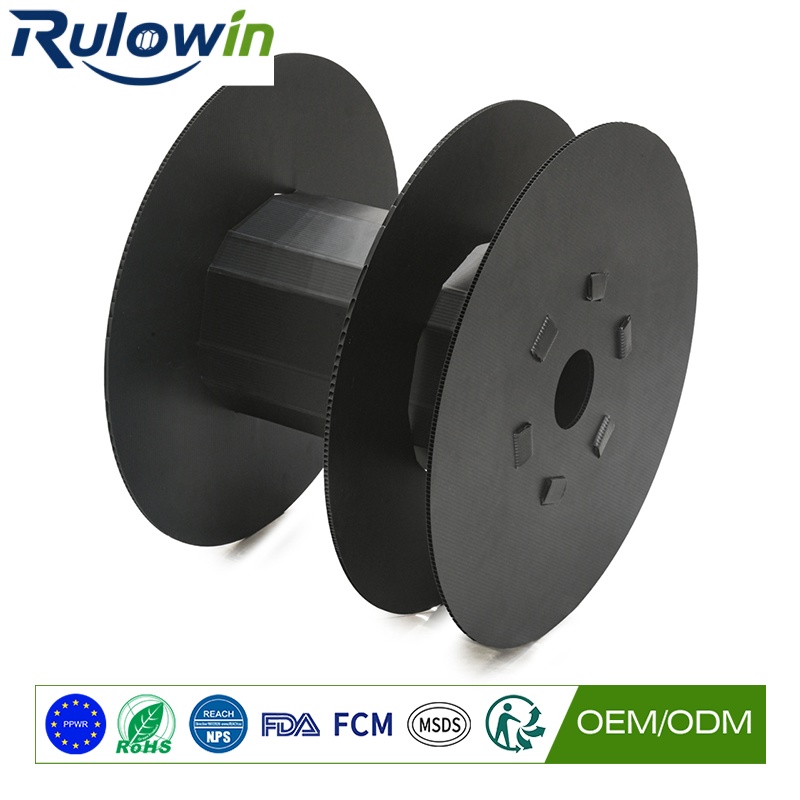
Somebody holds up a part-used spool and asks how much is left. It gets guessed from how it looks, the guess is often badly wrong, and the consequences range from an inaccurate stock figure to a customer being told something untrue.
Why looking at it misleads
The relationship between remaining length and remaining depth is not linear. Because each wrap further out is longer than the one beneath, the outer half of the pack by depth contains substantially more product than the inner half.
What this means practically: a spool that looks half consumed by depth is more than half consumed by length. How much more depends on the ratio of core diameter to flange diameter — a small core exaggerates the effect considerably.
People consistently overestimate what is left on a spool that is visibly part used.
Method one: weigh it
The most reliable method, and usually quicker than people expect.
- Know the empty spool weight. Mark it on the spool if your fleet varies.
- Weigh the part-used spool.
- Divide the difference by the product weight per unit length.
The accuracy is as good as your empty weight and your weight-per-metre figure. Both are worth establishing once rather than per occasion. If spools vary in weight, weighing individual empties as they enter service is worth the ten seconds.
Where this falls down: product with significant weight variation along its length, and spools with accumulated contamination or moisture.
Method two: measure the depth
Measure from the rim of the wound pack to the flange edge, or the diameter of the pack itself, and compare against a filled spool.
To convert depth to length you need to account for the layering, which is where this gets approximate. A rough working rule: length remaining is proportional to the difference of the squares of the pack radius and the core radius. If you do not want to do that arithmetic, a simple calibration works better — measure a full spool, measure one you have just run out, and interpolate.
Accuracy is moderate; it is affected by how tightly the pack is wound, which affects how many layers occupy a given depth.
Method three: count turns
Sometimes the most practical. If you know the length per turn at the current diameter, and you can count turns during winding, running the remainder off while counting gives a direct answer.
Impractical for large remainders, entirely practical for small ones, and it is how most people check a nearly-empty spool without realising it.
Method four: measure it coming off
The accurate one, and the only option when accuracy genuinely matters: run the remainder through a measuring device. Inconvenient, definitive, and worth doing when the number has a contractual consequence.
What it is used for, and whether accuracy matters
- Stock valuation. Needs reasonable accuracy, and weighing is usually sufficient.
- Telling a customer. Needs to be right. Use a measurement you can defend, and say what method you used.
- Production planning. Approximate is fine; consistency matters more than precision.
- Deciding whether a remainder is sellable. Usually a commercial question about minimum lengths rather than a measurement one.
Part-used spools generally
Worth thinking about at fleet level, because part-used spools are awkward assets:
- They occupy the same space as full ones
- They tend to accumulate rather than get used, which is the topic of our storage article
- Product on them ages while wound, which for anything prone to set is a real consideration
- Their value is hard to state, which makes them the first thing written off and the last thing anybody plans for
Making this easier
Two cheap habits: mark the empty weight on every spool when it enters service, and record the fill length when it is wound. The second is the one that pays — a spool that says what it was filled with makes every subsequent estimate trivial.
Neither requires anything from us, but if you are specifying our hollow board spools we can supply weight figures per size, which gets you the first habit for free.