
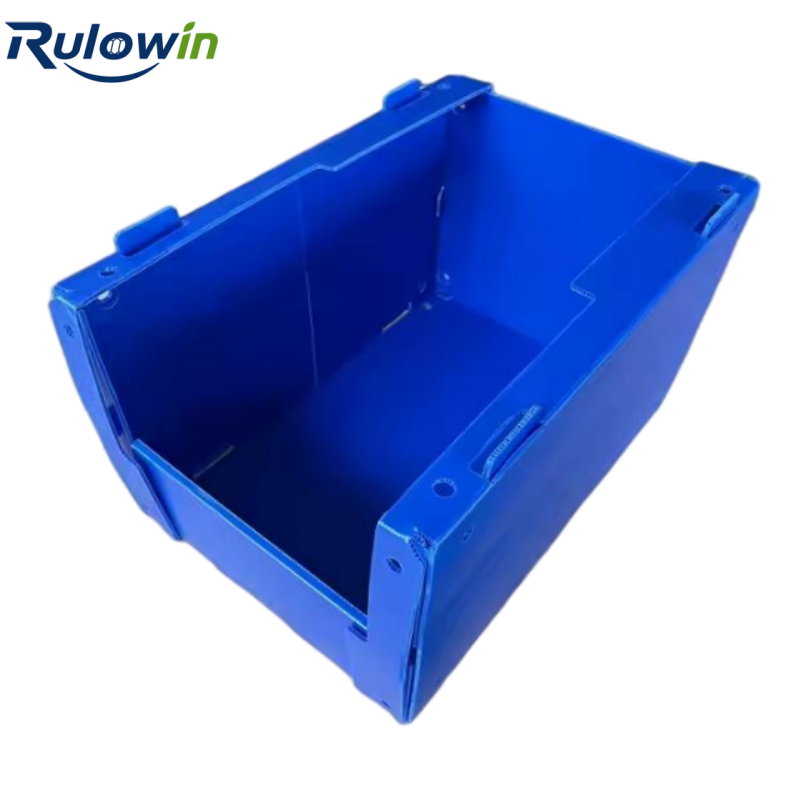
A barcode that reads perfectly when applied and fails after thirty wash cycles is the most common identification complaint in returnable packaging, and the diagnosis almost always lands on the label stock. About half the time the label is innocent.
The three real causes
Abrasion removes the printed surface progressively, so contrast drops until the scanner’s threshold can no longer separate bars from spaces. Placement puts the code where stacking or handling rubs it. And – most often overlooked – the substrate underneath moves: corrugated board expands and contracts with temperature and moisture, and a rigid label bonded to it accumulates stress until it lifts at the edges.
Edge lift is the killer. Once the edge lifts, wash water gets under the label and removal accelerates dramatically.
Placement beats specification
Moving a code fifty millimetres away from a stacking contact point frequently delivers a bigger improvement than upgrading the label. Look for an area that is vertical and protected in service, away from handles, away from stacking ribs, and ideally slightly recessed. If the pack has a natural shadow – under a lip, inside a rib – that is where to put it.
Codes on the base of a crate are exposed to every conveyor and floor contact. Codes on a protected upper side wall are not.
Label construction matters in a specific way
For PP substrate you need a face stock that flexes rather than a rigid film, and an adhesive that tolerates both the wash chemistry and the thermal cycling. The usual failure is a perfectly good label that is too stiff for a substrate that moves. Thinner and more conformable generally lasts longer than thicker and tougher.
Raising contrast headroom
A code printed at maximum contrast gives nothing in reserve. Printing bars slightly heavier than specification – within the tolerance the symbology allows – buys contrast headroom that keeps the code readable after the surface has scuffed. This matters far more than the label itself.
Scanner settings hide the gradual decline
Most fixed scanners have a decode threshold that quietly accommodates degrading codes until it suddenly cannot. Operators experience this as an abrupt failure, but the decline was visible for months – if somebody was measuring. A quarterly read-rate check on a sample of packs gives warning and lets you relabel before it becomes an operational problem. This is the same reasoning we set out earlier for barcode labels on picking boxes.
Consider marking instead of labelling
Where the volume justifies it, a printed or laser-etched code has no edge to lift and nothing to abrade off, because it is part of the material or sits below the surface. The trade-off is flexibility: changing a code means reprinting the pack. For fixed asset numbers that is no hardship at all.
What to do when nothing sticks
If labels keep failing regardless of specification, the substrate is moving more than the adhesive can tolerate. The options then are a recessed label pocket that shields the label edge, a carrier plate bonded to a flat area, or marking the code directly into the material.
All three cost more than a label and all three outlast it. Where the pack is expensive and the loop is long, the arithmetic favours one of them quickly, and the decision should be made on total cost rather than on unit cost of the identification.
What we can do
We place and apply identification to corrugated picking boxes and would rather argue about placement than sell you better labels. Send a photo of the pack in its working stack and we will point at the one spot that will still be readable after a year.