
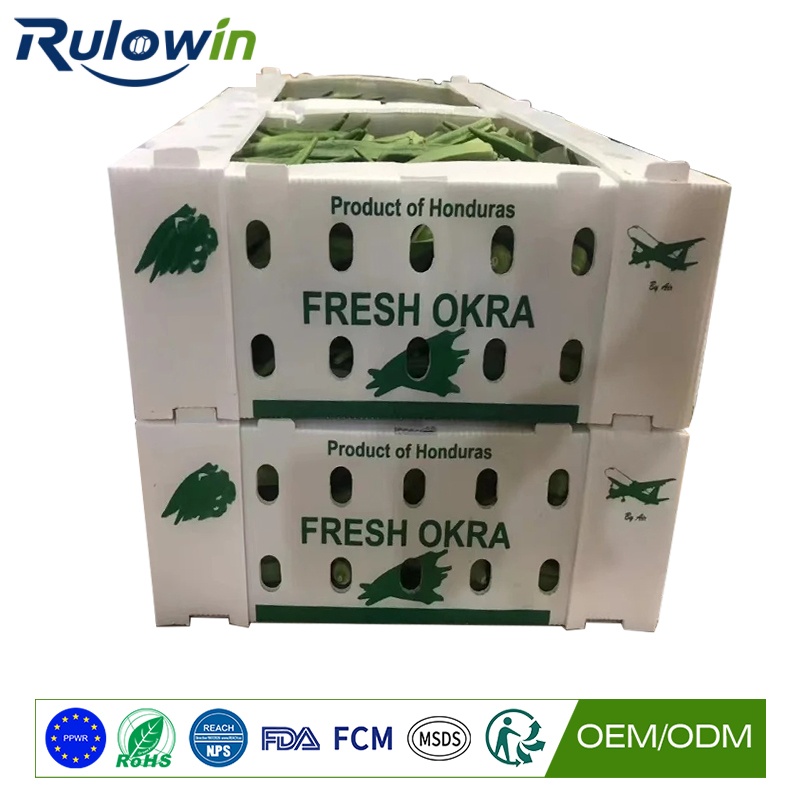
Colour coding is the fastest sorting aid available on a busy dock, faster than any code a scanner reads, because it works at ten metres from any angle. The problem arrives when sites change, colours get added, and somebody proposes repainting several thousand crates.
Why repainting fails
Paint and coatings on polypropylene need the same surface preparation argument as printing, and on a used crate the surface is abraded, contaminated and inconsistent. Field-applied coatings chip at contact points within weeks, giving a patchy crate that is harder to identify than a plain one. Repainting crates is a project that always looks good in the plan.
Colour the replaceable part instead
Almost every reusable design has components that wear out and get replaced anyway – corner pieces, strips, clips, labels, runners. Colour those. A colour-coded corner strip costs little, is replaced on the normal maintenance cycle, and can be changed overnight when the site list changes.
This is a specific case of a general principle: put the thing that changes on the part that is already replaceable.
In-mould or extruded colour lasts
Where colour must be permanent, it has to be in the material rather than on it. Pigment through the polymer survives abrasion indefinitely because there is no surface layer to remove – a scuffed red crate is still red. That is why the base resin colour is the right way to carry site identity for new purchases, even though it locks you to that colour for the life of the pack.
Limit how many distinctions you need
Four colours work. Eight do not, particularly at dawn, in rain, or for colour-blind staff, which is around one in twelve men. Where more than four distinctions genuinely matter, combine two cues – a colour plus a shape, or a colour plus a position stripe. Two four-level cues give sixteen combinations that read instantly.
Sort by the cue people actually see
The cue that matters is whatever faces outward in the stack. Marking the upper side wall is invisible in a stacked pallet; marking the stack indent or the top rim of every side is visible from anywhere. Design the code around the working orientation, not the drawing orientation.
Plan for the mixed pile
Whatever system you use, assume mixed piles will occur. The cost of the system is mostly the cost of resolving those, so make the misfits obvious at a glance and give the team a defined place to put “unknown origin” packs. Colour coding helps enormously here, which is what it is for – the same logic we described for identification that survives the loop.
Keep a written key
A colour system without a written key drifts, because new staff guess and old staff improvise. One laminated sheet at each door, with the colour, the meaning and the date it took effect, is enough – and it needs updating whenever the list changes, which is the part that gets skipped.
Also state what happens to stock in the old colour. Leaving it in circulation without a decision produces mixed piles, and mixed piles are exactly the failure the system was installed to prevent.
What we can do
We can supply produce crates in specific resin colours, or with replaceable coloured components for systems that will change. Tell us how many distinctions you need and how long the list is likely to stay stable, and we will recommend pigmented base or replaceable parts accordingly.