
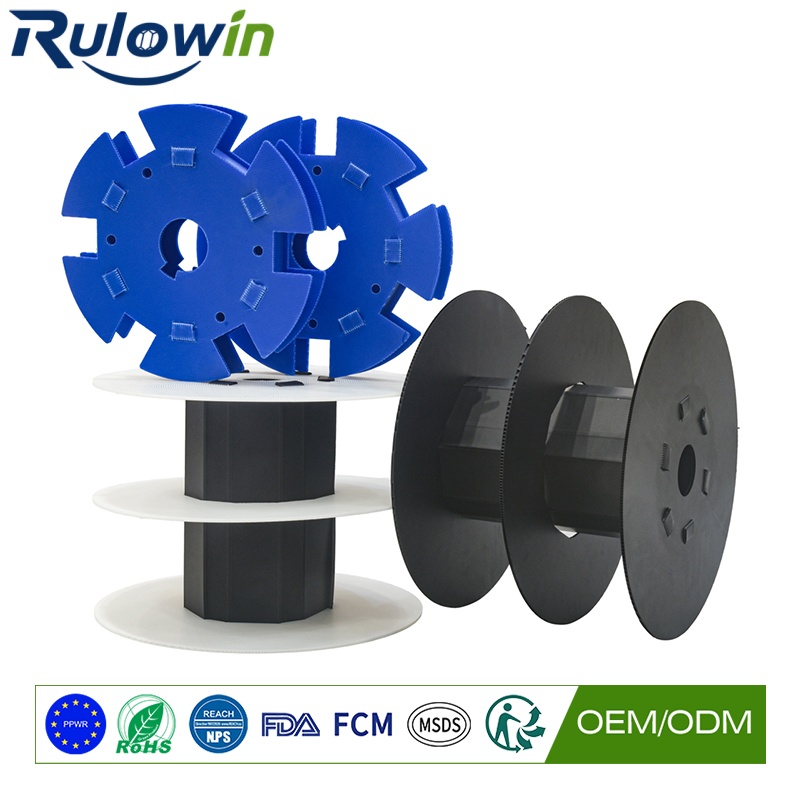
Cable reels get marked for two different reasons: identification that has to survive the asset’s life, and information that needs to be crisp and changeable. Those two requirements point at completely different marking methods, and buying one to do both jobs is how budgets get spent unsatisfactorily.
Ink marking is cheap and does most jobs
Pad printing, inkjet and screen printing all put legible marks on a reel flange at low unit cost. Branding, cable type, length and batch all fall naturally into this category, because most of that information is either generic or specific to one trip.
The limitation is well understood: ink abrades,particularly on the flange face which is exactly where reels get dragged and stacked. On a reel that makes hundreds of trips, printed information is a consumable, not a permanent record.
Laser marking removes nothing and adds nothing
A laser marks by changing the surface – carbonising or foaming the polymer locally. There is no added material, so nothing can peel or flake, and the mark is below the surface enough that abrasion is largely irrelevant. It is genuinely permanent on plastic. It is also a capital cost per part and it generally appears in a single colour determined by the polymer and the laser parameters.
Contrast is the constraint. On unpigmented or light polymer the mark is strong; on dark or heavily pigmented material it can be weak unless the additive package is chosen for it, which means specifying the grade with marking in mind.
Moulded-in marking beats both for permanence
Where the mark is known at tool making time – ownership, asset series, manufacturer – raising it in the mould costs nothing per unit and cannot be removed by anything short of destroying the reel. Its only disadvantage is that it cannot change. For asset numbering this is usually the right answer, and it is what we recommend most often.
Which reel needs which
A reel that stays in a controlled two-site loop, scanned at each end, needs almost nothing permanent beyond an asset number – often applied with a durable label or a moulded number, as set out in marking reel flanges without a printer. A reel that goes into general circulation, third-party logistics or rental genuinely benefits from permanent marking, because nobody owns its record reliably.
Data matrix versus barcode
Where surface area is tight and damage is likely, a data matrix code carries far more information in less space and tolerates partial damage better, because of its error correction. Scanners cost more and it needs a camera-based reader rather than a laser. For asset tracking on expensive reels the trade-off usually favours matrix.
Where we would not spend the money
Permanent marking on low-value reels in a short loop is spending money on a record nobody reads. Put it on the twenty per cent of the fleet that leaves your control, and leave the rest printed.
Legibility after damage
A permanent mark is only useful if it can still be read once the reel has been dragged across a yard. Contrast matters more than depth here, and a mark on a protected face – the inner flange face, or a recessed area – will read long after one on an exposed rim has been polished away.
Where the reel is scanned rather than read by eye, test the scanner against a deliberately damaged mark before committing. Reading a scuffed code under yard lighting in the rain is a different proposition from reading a sample on a desk.
What we can do
We supply plastic cable drums with printed, laser-marked or moulded-in identification and will ask where the reel goes before recommending one. Describe the loop and how often the reel leaves your sites, and we will tell you if any permanent marking is justified at all.