
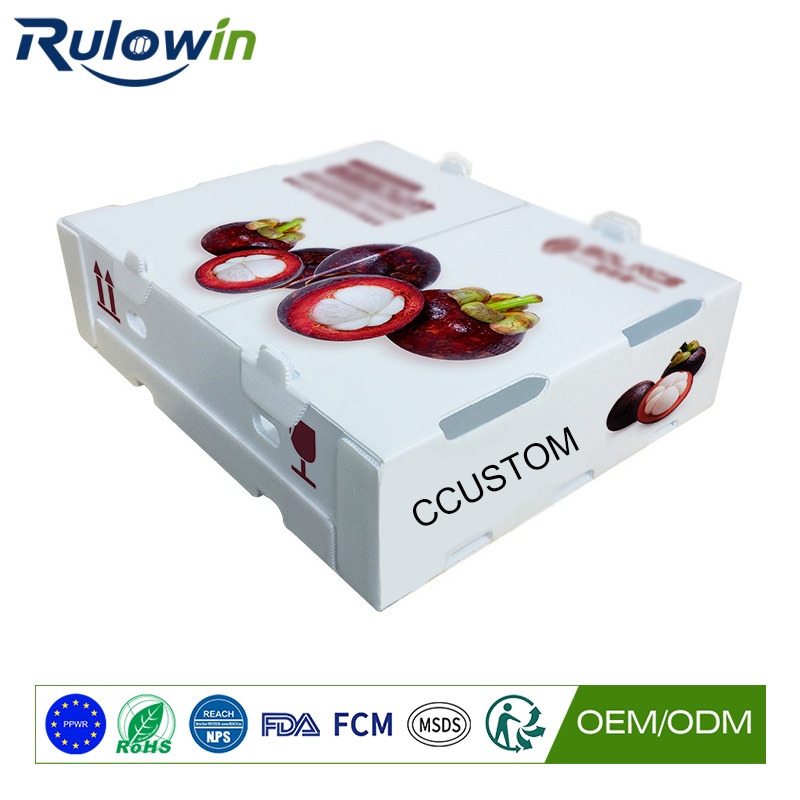
Most of the attention on a vented crate goes to the wall holes, because they are the visible part. For washed produce the base pattern usually matters more, because that is where the water from the load ends up and whether it can get out decides the condition of the bottom layer.
What happens to the water
Washed produce keeps releasing surface water for a while after it leaves the wash. In a crate with an effectively closed base, that water pools at the bottom around the lowest layer of fruit. In a crate with drain paths it leaves. The difference shows up as a bottom layer that is marked, soft or starting to split – and it is the layer nobody inspects until the crate is emptied at the far end.
Pooling versus soaking
The aim is not to remove every drop. Standing water that drains in a minute is fine; water held against produce for hours is not. A drain path that is too small clogs with product debris and stops draining altogether, which is worse than a solid base because it gives the impression of drainage. Look at the path size relative to the debris the crop produces, not relative to water.
The pallet underneath
Whatever drains out of the crate goes onto the crate below or onto the pallet. On a stack of ten crates that is a meaningful amount of water reaching the bottom of the stack and then the floor or the truck bed. Some operations put a drip tray or a sacrificial layer at the base of the stack for exactly this reason, and it is worth deciding deliberately rather than discovering a wet floor at the delivery point.
Cold rooms change the picture
In a cold room the water that drains off does not evaporate, it sits. A cold room floor under a stack of draining crates is a slip hazard and a hygiene issue, and it is one of the reasons some packers prefer to let crates drain in a staging area before they go into cold storage. The condensation behaviour in that environment is described in condensation inside a palletised fruit box.
Cleaning the base
A drain path that works for water also traps product debris, and it has to be reachable with a brush or a jet. Crates with internal ribs that create dead corners are harder to clean properly than crates with simple open channels, and the difference shows up in a swab test rather than in a visual check. If the wash regime is a tunnel with fixed nozzles, ask whether the nozzle pattern reaches the base channels.
Liners and pads
Some crops get a pad or a liner in the base to cushion or to absorb. That changes the drainage completely – an absorbent pad holds the water against the produce instead of letting it drain, which is right for some crops and wrong for others. Where a pad is used, a corrugated PP sheet cut as a rigid layer pad keeps its shape when wet and can be washed and reused, unlike a paper alternative.
What we can do
We supply produce crates with base patterns matched to the crop, including open-channel designs that a wash jet can reach. Tell us whether the produce is packed wet, how long it sits before cooling and what the crop debris looks like, and we will recommend a base rather than a catalogue number.