
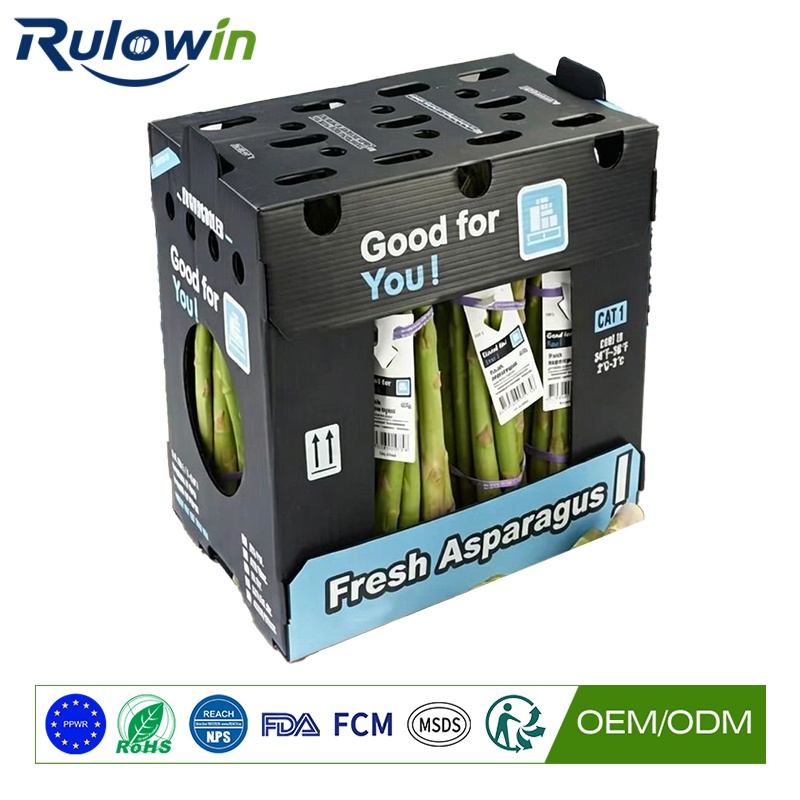
A covered loading bay is a luxury on a lot of produce sites. Pallets get staged outside, rain comes in sideways, and the stack sits wet until the truck arrives. With cartons that is a rejected load. With crates it is usually fine – but not automatically, and the three things that go wrong are worth knowing.
The stack itself is not the problem
Water running down a stack of crates does not weaken them. It drains through the wall vents and the base paths and it leaves. A stack that has been rained on for an hour stacks the same as a dry one, and it can be loaded straight onto a truck without the re-work that a wet carton pallet needs. That is most of the value right there.
What the water carries in
The problem is not the water, it is what comes with it. Rain running down the outside of a stack carries whatever was on the crates – soil, product residue, whatever was on the yard surface – into the produce below through the vents. A stack staged on a dirty hardstanding splashes that onto the bottom crate. Keeping the staging area clean and slightly raised matters more than covering the stack.
Grip and handling
Wet crates are slippery. A picker lifting a wet crate by a hand hole with wet gloves on a wet yard is a genuine manual handling risk, and it is the incident that shows up in the log rather than the one that shows up in the quality report. Hand hole design matters here, and so does telling the site to slow down rather than to hurry when it is raining.
Standing water under the stack
If the bay is flat and poorly drained, the bottom crate stands in a puddle for hours. That is fine for the crate and bad for hygiene – it is a splash source and it is where whatever was on the ground ends up. Bearers or a pallet under the stack cost very little and keep the bottom crate out of it.
What to do before the truck closes
Most of the water on a rained-on stack is on the outside. A few minutes of drain time in a covered area before loading removes most of what would otherwise end up as a wet floor in the trailer and as condensation later. Where the load is going into a chilled trailer, that drain time matters more, because the water has nowhere to evaporate once the doors close – the mechanism described in condensation inside a palletised fruit box.
When to cover anyway
Crops that are graded on appearance and sold on it, anything packed in a liner, and any load where the buyer inspects the outside of the packaging. The crate does not care about rain; the presentation sometimes does. Keeping a few covers for the top of a stack is a cheap insurance against a rejection that has nothing to do with the fruit.
What to keep at the bay
Three things make an uncovered bay workable: bearers or pallets to keep the bottom crate out of standing water, covers for the top of a stack, and a squeegee that somebody is expected to use. None of them cost much and together they remove most of what rain does to a staged load.
The fourth is a decision about how long a stack may sit before it is covered. Left as a judgement call it becomes “until somebody remembers”, and it is better stated as a rule – any stack left overnight gets covered – because a rule is followed and a judgement is not.
What we can do
We supply stackable produce crates that tolerate outdoor staging, and we will advise on base channel size and hand hole shape for sites that load in the open. Tell us whether the bay is covered and how the stacks are staged.