
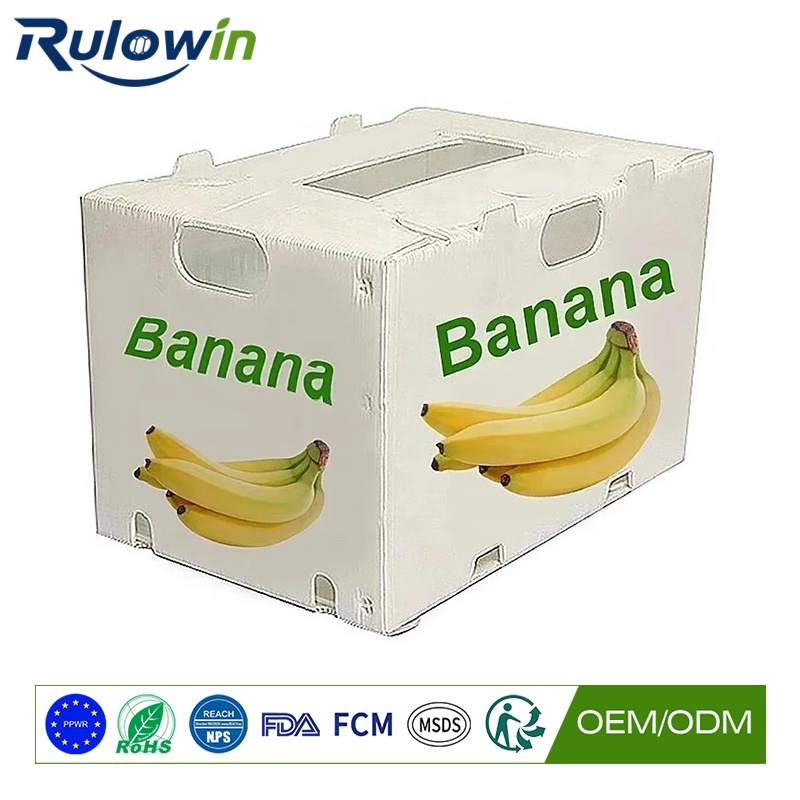
Anyone who has watched a pallet of cartons lean over a weekend knows what losing wet strength looks like. The equivalent failure does not happen to a polypropylene crate, and it is worth understanding why, because the reason determines what the crate is and is not good for.
The mechanism in paper
Paper is held together by hydrogen bonds between cellulose fibres and by sizing agents added at the mill. Water occupies those bonds and plasticises the fibres. The structure does not dissolve, it simply stops resisting – the fluting buckles, the board bends, and no amount of drying restores the original geometry. That is why wet-strength additives exist and why they only ever buy time.
The situation in polypropylene
PP is a semi-crystalline thermoplastic. Water does not plasticise it, does not hydrolyse it at ambient temperature, and does not penetrate the crystalline regions. There is no mechanism by which standing water reduces the stiffness of the wall. A crate left out in the rain for a month has the same stacking strength it had when it was moulded, minus whatever the sun has done to it – and those are two separate questions.
What does change over time
Three things, none of them water. Ultraviolet exposure, which attacks the polymer chains at the surface and shows up first as chalking and then as brittleness. Repeated impact at low temperature. And stress cracking from certain cleaning chemicals at high concentration. If a crate fleet is losing strength, it is almost always one of those three, and the symptom is a crack rather than a soft wall.
How to tell the difference on site
A crate that has gone soft has been damaged by heat or by a chemical, not by water – if you can press a wall in and it deforms and stays deformed, something has attacked the polymer. A crate that has gone brittle and cracks along a corner has been UV-damaged or cold-impacted. A crate that is simply wet is fine. Knowing which you are looking at tells you what to fix, and it is worth a minute with a few crates before concluding the fleet is worn out.
The practical consequence for stacking
Wet crates stack to full height in the field, in the wash bay and in the cold room without the derating that cartons need. That means the same pallet footprint carries the same load whether it rained last night or not, which is why stacking strength of field-packed fruit boxes behaves differently from the carton equivalent. The failure mode to watch in a crate stack is not softness, it is misalignment – a crate not seated square on the one below puts load on a corner instead of a wall.
The honest limit
Water does not weaken the crate, but it does carry grit into the drain paths and it does support microbial growth if crates are stacked wet and stored enclosed for weeks. Wet strength and hygiene are separate problems, and the second one is real: stacked wet crates in a closed store is how biofilm gets established. Drying and storing them properly is covered in drying and storing produce boxes between uses.
What we can do
We supply PP produce crates that hold full stacking strength wet, and we will say plainly what does shorten their life – UV, cold impact and wash chemistry – rather than claiming they last forever. Tell us how and where they are stored and we will give a realistic service life.