
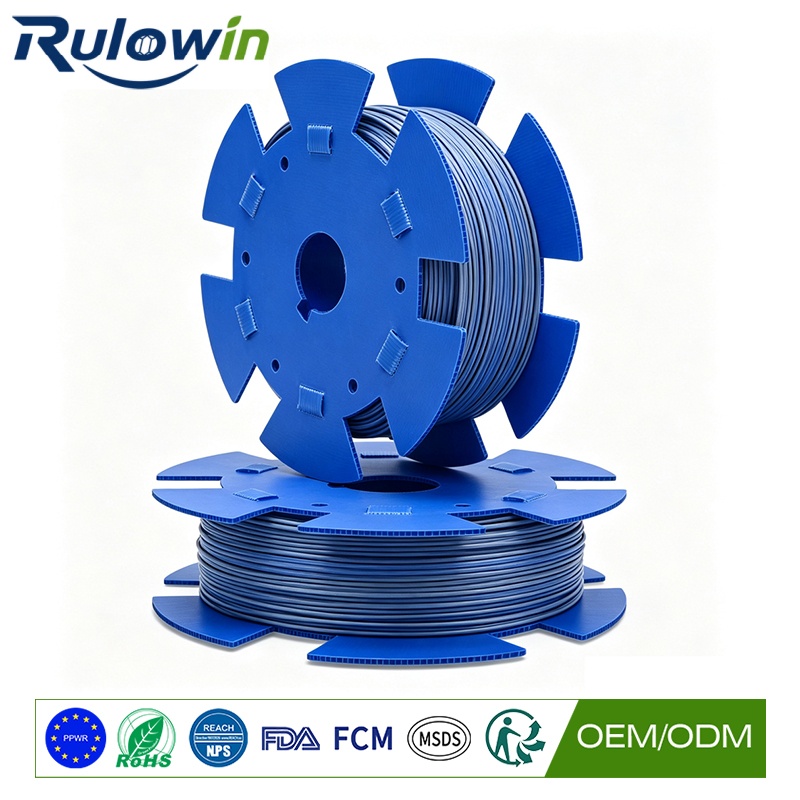
Concentricity problems show up as runout, and runout shows up as tension variation, product damage and machine complaints that get blamed on everything except the spool. Most workshops do not have a coordinate measuring machine, and do not need one — the failures that matter are large enough to find with simple tools.
What concentricity means here
Three things can be out of true, and they are different problems:
- The bore is not concentric to the core. Mount the spool and the product-carrying surface wobbles.
- The flange is not concentric to the core. The rim runs out even though the bore is fine.
- The core itself is not round. Everything keyed to it wobbles.
Telling them apart matters, because the fixes are completely different. The first two are manufacturing issues; the third is often damage.
Check 1: spin it
Mount the spool on a shaft — ideally the shaft it will actually run on, since a bent shaft tells you nothing about the spool. Turn it slowly and watch the rim against a fixed reference. A ruler held steady, a pointer, anything stationary.
You are looking for the gap between reference and rim changing as it turns. Anything visible to the eye is significant. This takes ten seconds and finds the majority of real problems.
The limitation worth knowing: this cannot distinguish which of the three faults you have, and it will miss anything smaller than roughly half a millimetre. But what it finds, matters.
Check 2: dial indicator
A magnetic-base dial indicator is a modest purchase and takes the previous check from qualitative to quantitative. Same procedure — indicate on the rim, on the core, and on the flange face, each separately.
- Reading changes on the rim but not the core: flange-to-core concentricity
- Reading changes on the core: either the core is out of round or the bore is off-centre
- Reading changes on the face as it turns: the flange is not running square — wobble rather than eccentricity
That third one is common and often missed, because nobody thinks to indicate on the face.
Check 3: measure the bore, then the shaft
An internal caliper or bore gauge at several points around the bore and at both ends. Then measure the shaft the same way. What you are looking for:
- Bore ovality — different readings around the circle. Usually wear, and covered at length in our article on bore wear.
- Bore taper — different readings at each end.
- Clearance — the difference between the two measurements. Too much clearance is a fit problem regardless of how concentric anything is.
Do this on several spools. One tells you nothing about variation; ten tells you whether you have a systematic issue.
Check 4: the roll test
Lay the spool on its rim on a smooth flat floor and give it a gentle push. It should roll smoothly in a straight line. A spool that wobbles as it rolls, or that will not roll straight, has something wrong — usually at the rim, sometimes a bent flange.
Crude, and genuinely useful as a triage check when a batch arrives and you want to sort quickly.
What to do with the results
Set a limit, write it down, and reject consistently. The limit does not need to be sophisticated — “no visible rim movement when spun” is a workable standard for most industrial spooling, and where it is insufficient you have identified the applications that need something better.
Record failures by supplier and by batch. A single bad spool is an event; three from one delivery is a pattern, and a pattern is a conversation worth having early rather than after the whole consignment is in service.
Where simple checks are not enough
High-speed payoff, or precision product, or anything automated. If so, say so in your specification and expect to pay for measurement as part of production. Our article on sampling and qualification covers what to ask suppliers for in those cases.
What we check ourselves
On our hollow board spools we check fit-critical dimensions before despatch. What we do not do is guarantee a precision grade we cannot deliver — fabricated hollow board has honest limits, and we would rather tell you what the process actually holds than put a number on a drawing that turns out to be optimistic.