
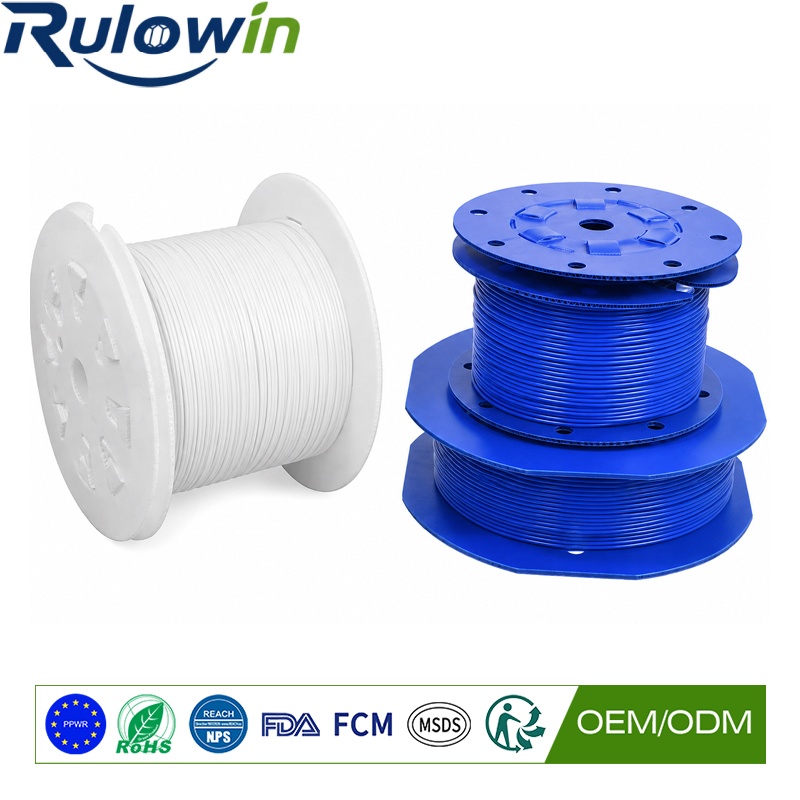
FTTH drop cable is a specific pain. It is stiff enough that it resists being pulled around a corner, and soft enough that it slips into the gap between flange and hub. Most of the problems crews report on a drop-cable job – kinks, jams, overruns – come from reels designed for heavier cable being used on lighter cable.
Small, light, and that is the problem
Drop cable comes on small reels, and small plastic reels are light. Light reels keep spinning after the pull stops, and the cable paid off during that coast is loose. Loose cable is what tangles.
So the single most useful feature on a drop-cable reel is some way of controlling the overrun – a brake, or a hub that has been given a little friction, or just a crew member who knows to hold it. This is not sophisticated and it is where most of the trouble is.
The flange gap
The second specific issue. Drop cable will find the gap between flange and hub if it is pulled at an angle, and once it is in there it jams. Reels intended for drop cable have a tighter clearance there, or a hub that closes the gap.
Pull in line with the reel rather than at an angle and the problem mostly disappears, but the design should not depend on the crew getting it right every time.
What to specify
Hub diameter from the cable’s minimum bend radius – drop cable is usually tight-tolerance, so respect it. A bore that actually matches the payout spindle, because a loose bore on a light reel produces a wobble that shows up as tension variation. Flange diameter as small as the length allows, because a smaller flange means less stored inertia and less overrun.
And a flange thick enough for the winding tension, which is the counter-argument to going too small. We covered the sizing in what flange diameter you need, and the failure mode in why flanges crack near the hub.
What to avoid
Using a large reel left over from a backbone job. It will carry the length, it will be heavier than it needs to be, and the overrun will be worse because the inertia is worse. And reusing a reel that has been wound with a larger-diameter cable – the flange has already been worked at a higher radial pressure.
Testing a reel before committing
Take a sample reel and run a full length off it at the speed you actually work, with a second person watching the reel rather than the cable. Watch for three things: cable riding up towards the flange, any tendency to pay out after the pull stops, and any wobble in the reel itself.
All three are visible in one run and all three are much cheaper to find with a sample than with a container. If a supplier will not send a sample, that is information as well.
It is also worth winding one and leaving it loaded for a week before paying it off. Cable that has sat under pressure behaves slightly differently, and that is closer to how a reel will actually be used.
What we can do
We supply lightweight plastic reels for fiber drop cable with hub geometry and bore tolerances set for small-diameter cable. Tell us the cable diameter, the length per reel and how it is being paid out, and we will specify – including if a reel you already own is fine.