
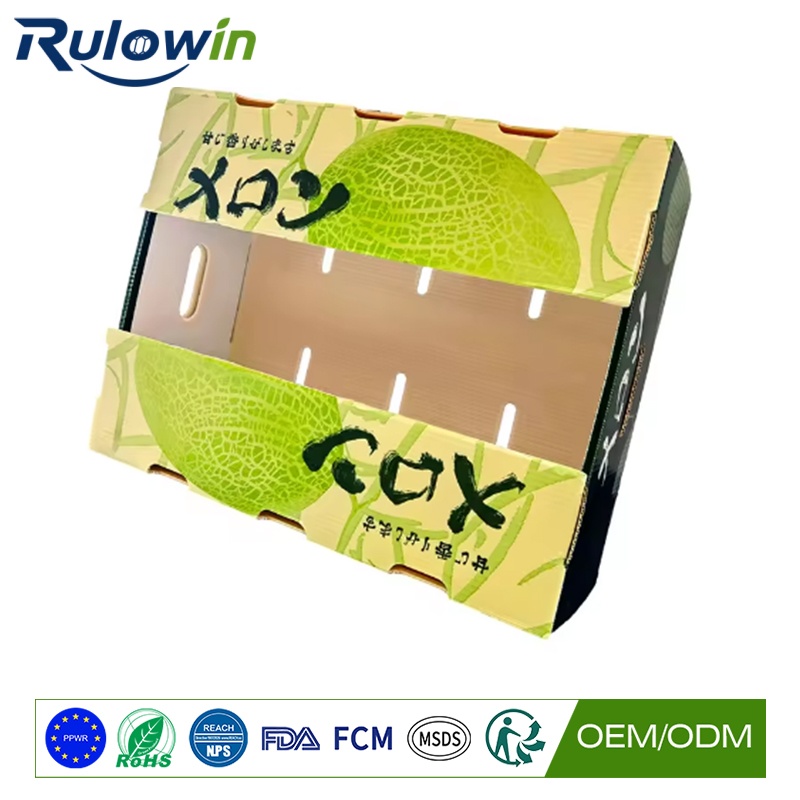
Ventilated crates exist for one reason: produce is often picked warm and has to be cooled before it goes into a cold chain. Field heat leaves through the crate walls. So the crate with the most open area cools fastest – and also bruises soft fruit most readily. Every ventilated crate design is somewhere on that line.
Soft fruit
Berries, cherries, ripe stone fruit. These need many small openings rather than a few large ones, and a floor with ribs or a raised pattern so the fruit rests on structure rather than over a hole. The failure to avoid is fruit sagging into an opening and being pressed by the crate above.
Stack height matters more here too. Soft fruit under sustained load continues to deform, so the useful control is time under load rather than a maximum height. We covered the stacking side in how to stack fruit crates so the bottom layer doesn’t bruise.
Hard produce
Apples, citrus, root vegetables, cucumbers. These tolerate large openings and benefit from fast cooling. Vent area can be high – thirty per cent of the wall surface or more – and the floor can be an open grid.
For these crops the crate’s job is mostly airflow and stackability, and the bruising constraint largely disappears. This is where a highly ventilated crate is unambiguously right.
Leafy and wet produce
Different again. Leafy produce needs airflow but is easily damaged by sharp edges, and wet produce means the crate has to drain. Drainage holes in the floor as well as vents in the walls, and a smooth internal finish with no flash or sharp corners.
These crates also get washed more often, which is worth mentioning at specification time – a crate that goes through a wash tunnel needs to be built for it. We covered that in can PP crates go through an industrial wash tunnel.
What to tell a supplier
The crop, the fill weight, whether it is cooled after picking, and how long a loaded stack stands. Four things. That is enough to specify vent geometry, floor pattern and wall thickness, and it is a lot more useful than asking for “a ventilated crate”.
Also worth telling them the truck or container internal height, because a crate that is fifty millimetres too tall costs you a layer on every load for the life of the crate. That point comes up in what size crate you need for 20 kg of tomatoes.
Stacking and nesting, which pull in opposite directions
A crate that stacks securely when full usually does not nest tightly when empty, and the other way round. Nesting saves return volume; stacking saves damage. Most designs compromise, and which way to lean depends on your return leg.
If empties come back on the same vehicle that delivered, nesting is worth a lot – it is the difference between one truck and two. If empties are stored on site between runs, stacking stability matters more and a poorer-nesting crate is the right choice.
Worth measuring both on a sample before ordering: how many empties fit on your return vehicle, and how a loaded stack behaves after an hour standing.
What we can do
We make PP crates for fruit and vegetables with vent and floor patterns set by crop. Tell us what you are packing and how it is cooled, and we will specify – and if one of our standard crates already suits, we will say so rather than sell you a new tool.