
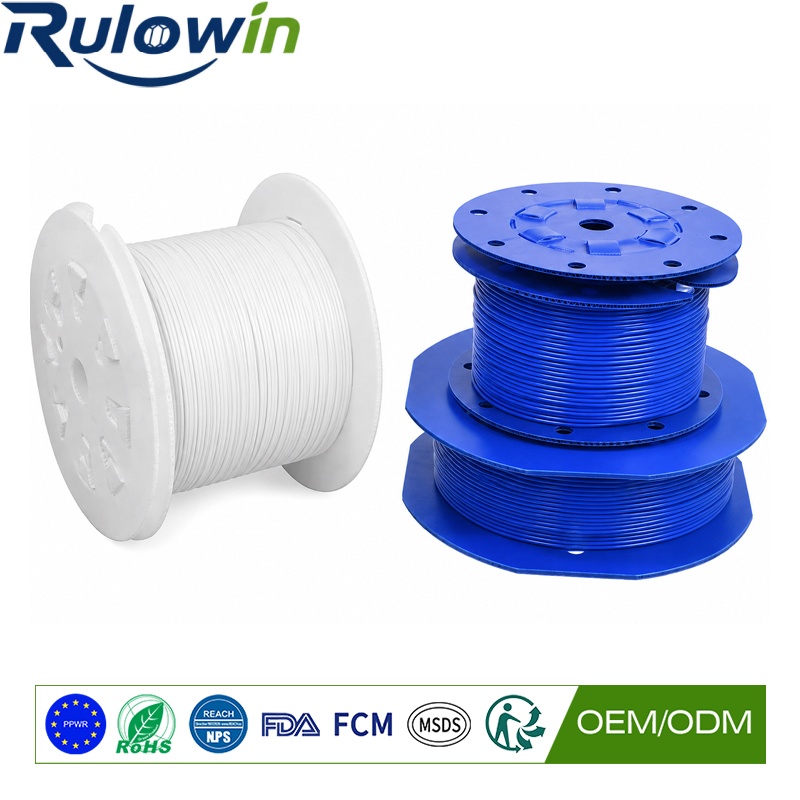
Automotive harness work is unusual in this series: the spools are small, the product is fairly forgiving, and neither of those is what drives the economics. What drives it is how many times a day somebody handles a spool.
The economics are labour, not material
A small spool is cheap. A small spool handled fifty times a day is not, because the handling cost exceeds the material cost within weeks. This is the argument made generally in our article on changeover time, and harness lines are the clearest case of it.
Everything below should be read with that in mind.
What the line needs
- Quick mounting. Whatever mechanism holds the spool needs to be closable in one motion.
- Quick threading. Getting the wire started fast matters more than anything else about the wind.
- Consistent dimensions so nothing needs adjusting between one spool and the next.
- Clean payout. Nothing that snags, because a snag stops a line that runs fast.
That third point is where choice of construction matters. Fabricated hollow board has more dimensional variation than moulded — discussed honestly in our comparison article — and on a line doing hundreds of changes a week, that variation costs more in adjustment time than the unit price saves.
The tension requires care
Harness wire is usually insulated with PVC or cross-linked material. Wind too tight and you compress insulation at the core; too loose and the pack collapses. For thin-wall insulation the window is narrow, and thin-wall is increasingly standard because it saves weight in the vehicle.
If you have moved to thinner insulation and started having payoff problems, that is why.
Twist is the enemy
Harness wire accumulates twist readily, and twist creates problems at the assembly bench that are expensive to fix downstream. The causes and prevention are covered in general terms in our rewinding article, and harness work is among the more sensitive applications.
Colour coding earns its keep here
Harness lines handle many colours and specifications. Anything that reduces misidentification pays immediately. Colour-coded spools are discussed in our article on colour coding, and this is one of the applications where it is clearly worth specifying rather than merely nice.
What to look for in a returnable small spool
- Mounts and releases in one motion
- Dimensionally consistent enough that nothing needs adjusting
- Snag-free surfaces throughout the payout path
- Durable identification that survives being handled constantly
- Light enough that operators can handle quantities of them
Where reusable makes sense here
Usually shorter loops. Because the spools are cheap and small, the reverse logistics costs can exceed what you save unless the loop is short and dense — the arithmetic from our reverse loop article applies, and small light spools are actually the harder case because freight per unit of value is poor.
Sometimes the answer is a disposable spool inside a reusable container rather than a reusable spool. Worth modelling both.
What we would say honestly
For very high changeover automotive work, our hollow board spools suit some situations and not others. Where volumetric matters — larger sizes, heavier packages — the construction works well. Where consistency and mounting speed dominate at small sizes, moulded may genuinely be better and we will say so.
Tell us your changeover rate, your wire specification and what your current spools cost you in time rather than money, and we can have that conversation properly.