
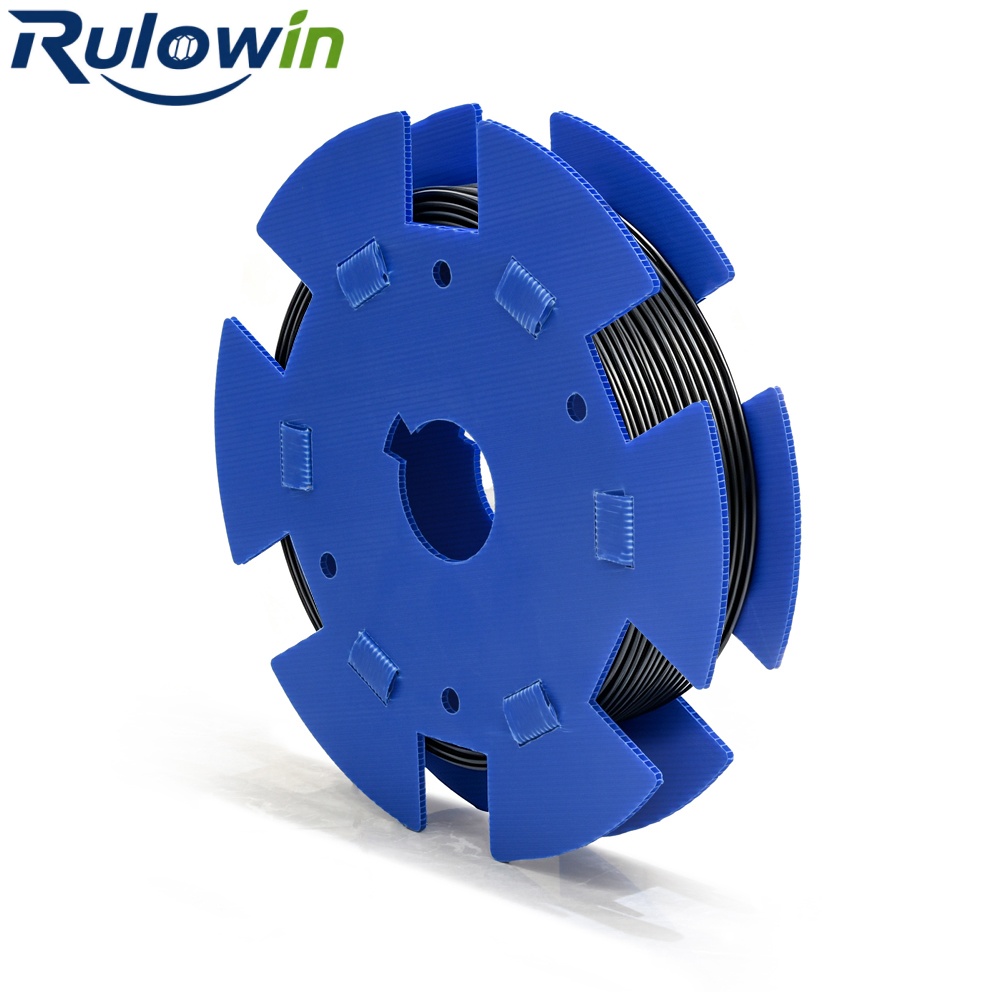
Product that is wound onto a spool and then transferred to another has been off and on again, and every transfer is an opportunity to introduce twist. For most cable this is a non-event. For some products it is the difference between a usable length and scrap, and the operators who handle those products know it well.
What twist does
A turn per metre sounds trivial. Over a few hundred metres it accumulates into a product that will not lie flat, that loops on itself during installation, and that puts torsional stress into whatever it is terminated into.
For steel wire rope and for some textile products, twist changes the fundamental behaviour of the product. For twin-core or paired cable, it changes the lay and can affect performance. For fibre, torsional stress is a reliability issue rather than a cosmetic one.
Where twist comes from
Two sources, and they behave differently:
- Winding on. If the product is fed onto the spool with the spool axis not aligned to the incoming direction, each turn lays on with a slight rotation. Spooling product off a rotating package — a capstan or a coil, for instance — introduces twist by definition.
- Paying off over the flange. Pulling product axially off the end of a spool, rather than tangentially off the side, adds one twist per turn removed. This is the classic cause, and it is entirely a handling habit.
The rule that prevents most of it
Pay off tangentially, never over the flange. Pull the product off the side of the spool so that it unwinds the way it was wound, and no twist is added.
This sounds obvious and it is violated constantly, usually because pulling over the end is faster when a spool is lying flat. The fix is a spindle or a simple frame that lets the spool rotate — cheap, and it removes the problem entirely.
Rewinding between spools
If a transfer is necessary, keep both spools on parallel axes and feed the product straight between them. Where precision matters, fit a twist detector — a simple rotating marker on the product lets the operator count turns and correct.
Do not wind from a coil directly onto a spool if the product is twist-sensitive. A coil pays off over the end by its nature, and the twist goes straight onto the spool.
Checking afterwards
The practical test is simple: lay a length of the rewound product on the floor and see whether it lies flat or tries to curl into loops. A length with accumulated twist will form loops; a length without will lie straight. It is crude, it is fast, and it catches everything that matters.
For a more formal check, clamp one end, hold the other, and count how many turns it takes to relax. Repeat it on a length from a spool that was wound directly and compare.
When it does not matter
For single-core, round, non-armoured cable with a robust jacket, twist tolerance is generous and none of this is worth worrying about. It matters for twist-critical geometry: paired and quad constructions, some textile products, wire rope with a lay that must be preserved, and anything going into an application where the product will be under tension in service.
Knowing which category your product is in is the whole task. If it is in the second one, the handling discipline is cheap; if it is in the first, do not spend money on it.