
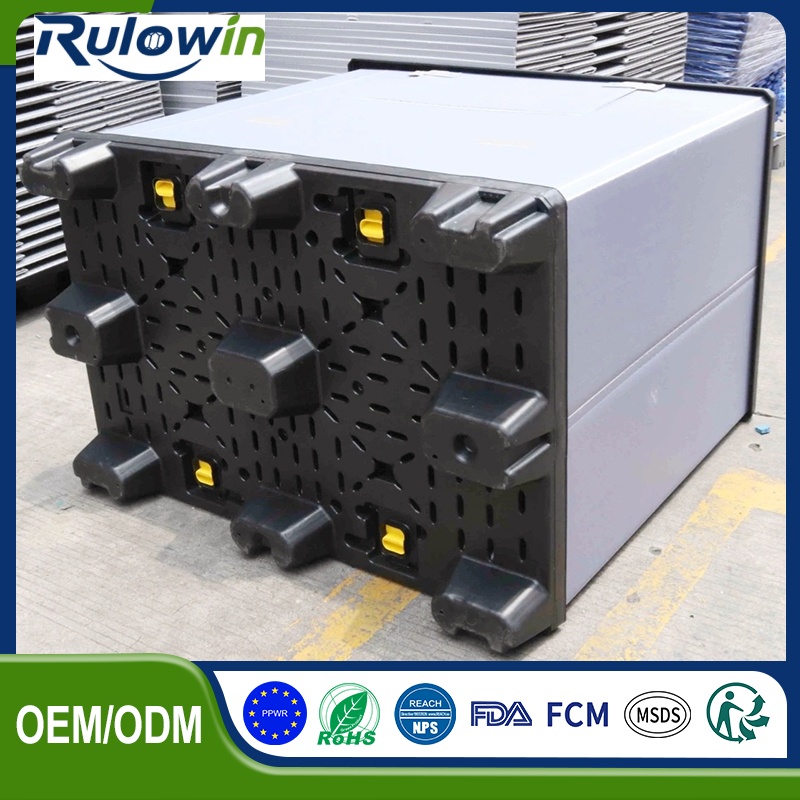
Automotive component loops are the most demanding internal packaging application there is: high frequency, short cycle, tight delivery windows, and parts whose surfaces matter. A box in this environment is handled constantly, has to protect a painted or machined face, and has to fit a rack module that was designed years before the box was specified.
Surface protection comes first
Painted, plated and polished parts are damaged by contact with a hard wall and by movement inside the box. The answer is not a softer box – PP is already reasonably forgiving – it is separating the parts from each other and from the walls. Fixed dividers, or a contact surface that is smooth rather than textured, and a base pad where parts sit on a machined face. Scratches on a class-A surface are the most expensive rejection in the loop and the easiest to design out.
Rack module compliance
Automotive line-side racking is specified by the manufacturer to a module, and boxes that do not fit the module do not get used regardless of how good they are. Get the rack module first – the footprint grid and the height per opening – and derive the box from it. Where a part does not fit the module, use a divider to subdivide a compliant footprint rather than a bespoke one that will not go in the rack. Line-side presentation is covered in more depth in dunnage for automotive line-side racks.
Sequence and orientation
Where parts are delivered in build sequence, the box has to present them in that sequence, which means either one part per compartment in order or a clear orientation marker so the operator does not have to rotate the part. A box that forces the operator to turn every part over costs a second per part, and at automotive cycle times a second per part is a measurable loss.
Return frequency and fleet size
Automotive loops are fast, which is good for payback – a box that comes back in two days supports far more trips a year than one that comes back in six weeks – and demanding on fleet management, because the empties have to be collected at the same rate they are generated. The empty return is the constraint in almost every automotive scheme, not the box.
What automotive gets wrong about packaging
The most common mistake in automotive packaging is treating it as a materials problem. It is a logistics problem: how many boxes, where they sit, who moves them, and how fast they come back. The box itself is usually adequate; the loop is what fails. Plants that specify a better box to fix a loop problem get a more expensive fleet and the same shortage in week three.
The second mistake is under-specifying the return. Automotive loops run at high frequency, which means empties are generated at high frequency, and the collection route has to match. A runner pass that is sized to the parts delivery schedule will not be sized to the empty generation rate, and the two are not the same number. Size the empty collection to the empties, not to the parts, and the loop holds.
Dunnage inside the box versus a shaped insert
There are two ways to protect a shaped part inside a box: loose dunnage that gets placed around it, or a shaped insert that locates it. Loose dunnage is flexible and gets left out. A shaped insert is fixed and cannot be omitted, which is why it survives contact with a real production line.
The trade-off is flexibility. A shaped insert belongs to one part number and is worthless when the part changes; loose dunnage works for anything. The usual resolution is a shaped insert for the high-volume parts that run for years, and loose or compartmented dunnage for the tail. Where a programme is short or a part is still in design change, do not tool an insert – the tooling will be obsolete before it is amortised, and a compartmented box with a pad will do the job adequately.
What we can do
We supply PP corrugated turnover boxes to automotive rack modules with fixed dividers and surface protection specified for the part. Send us the module and the part and we will tell you what fits – and tell you when a part will not fit any standard module.