
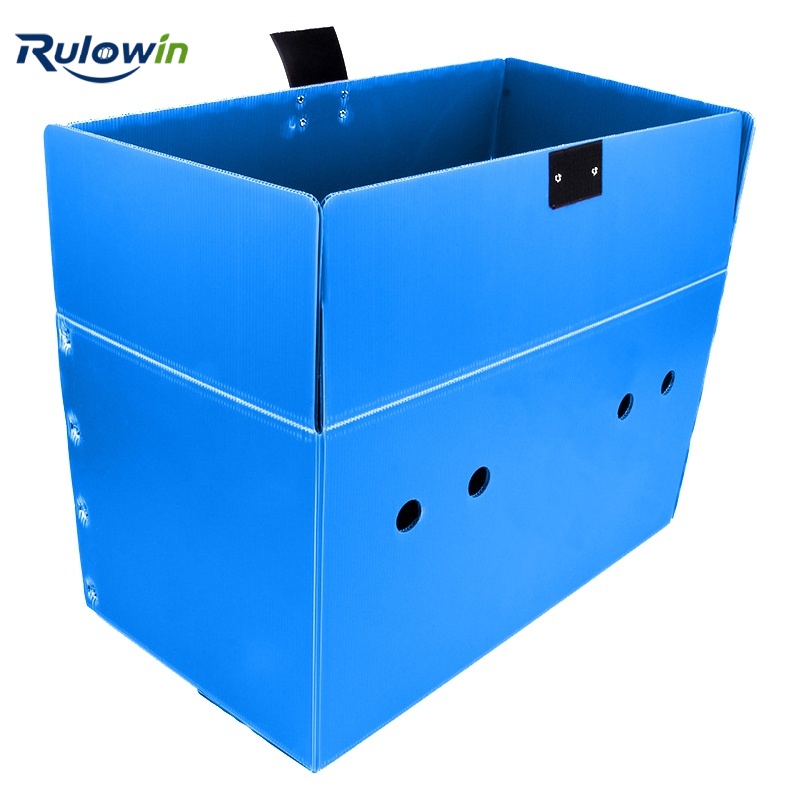
Polypropylene is an excellent insulator, which is exactly the wrong property for carrying static sensitive components. A standard PP corrugated box will hold a triboelectric charge generated by parts sliding against it, and a charged box next to an unprotected board is a failure waiting for a dry day. If the parts are static sensitive, the packaging decision is not a detail.
Two approaches, and they are not equivalent
An anti-static box uses an additive to limit charge generation; it reduces the problem and does not remove it, and the effect can diminish with wear and washing. A conductive box – typically a carbon-loaded or coated sheet – provides a path to ground and is the specification where a real ESD control programme exists. Which is required depends on the sensitivity of the parts and on whether the process has a grounded handling chain at all. An ESD box in a process with no grounding is theatre. The material side of controlled environments is covered separately in cleanroom compatible PP board.
Check the whole chain, not just the box
An ESD box is only one link. The trolley, the bench, the operator’s wrist strap and the floor all have to be in the same system, or the box is an island. Before specifying an expensive conductive box, check whether the handling chain is grounded. If it is not, the money is better spent on the bench and the strap, and a standard box plus a conductive liner may be the correct answer.
Measure it, and keep measuring
Surface resistivity is measurable and it drifts. A conductive box that has been washed a hundred times, abraded and exposed to a dry environment will not measure the same as it did on delivery. Put a surface resistivity check into the periodic box inspection – the same point in the loop where damage is checked – and retire boxes that have drifted out of range. Without measurement, an ESD packaging programme is a purchase rather than a control.
Where standard PP is fine
Cable assemblies, enclosures, mechanical sub-assemblies and anything without exposed semiconductor devices do not need ESD packaging, and specifying it is wasted money. The question is whether the part has an exposed device and whether the process has a control programme. Both have to be true before the extra cost is justified. Where it is justified, our ESD corrugated PP box is the product rather than a standard turnover box.
Humidity changes everything
Static generation and static dissipation both depend on humidity, and a dry environment makes everything worse: more charge generated by the same movement, and a higher surface resistivity on an anti-static material that was comfortably in range when it was measured in a humid factory. A packaging specification validated in August can fail in January in a heated building.
Two consequences. Measure surface resistivity in the environment where the boxes are used, not at goods-in on a wet day, and measure it more than once a year. And where the environment is dry and controlled, specify a conductive grade rather than an anti-static one, because the anti-static performance margin is exactly what disappears when humidity does. Where humidity is controlled as part of the process, say so in the specification – it is a relevant condition, and a supplier quoting without it is quoting for an average building rather than yours.
Anti-static performance versus washing
An anti-static additive works by migrating to the surface of the material, and washing removes surface material. A box that measures correctly on delivery can drift out of range after a wash programme, and the drift is faster with hot water, aggressive detergents and abrasion. This is the most common reason an ESD packaging programme fails an audit a year after it passed.
If boxes are washed and also required to be anti-static, either specify a conductive grade whose performance is a bulk property rather than a surface one, or exclude ESD boxes from the wash programme and clean them by a method that does not remove the surface layer. Measuring after washing rather than before is what reveals the problem, and it should be part of the periodic inspection rather than a one-off at delivery.
What we can do
We supply both standard PP corrugated turnover boxes and corrugated PP ESD boxes, and we will ask about the handling chain before recommending the conductive one. Tell us the sensitivity class and whether the bench is grounded, and we will tell you honestly which you need – sometimes the answer is neither.