
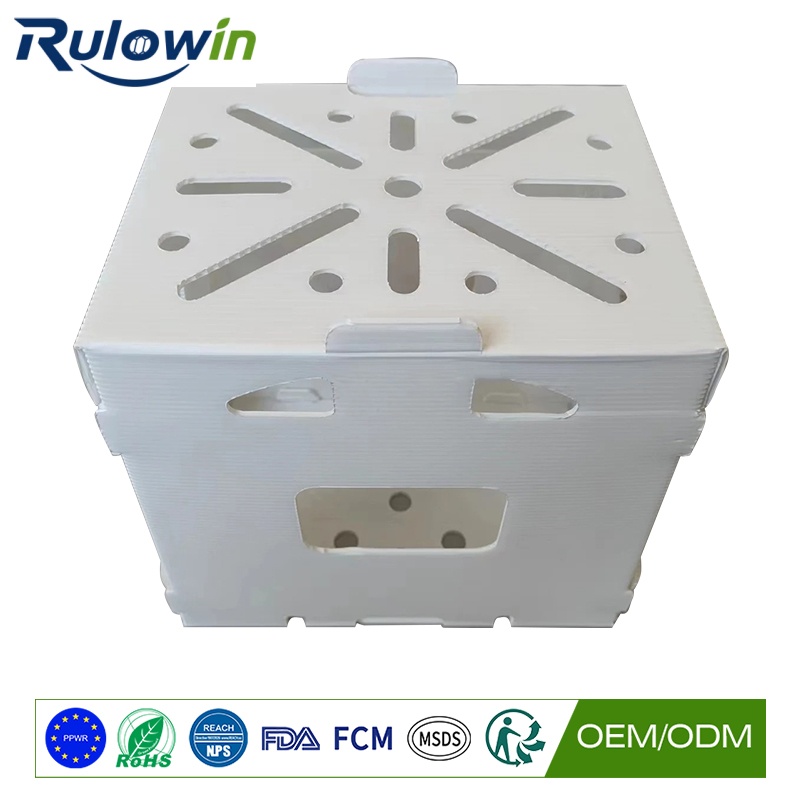
A crate that nests drops inside another when it is empty, so a stack of fifty empty crates is much shorter than fifty stacked full ones. That ratio determines how many fit on a truck and in a store, and because empty legs are most of the journeys a crate makes, it drives a large share of the operating cost.
What the ratio actually is
It is the height of a stack of nested empty crates compared with the height of the same number stacked in use. A ratio of three to one means fifty nested crates occupy the height of roughly seventeen stacked ones. Anything above two to one is useful; below that, the crate is barely nesting and the claim is not worth much. Ask for the number in millimetres – the height of fifty nested and fifty stacked – because that is the only form that is not ambiguous.
Why some crates cannot nest
Nesting requires tapered walls, and tapered walls reduce the usable volume at the base and can make a stack less stable when full. A crate designed primarily for stacking strength under load will nest less well than one designed for empty transport efficiency. That is a genuine trade-off and the right answer depends on how many empty legs the loop has.
Counting the legs
A closed loop with short distances and crates returned on the same vehicle that delivered them has few empty legs, and stacking performance matters more than nesting. An open loop with crates trucked back from a distant distribution centre has many, and nesting dominates. Drawing the loop and counting is the only way to know which crate to buy – and it is the same exercise that drives freight on empty crates and why it dominates.
Nesting and storage
Nested crates take far less floor space in a store, which matters on farms where the fleet spends eight months a year parked. It also matters in the packing hall during the season, where crates staged for the day take up space that is needed for produce. A good nesting ratio is a space saving that gets noticed every day rather than only on the transport invoice.
Nesting and drying
Tightly nested crates dry slowly, because air does not move between them. Crates nested straight out of a wash and stored that way will stay damp, and damp enclosed crates are how staining and microbial growth start. Where crates are nested for storage they should be dry first, or stored with a gap, which is the point made in drying and storing produce boxes between uses.
How to measure it yourself
Stack twenty empty crates as they nest, measure the height. Stack the same twenty as they sit when loaded, measure again. Divide one by the other. That is the ratio and it takes two minutes, and it is the only version of the number that cannot be argued with. Do it on the sample crate before ordering rather than on the datasheet afterwards.
Then multiply by the empty legs. If a loop has four empty movements per loaded one and the nesting ratio is two to one, the nesting is removing half the volume on two thirds of the movements. That is usually the largest single transport saving available, and it is decided entirely by a design choice made at purchase.
What we can do
We supply nestable produce crates and state the nested and stacked heights per fifty crates so the transport arithmetic can be done properly. Tell us the loop and we will say whether nesting or stacking strength is the priority.