
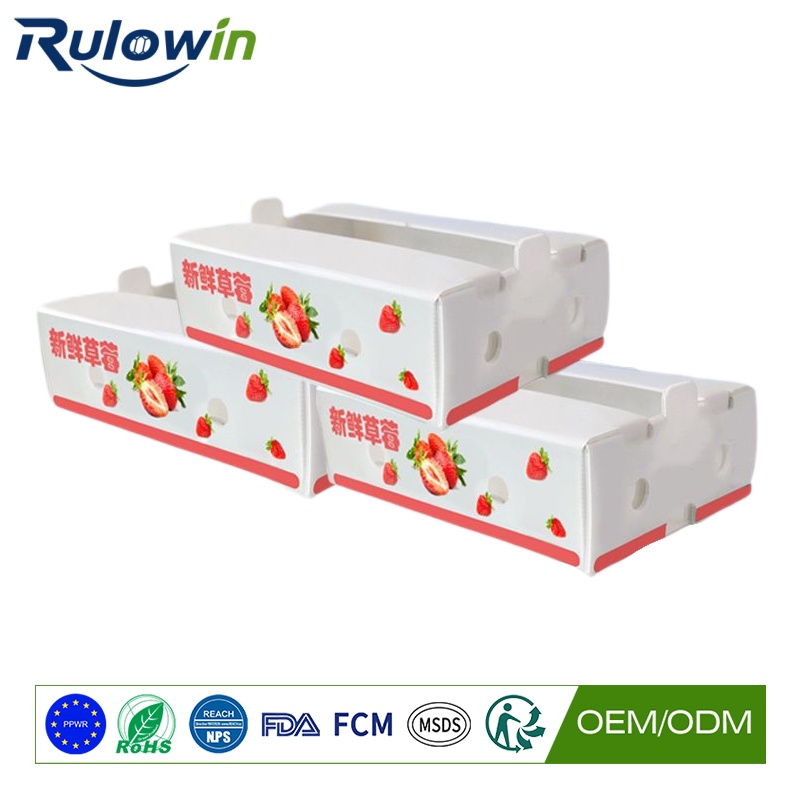
Field packing is the hardest environment a produce container ever sees. The crate is set down on wet ground, it is filled in the open, it gets rained on, it is carried to a trailer over a muddy headland and it is stacked wet. Anything that depends on staying dry is finished before lunch.
What the crate is actually asked to do
Four things at once. Hold a load while standing on an uneven, soft surface. Survive being dropped from waist height onto that surface when it is full. Drain, so the produce is not sitting in the water it arrived with. And stay liftable when it is wet and muddy, with a picker wearing gloves.
Polypropylene does not take water up
This is the whole material argument and it is worth stating plainly: PP is not hydrophilic. Water sits on it, runs off it, or drains through the holes. It does not wick along the wall, it does not swell, and it does not lose stiffness when wet because there is nothing in it for water to break down. A crate that has stood in a puddle overnight performs the same as a dry one, which is not true of anything made from cellulose.
Where the failure actually happens
Not in the wall. In the base, at the junction between the base and the side wall, and at the hand holes – the three places where the section changes and the moulding is thinnest. A crate that has been dropped repeatedly onto a hard surface cracks at the base corner first. When you are looking at a sample, drop it loaded onto concrete from waist height a few times and look at those three places rather than at the general wall.
Mud and grit are the real enemy
Water is easy. Grit is not. Soil carried into the crate abrades the produce and it abrades the crate’s internal surfaces, and once a crate has been used for root crops with soil on, it needs washing before it goes anywhere near a soft fruit crop. The practical rule on mixed farms is to keep crate colours separate by crop type so field soil never crosses into a clean packing job.
Drainage under a stack
A crate full of wet produce sitting on a pallet is holding water that has to go somewhere. If the base is effectively solid the water sits with the produce, which is a quality problem for anything soft. Drain paths matter more in field packing than in a packhouse because there is no drying step afterwards. The base pattern question is closely tied to what fruit box ventilation and what the holes are for describes on the walls.
Cold mornings and wet crates
Early morning field packing means cold, wet and sometimes frosty. Polypropylene gets stiffer and more impact-sensitive as it gets colder, so a crate that shrugs off a drop at 20C can crack at 2C. If picking starts before dawn, it is worth knowing – and it is one of the reasons long-term cold storage deserves its own conversation, as in why PP crates crack in cold storage.
What we can do
We supply field-packing crates with drain paths and reinforced base corners, and we will send samples to drop-test on your own ground rather than quoting from a datasheet. Tell us the crop, the drop height that actually happens and whether picking starts cold.