
Almost every scuffed floor gets blamed on foot traffic, and almost every time the boot is not the culprit. Rubber and soft PVC soles are softer than polished concrete, terrazzo, lacquered timber and most vinyl. The thing that scratches a finish is harder than the finish, and on a construction site that means quartz dust, masonry dust, swarf and the occasional screw.
How a scratch actually happens
A hard particle gets between two surfaces and is dragged. The particle is the cutting tool, the boot or the wheel is the force, and the finish is the workpiece. Remove any one of the three and nothing happens. That is why a brand new floor can be wrecked by a single morning of traffic after a grinding operation two rooms away – the grit is on every sole in the building before anyone notices.
Why a smooth hard panel makes it worse
A smooth-faced panel does not hold grit; it carries it. Particles sit on the surface and get dragged back and forth with every footfall, and because the panel is hard they are not absorbed into it, they are driven into the finish below. Worse, a hard smooth panel against a hard smooth floor has very little friction between them, so the panel itself slides and takes the grit with it. This is the mechanism behind the fine random scratch pattern that shows up at handover on floors that were protected the whole time.
What a fibrous face does instead
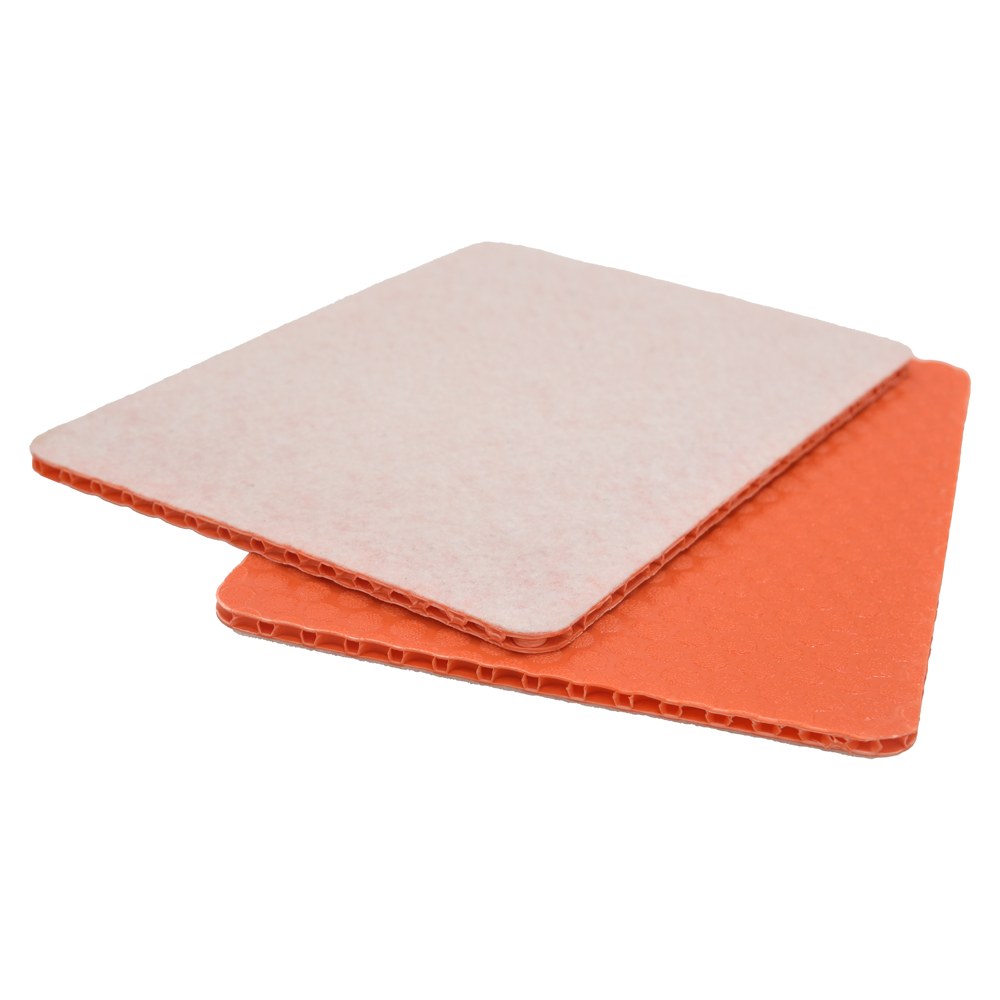
A needled felt or fleece face has depth, and grit that lands on it works into the structure rather than sitting proud on it. The particle is held away from the finish until somebody lifts the panel and cleans it. The face also grips the floor below, so the panel does not slide and drag what it is carrying. Neither property is about softness for comfort – both are about where the abrasive ends up.
Why cleaning the panel matters as much as choosing it
A felt face that is saturated with grit stops holding any more and starts behaving like a smooth hard panel with a fine abrasive bonded to it. On a long programme the panels in the main traffic lanes need lifting and cleaning every few weeks, or rotating with panels from low-traffic areas. Sites that never lift their protection are the ones that get the handover surprise, because the protection was doing its job for the first month and quietly stopped. We cover the failure pattern in why site floor protection fails in week two.
The entrance is where the grit comes from
Grit arrives on soles and wheels from outside. A scraper mat or a brushed zone at the entrance before the protected area starts removes a large share of it before it ever reaches a finish. It is the cheapest intervention on this whole list, and it is the one most often skipped because it is not on anyone’s material schedule.
When grit is genuinely not the problem
On rough concrete, on unfinished screed and in plant areas, there is no finish to protect and grit management is pointless effort. Equally, some finishes are harder than the grit – fully vitrified tile and ground and sealed concrete with a hard sealer will generally take it. Saying so at enquiry is cheaper than selling protection that is not needed.
What we can do
We supply felt-faced honeycomb protection panels and can supply them in a colour that makes grit loading visible, so cleaning gets done before it stops working. Tell us what the floor is finished with and what is being carried across it, and we will tell you whether a fibrous face is worth the extra cost.