
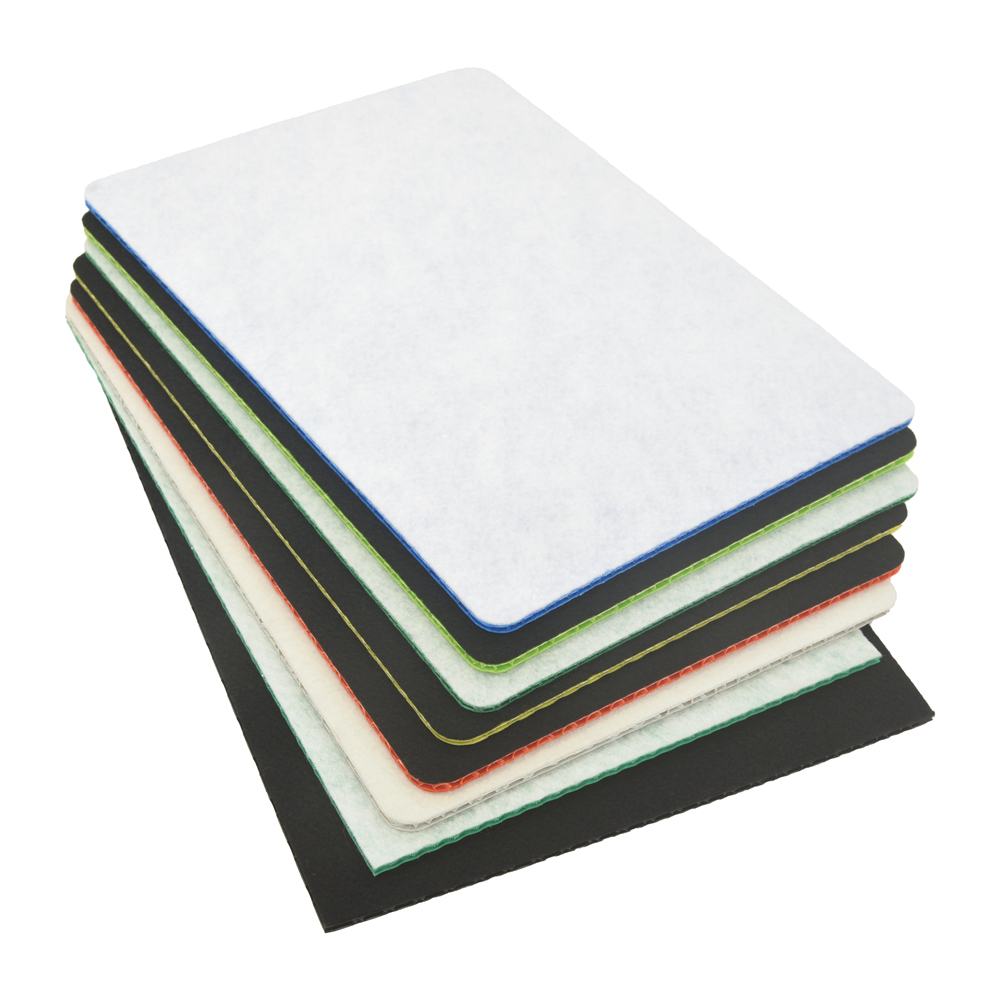
Natural stone and terrazzo are hard enough to shrug off almost anything that lands on the middle of a slab. What ruins them is edge damage – a chipped arris along a joint, a broken corner at a doorway, a crescent out of the edge of a stair tread. Protection that only thinks about flat surfaces leaves those edges exposed, and edge repairs on stone are expensive and rarely invisible.
Why edges fail and faces do not
Two reasons. An unsupported edge has no material behind it to resist the load, so a wheel or a dropped tool that arrives at the edge shears a piece off rather than compressing the surface. And the arris – the slight chamfer or bullnose on the edge of a slab – is the thinnest, most fragile part of the whole installation. A terrazzo floor that has carried a full fit-out without a mark can still be written off on the strength of six chipped arrises along a corridor joint.
Joints are the weak line
Stone and terrazzo are laid in slabs with joints between them. The joint line is a discontinuity: any load arriving there is carried by one slab or the other, not shared. Protection laid with its own joint coincident with the floor joint below creates a soft line straight down the weak point. Offsetting the protection joints from the floor joints by half a panel is a two-minute decision at laying time and removes a whole category of damage.
What actually protects an edge
Two things working together. Something stiff enough to spread a wheel load past the edge rather than into it, which means a honeycomb panel with a real core rather than a flexible sheet – the spreading behaviour is what honeycomb panels under heavy point loads is about. And coverage that extends past the edge – protection stopping flush with the edge of a stone stair tread leaves the most vulnerable line on the whole floor uncovered. Panels cut to overhang, or a dedicated edge profile, are the fix.
Where protection itself causes the chip
Honest point. A rigid panel that rocks is worse than no panel at all, because every footfall hammers the panel edge against the stone. Rocking comes from panels laid over debris, over uneven joints, or with a curled edge. Sweeping before laying and checking that panels sit flat is not a nice-to-have on stone; it is the difference between protection and a slow chipping machine.
Wet cutting and slurry
If any cutting or grinding happens near stone, the slurry is abrasive and alkaline and it etches polished surfaces permanently. Protection has to be laid before that work starts, not after, and lifted and cleaned before it is walked off the area. This is the sequence that gets missed when trades are sequenced tightly, and it is worth naming explicitly in the programme.
Checking the floor before laying
Stone often arrives with existing edge damage from transport and handling, and protection laid over it gets blamed for it at handover. Photograph the edges before laying, particularly at doorways and stair treads. It takes an hour on a large floor and it settles an argument that otherwise nobody can resolve.
What we can do
We supply stiff honeycomb protection panels cut to size so edges and stair treads are covered rather than stopped short of. Tell us the floor type and where the joints and edges fall, and we will lay out a cutting schedule that keeps panel joints off floor joints – or tell you if a softer faced panel is the better call for a polished finish.