
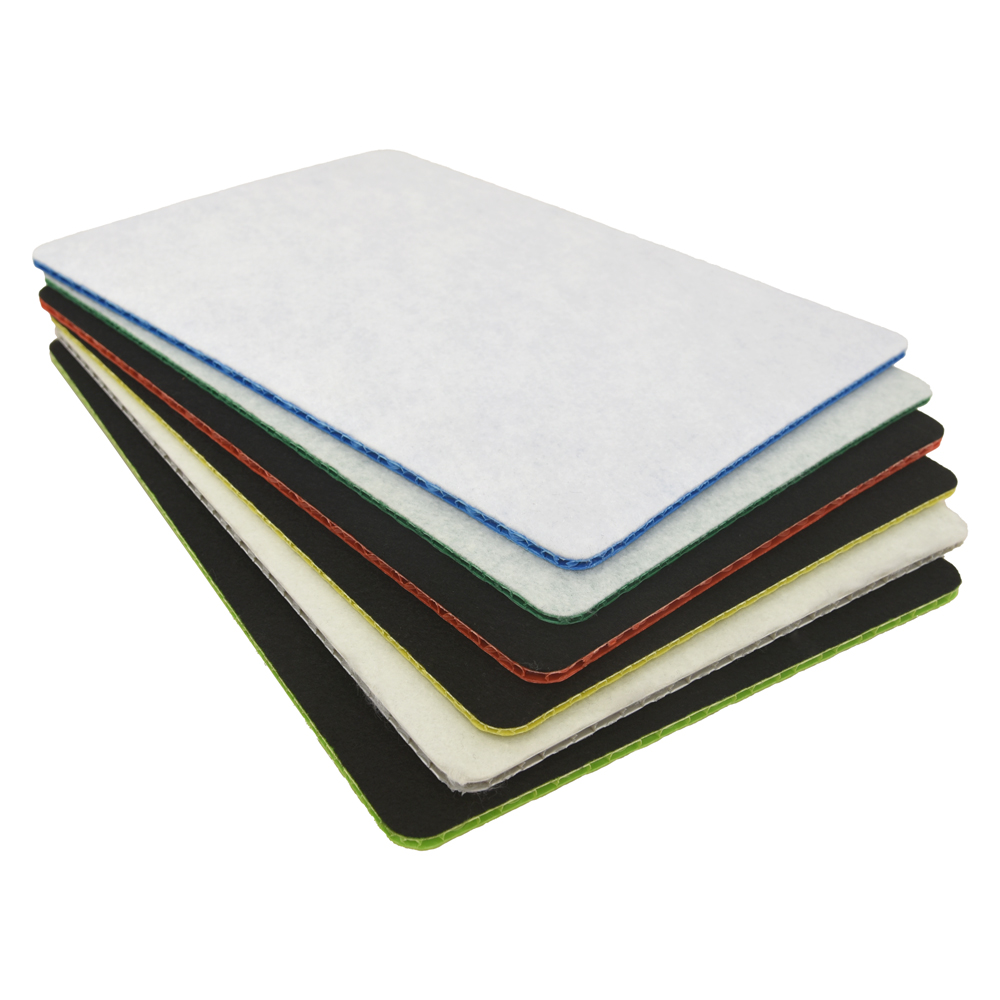
The complaint is always the same: protection that was fine for a fortnight suddenly became dangerous after rain, a wash-down or a spill. Nothing about the panel changed. What changed is that a continuous film of water got between shoe and panel, and a smooth face has nowhere to put it.
The film mechanism
Polypropylene is not absorbent, so water sits on it. On a smooth face that water forms a continuous film, and the shoe rides on the film rather than touching the panel. Grip collapses to whatever the water layer provides, which is not much. This is why a panel can score reasonably in a dry laboratory test and behave badly in a wet corridor.
Dust does something similar
Fine plaster or concrete dust behaves like a dry lubricant on a smooth face, particularly the very fine material from cutting and sanding. The floor looks clean and is not. Anywhere cutting is happening nearby, the adjacent protection will be dusty and the smooth panel will be slippery.
What a raised pattern changes
Studs break the film. Water is pushed into the channels between them, the shoe contacts the stud tips, and there is always a route for water to escape sideways. Grip does not return to dry values, but it stays predictable instead of collapsing, which is what matters for someone walking with a load.
Pattern depth versus cleanability
Deeper patterns displace more water and hold more dirt. In a clean internal corridor a fine stud field is enough; in a muddy external entrance a coarser pattern works better and needs brushing rather than mopping. Matching the pattern to the contamination is more useful than choosing the most aggressive one available. The wet-entrance case is covered in embossed face drainage on wet sites.
Cleaning residue is its own hazard
Detergent left on protection is as much of a problem as water. Where cleaning happens daily, rinse rather than leaving a film – a panel with dried detergent on it behaves like a wet one until somebody washes it properly.
Why the wet number is the only one that matters
A slip test on a dry panel tells you almost nothing about site risk, because nobody slips on a dry, clean panel. The number that matters is the wet one, and ideally the wet-and-dirty one. Where a supplier quotes a pendulum value, ask whether it was measured wet. A smooth polypropylene face that reads well dry can drop into the high-risk band wet, which is the difference between a defensible specification and an incident report.
What contamination does to a good surface
Clay slurry, cement slurry and sawdust all reduce grip, and they do it by filling the pattern: a textured face with its valleys packed with clay is effectively smooth. That is why cleaning frequency matters more than pattern choice on a muddy site, and why a coarse pattern can outperform a fine one even where the fine one tests better clean. The pattern has to be big enough to keep working when it is partly blocked.
Footwear is half the equation
A panel is only ever half of a slip risk; the other half is what is on the foot. A site with a boot policy and a scraper mat at the entrance has far fewer slips on the same panel than one without. We would rather sell a mat and a boot brush than a more expensive panel that will be covered in mud by Tuesday.
What we can do
We make honeycomb protection panels with fine or coarse stud patterns and can supply the same panel with a soft face on the reverse. Tell us what liquid or dust the panel will meet, and we will say which pattern suits – including where we would not recommend ours.