
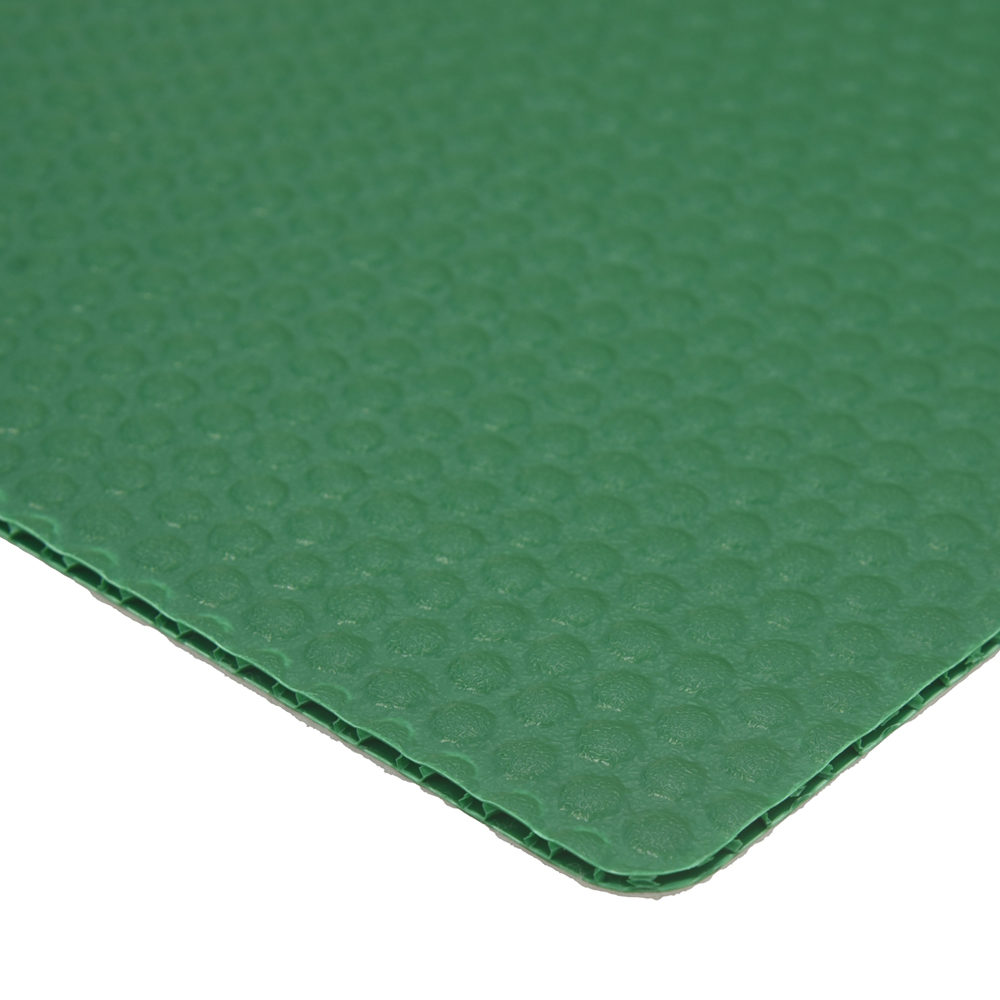
Thickness gets specified on every honeycomb panel order and density gets specified on almost none. That is backwards, because thickness is easy to hold and density is not, and density is what determines how the panel behaves under load.
What density means here
Mass per unit area – how much PP is in the panel. It is set by the cell wall thickness and the core structure, and it correlates with compressive strength and with stiffness far more closely than the overall thickness does.
Two panels of the same thickness from two suppliers can perform very differently, and the difference is almost always density. This is the main reason two quotes for the same nominal panel are not comparable.
Why it varies
Extrusion and cell formation are processes with normal variation, and density moves with them more than thickness does. A thickness tolerance of a few percent is routine; a density tolerance is wider, and it is usually the first thing to drift on a long run.
Which is why it is worth asking for. A supplier who states a density range is measuring it; one who only states thickness may not be.
What to specify
A nominal density with a tolerance, alongside the thickness. Both numbers, on the quote, so there is something to check against. If you only ever get thickness, you have no way to tell whether a batch is the panel you approved.
The wider specification question – which numbers on a spec sheet actually matter – is covered in packaging spec sheet terms, translated.
How to check it
Weigh a sample and divide by its area. That is it – a set of scales and a tape measure, and it is the single most useful check on a honeycomb panel delivery. If the weight is below what you agreed, the panel is lighter than specified and will perform accordingly.
Do it on the first delivery from a new supplier and periodically thereafter. It takes two minutes.
What density does and does not affect
It affects compressive strength, stiffness and impact resistance, all in the same direction – more density, better performance. It does not affect surface finish, colour, or how the panel handles water.
It is also the main driver of price, because it is the main driver of material content. A cheaper panel of the same thickness is usually a lower-density panel, and that is the most common form of the specification difference described in cheapest vs best value in packaging.
Density and price
Density is the dominant driver of panel cost, because material is the dominant cost. Which means a cheap panel of the same thickness is almost always a lower-density panel, and comparing on thickness alone is how a buyer ends up with a panel that underperforms.
Ask for both numbers on any quote you are comparing. If a supplier will not give density, that is worth noting.
And what to write down
Put the density on the specification you keep, next to the thickness. If it is only ever on the quote, the next person to order will order on thickness alone and get a different panel.
What we can do
We supply PP honeycomb panels and state thickness and density on every quote, with tolerances. Tell us what the panel has to carry – we will specify a density for that rather than a grade name, and tell you what we can hold.