
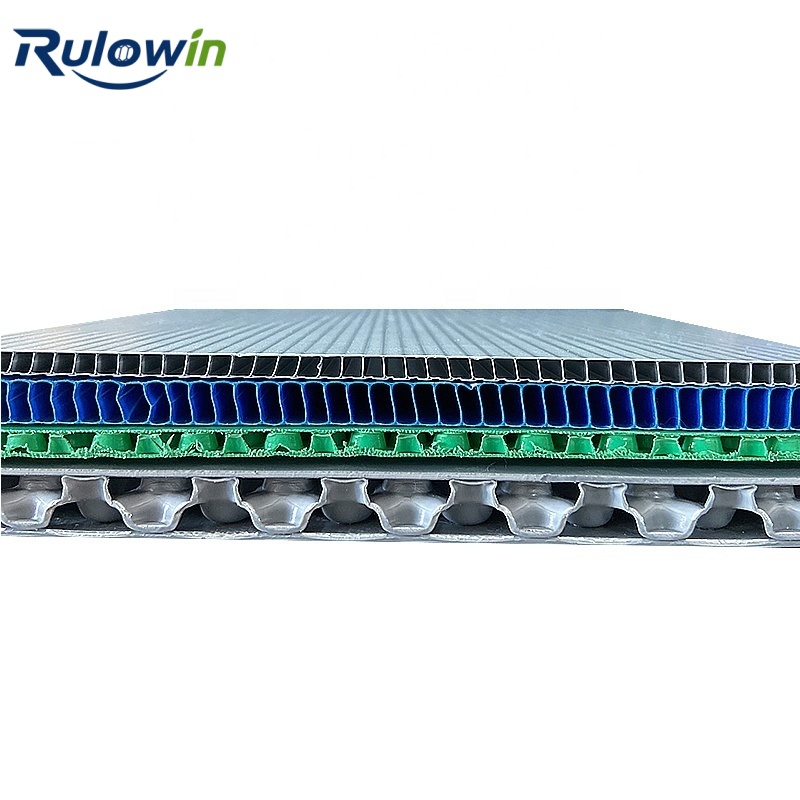
Corrugated plastic sheet – sometimes twin-wall, sometimes fluted sheet – is a single extruded sheet of polypropylene with two flat faces joined by vertical webs. The channels between the webs run in one direction, the direction of extrusion. That single fact explains most of its behaviour and most of the surprises people have with it.
What the channels do
They give the sheet thickness without weight, in the same way a corrugated cardboard sheet does. Thickness brings bending stiffness, so a four-millimetre sheet is enormously stiffer than a one-millimetre solid sheet of the same weight.
But the stiffness is directional. Along the flutes, the sheet is stiff. Across the flutes, there is nothing but the faces and the webs, and the sheet folds fairly easily along a flute line. That is a feature – it is why the sheet can be bent into a corner or wrapped – and it is also the reason a sheet cut the wrong way round sags.
Common uses
Layer pads on pallets, protective floor covering, signage, partitions, boxes and totes made by folding, and tree guards. Most of these use the bendability deliberately. The sheet scores and folds along a flute, which is how a flat sheet becomes a box without any tooling at all.
What it is not
It is not a structural panel. It will not take a point load across the flutes the way honeycomb will, and it does not have the through-thickness crush resistance. If something heavy with a small footprint is resting on it, use honeycomb.
It is not a long-term outdoor material unless it is UV-stabilised. Unstabilised polypropylene chalks and goes brittle in sun. Stabilised grades are a small premium and are worth it whenever the sheet will be outside for more than a season – we covered this in can corrugated plastic sheet be used outdoors.
And it is not waterproof at the edges. The flutes are open channels. Cut a sheet and the channels are exposed, which lets water and dust in. Sealed-edge sheet exists and costs very little extra.
Reading a specification
Thickness in millimetres is the number that matters, then flute structure, then resin. Grammage is a weight and tells you less than people assume – we went through why in what GSM means on a corrugated sheet spec sheet.
Making things from it, and why it suits small runs
The sheet’s real advantage is that it needs no tooling. Score along a flute, fold, and you have a corner. Cut, fold, tape or weld, and you have a box. For short runs and prototypes – and for anything whose dimensions are going to change next month – that is worth more than a lower unit cost from a moulded part.
Welding works well and is how a lot of boxes are made properly: hot-air or ultrasonic welding gives a joint that is stronger than tape and does not creep. Tape is fine for prototypes and for anything with a short life.
At volume, injection moulding takes over, and the crossover is usually in the low thousands. Below that, fold and weld wins.
What we can do
We supply PP corrugated sheet cut to size, with sealed edges if you need them, in plain, embossed or UV-stabilised grades. Tell us what the sheet has to do and we will specify it – and tell you honestly when a cheaper or a thinner sheet will do.