
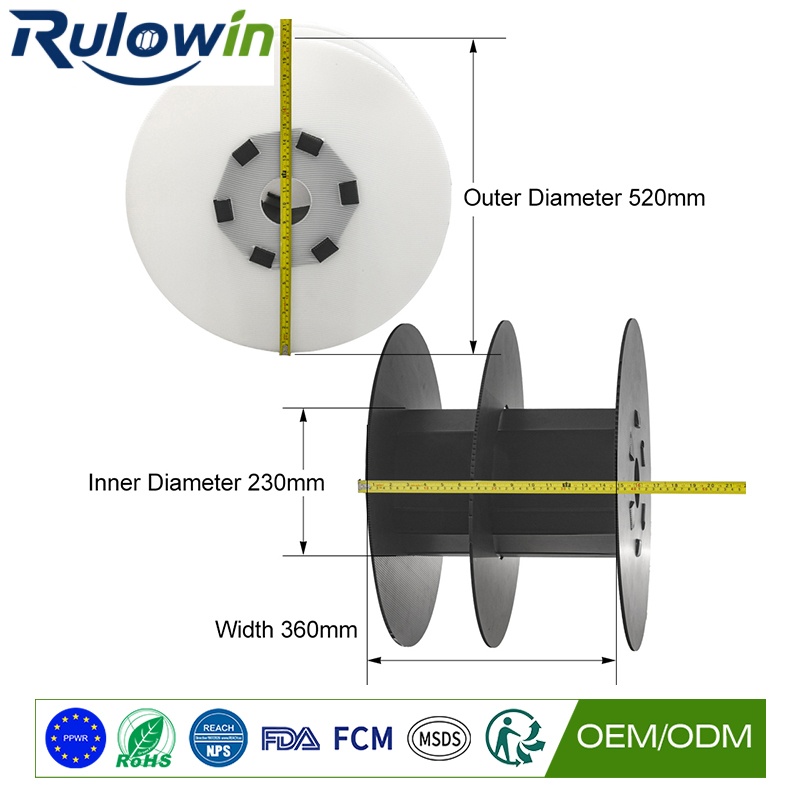
For most spooled product the packaging is a small fraction of the shipped weight. Sometimes the ratio is extreme — a heavy, dense product on a light spool. That condition has specific consequences worth knowing about, and it makes some of the usual advice wrong.
Why the ratio matters
Freight is dominated by product. Everything discussed in our weight and freight article becomes less relevant — saving weight on the spool saves little when the product outweighs it ten to one.
But return freight is not. On the empty return leg the spool is everything. For a returnable programme with a high product-to-spool ratio, the outbound and return economics are completely different, and they should be analysed separately rather than averaged.
The spool is carrying a load it did not have to carry on the way back. This sounds obvious and it has a specific consequence: a spool specified for a high product weight may be over-built for the return leg, where it is empty and being shipped for its own sake.
The engineering consequences
High product weight on a light spool means:
- Hoop load is high relative to spool mass, so flange stiffness matters more than spool weight does
- Core compression is the governing concern rather than flange deflection — the territory of our core construction article
- Handling is dominated by the product, so the spool’s own handling characteristics matter less than how the combination behaves
- Stacking limits are set by product weight, and the spool at the bottom of a stack is carrying mostly product
That last one is worth being explicit about. A stack of spools loaded with heavy product is a very different loading case from a stack of empties, and the stack height question in our stacking article should be answered for the loaded condition.
Where the usual advice inverts
- Weight reduction is not worth much on the outbound leg, but it is worth everything on the return — so a nested or take-apart construction earns its cost through volume rather than mass
- Spending more on the spool is easier to justify, because it is a smaller fraction of shipped value
- Over-specifying is a smaller mistake than under-specifying, which is unusual — in most packaging applications the reverse is true
- Loss hurts less per unit but the same in absolute terms, so fleet discipline still matters
What to specify carefully
- Core — the component carrying the load. Specify for the loaded condition, and for reuse, as noted in the core article.
- Flange stiffness rather than flange strength — deflection is what causes problems, as described in our deflection test article
- Stacking capability loaded if loaded spools get stacked
- Handling interfaces — whatever the equipment grips has to take the full weight
The commercial point
When product value per shipment is high, the spool cost is small and the cost of a spool failure is large. That asymmetry should drive the specification toward reliability rather than price, and it is worth saying out loud in internal discussions because it is often argued the other way on unit cost grounds.
The stoppage cost article makes the same point from the disruption side.
What we would ask
Product weight per spool, spool weight, and whether empties come back. That is enough to tell you whether you are in high-ratio territory and what it changes for our hollow board spools. If the product is heavy enough, we may suggest more core and flange than the diameter alone implies — and we will tell you if the ratio is high enough that another construction is worth considering.