
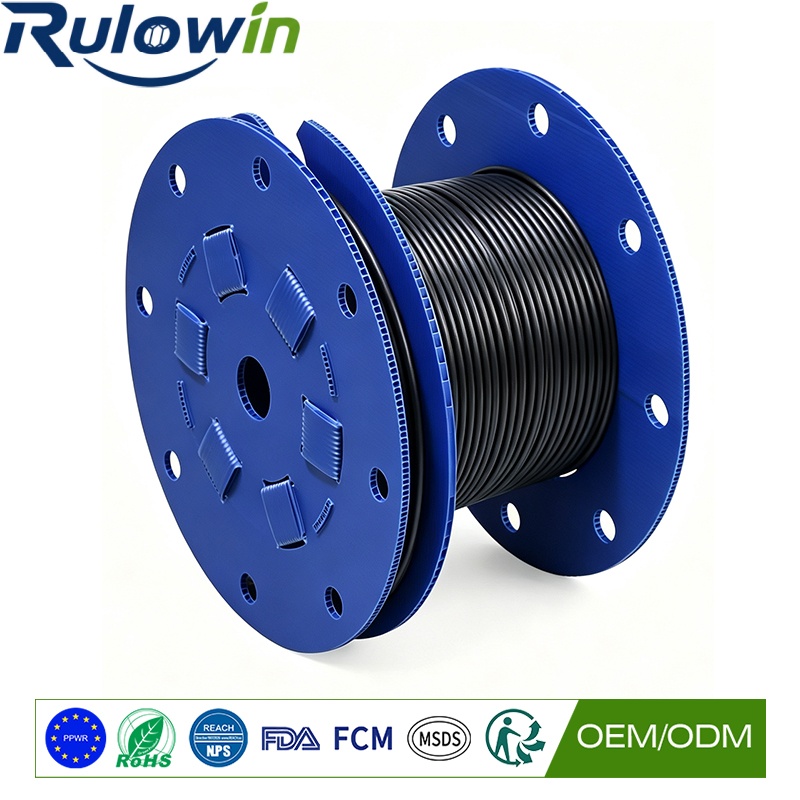
Most wound product is inert once it is made. Some is not — it continues to cure, crosslink, offgas, or otherwise change after it has been spooled, and the pack is where that happens.
This is a smaller category than the rest of this series covers, but when it applies it overrides most other considerations, and it is usually discovered the hard way.
What changes after winding
- Continued curing — some compounds, coatings and adhesives are not finished when they go on the spool
- Outgassing — volatiles leaving the product, sometimes for weeks
- Moisture migration — water moving within the product or out of it
- Blocking — surfaces gradually bonding to each other under pressure
- Dimensional change as any of the above proceeds
The common feature is that all of it happens under confinement, in a pack under pressure, with nowhere for anything to go.
Why the pack makes it worse
A spool is a closed environment. Layers pressed together, low air movement, no light. Whatever the product would do on a shelf, it does more slowly and more completely in a wound pack — and anything released has to diffuse through layers rather than dissipate.
The pressure is the part people underestimate. If two surfaces are going to bond, they bond faster pressed together. If a volatile is going to leave, it leaves slower through a compressed pack.
Practical consequences
- Layers bond and the spool will not unwind cleanly, or unwinds with surface damage
- Product properties drift between winding and use, sometimes outside specification by the time it is used
- Odour or residue transfers to the spool and then to the next batch
- Dimensions change, which affects anything that depends on pack tightness
What the spool can contribute
Generally the packaging is a bystander, but there are three ways it makes things worse:
- Trapping volatiles. A tightly packed spool with no vent path holds whatever is released against the product.
- Transferring residue. Anything deposited on the flange or core ends up on the next product wound — the argument made generally in our cleaning article.
- Reacting, rarely. Some aggressive chemistries do affect polypropylene, and some spool materials absorb what is released and carry it forward.
What helps
- Minimise dwell. The single most effective measure — ship and use rather than store.
- Reduce winding tension to limit contact pressure between layers.
- Consider interlayer separation where bonding is the problem, accepting the handling cost discussed in our interlayer sheets article.
- Do not seal or wrap a pack that is releasing anything.
- Keep spools dedicated to that product if contamination transfer is a risk, rather than running a mixed fleet.
That last one is often the pragmatic answer. If a product leaves residue that cleaning does not remove, the spools stop being general-purpose assets.
What we can tell you and what we cannot
We can tell you what our hollow board spools are made of, what they have been exposed to in production, and whether we would expect a given chemistry to affect them.
What we cannot do is predict how your product will behave in a wound pack. That is a question for whoever formulated it, and it is worth asking before you commit to a spooling method rather than after — because if the answer is that it needs to be shipped loose, no spool design changes that.
A question worth asking early
Does the product change after manufacture, and if so, does anyone know what the time window is? If nobody has asked, that is worth establishing. Plenty of winding problems attributed to tension or traverse turn out to be chemistry proceeding exactly as it was always going to.