
Every mechanical assembly has speeds at which it prefers to oscillate. Spools and their mounting arrangements are no exception, and the symptom — fine at 200 metres a minute, terrible at 260 — is distinctive enough to identify from the description alone.
What is happening
Anything with mass and stiffness has natural frequencies. Drive it at one of those frequencies and small inputs build into large movements rather than cancelling out. With a spool, the input is usually something small and periodic: slight imbalance, a bent shaft, an out-of-round core, the traverse of the product itself.
At most speeds those inputs do nothing visible. At the resonant speed they build.
How it presents
- Speed-dependent. The defining feature — worse at a particular band and better either side of it.
- Worse as the spool empties or as it fills. The mass changes, so the resonant speed moves, so a line that was clear at start of run enters the band half way through.
- Accompanied by noise that changes pitch with speed.
- Visible in the product as regular variation rather than random variation.
That second point is why it is often reported as intermittent. It is not intermittent; the resonant speed is moving as the pack weight changes.
What is usually oscillating
In rough order of likelihood:
- The spool on the shaft — a fit problem, or the shaft itself flexing
- An overhung shaft — a spool mounted at the end of a shaft with insufficient support is a classic cantilever
- The machine frame or a guard — sometimes it is not the spool at all
- The product span between the spool and the first guide, which has its own natural frequency and is often the longest unsupported run
That last one is worth checking early because it is cheap to fix — shortening or supporting a free span often removes the problem entirely.
Finding it
You do not need instrumentation for a first pass. Run through the speed range slowly and note where it starts and stops. That gives you the band, and knowing the band is most of the diagnosis.
Then test the cheap hypotheses:
- Try a different spool. If the band moves, it is spool-related. If it does not, it is the machine.
- Try a known-good spool on a different shaft position if you have one.
- Press on the frame or guard by hand at the problem speed — if it changes, you have found the member that is moving.
- Check the free span of product and support it temporarily.
What the spool contributes
Two things, and both are specified rather than accidental:
- Mass and its distribution. A heavier or larger spool shifts the resonant frequency. Sometimes that is all that is needed.
- Runout. Any eccentricity is the input that drives the oscillation. Even small runout matters at the resonant speed, which is why the checks in our article on concentricity are worth doing here.
Where a plastic spool can differ from a steel one is in damping. Polymer absorbs vibration better than metal, which sometimes softens resonance rather than eliminating it. We would not claim it as a design feature — it is a property of the material that occasionally helps.
Fixes, cheapest first
- Avoid the speed band, if the process allows it
- Support the product span better
- Check and correct shaft condition and spool seating
- Add support to an overhung shaft
- Stiffen whatever member is moving
- Reduce runout by specifying better concentricity
Worth knowing
Resonance is not damage accumulating in itself; it is a condition. But running in it does accelerate wear everywhere — bore, shaft, bearings — and it usually produces product that fails quality checks in a regular pattern. So it is worth resolving rather than living with, and the diagnosis is usually quicker than people expect once somebody walks the speed range and writes down where it happens.
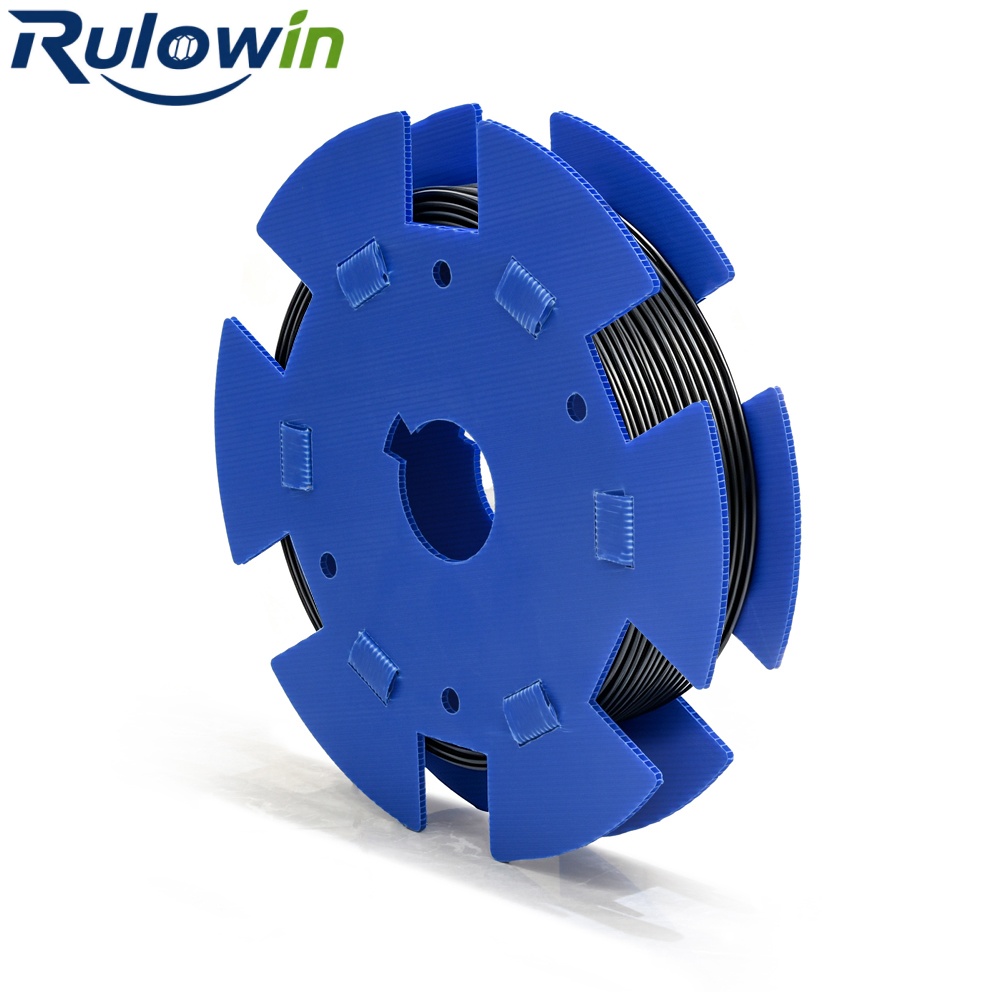
If the band moves when you change spools, tell us which spools behave better on our hollow board spools and we can look at what differs — mass, diameter, or concentricity.