
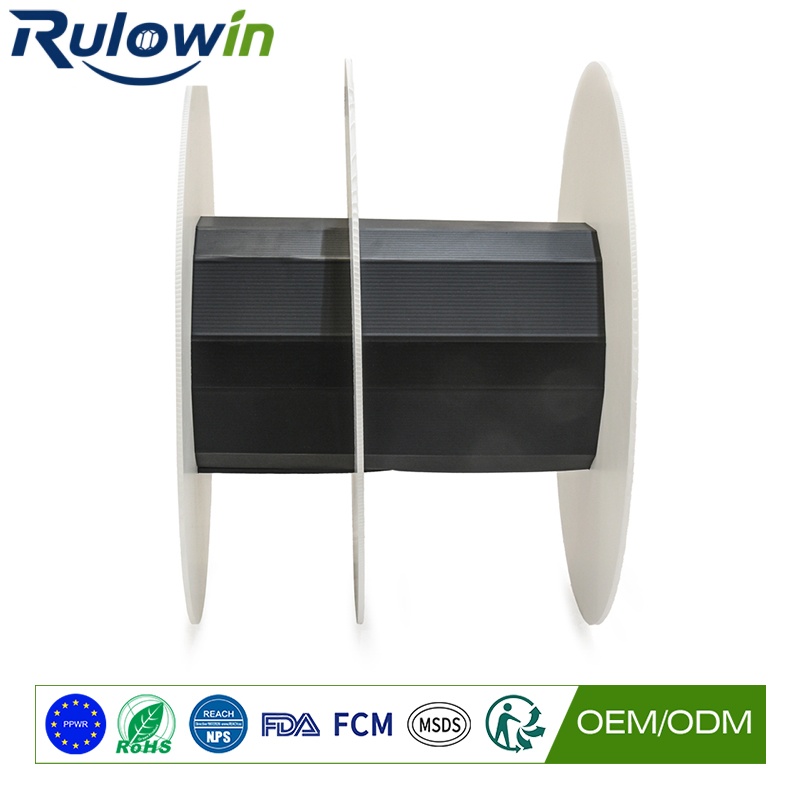
People negotiate spool price on quantity and material and wonder why the quote does not move much. Those are real levers, but several larger ones sit in decisions that were made earlier or by somebody else.
Listed roughly by how much they tend to move a quote.
1. Quantity per order
The obvious one, because setup cost is largely fixed whether you make fifty or five hundred. The whole discussion of tooling and minimum quantities in our tooling article flows from this. Ask what the price curve looks like rather than accepting one tier.
2. Standard versus custom dimensions
The largest hidden cost in most quotes. Every dimension that has to be set up rather than already exists adds setup time, tooling modification and inspection. Two adjacent sizes may cost surprisingly differently if one is a standard and one is not.
Worth asking: what is closest to this that you already make?
3. Material grade
UV stabilisation, antistatic additives, colourants and copolymer versus homopolymer all move the number, sometimes substantially. Specifying a grade you do not need is the purest waste in this list — see the honest treatment in our article on antistatic spools.
4. Tolerances
Deserves mentioning in any list like this. Every tightened dimension adds inspection and scrap. Our tolerance article covers which ones earn their cost; the summary is that most drawings hold several times more than necessary.
5. Colour
Natural PP is cheapest. Anything else is a colourant, and small quantities of an unusual colour mean either a surcharge or a minimum batch of masterbatch that dwarfs your order. If colour is for identification rather than appearance, ask which colours are standard.
6. Marking
Discussed in our markings article — added largely as an afterthought, priced like a significant process step. A printing setup is a setup cost like any other, so batching it matters.
7. Volume and nesting
The assembled-versus-nested decision affects freight enormously, and freight is a large part of landed cost for something bulky and light. See both the nesting article and the discussion of weight and freight.
8. Lead time
Short lead times cost money, usually through expedited production rather than through expedited freight. If your real requirement is longer than the lead time you asked for, saying so gets you a lower price for nothing.
9. Packing specification
Standard palletised and wrapped, or specified to death. Export packing, individual wrapping, returnable pallets — each adds cost, some of which you genuinely need.
10. Order regularity
A predictable, repeating order is cheaper to make than an identical irregular one. Suppliers plan around regular demand; unpredictable demand carries its own premium. This is invisible in unit price and real in it.
The two that are not levers but get negotiated anyway
Material substitution to something cheaper without asking. If a quote comes back unexpectedly low, check whether the specification survived. This is one of the things that first-article inspection catches.
Delivery terms. Ex-works versus delivered is not a discount, it is a transfer of cost and risk. Worth noting that comparing an ex-works quote with a delivered one without adjusting is how a 15% imaginary saving gets reported.
How to use this list
Before asking for a quote, go through and note which of these you actually need and which are inherited from a drawing nobody has revisited. Ask the supplier which are driving cost — that question costs nothing and tends to get a straight answer.
The single highest-yield conversation is usually item 2: whether something standard already exists close to what you asked for. It is worth asking every time.
What this leaves out
Cost of ownership, which for a returnable is usually larger than purchase price. Our article on cost per trip is the fuller version, and the honest conclusion there is the same as here — the cheap unit price is not necessarily the cheap outcome.
We will tell you which items apply to our hollow board spools for your specification, including when we think you are paying for something that does nothing for you.