
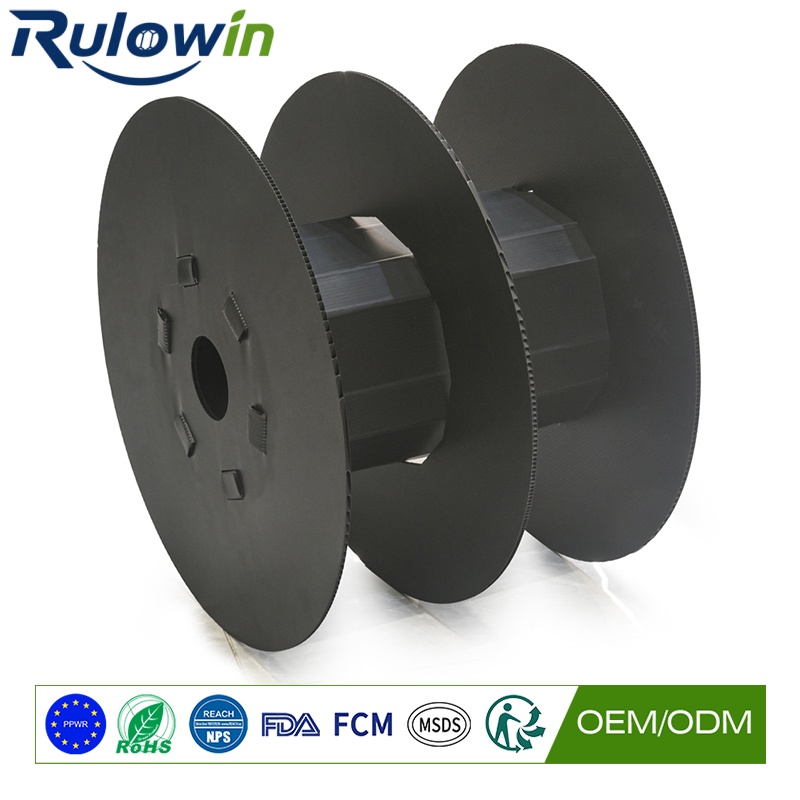
Glass fibre roving behaves like nothing else commonly spooled. It is light, abrasive, produces dust that gets into everything, and loses properties when individual filaments break. Spools for it have their own small set of requirements.
Why it is awkward
- Abrasion. Glass fibre is harder than most things it touches. It will polish a core, wear a flange, and slowly abrade anything it rubs against over a long wind.
- Filament breakage. Roving is many filaments. Rubbing breaks some, and broken filaments change how it feeds and how it wets out downstream.
- Dust. Broken filaments produce fine glass dust. It gets into bearings, into the bore, onto everything.
- Sizing sensitivity. The coating applied to roving matters for downstream processing, and anything that abrades it matters too.
- Static. Roving generates charge readily and attracts its own dust.
Core and flange surfaces
They need to be smooth, and they need to stay smooth. This is a different requirement from hygiene or appearance — it is about the product dragging across a surface at every wrap.
Wear here is cumulative and gradual, which means:
- Expect reduced core life relative to metallic product
- Inspect core surfaces on a schedule rather than waiting for something to go wrong
- Retire cores once their surface has degraded, even if they look structurally fine
That last point matters. The failure is not that the spool breaks, it is that the surface stops being smooth and quietly starts damaging product.
Flange clearance
Product rubbing against the flange is worse here than almost anywhere — it is both abrasion damage and filament breakage together. Generous clearance and nothing protruding on the flange face. The mechanisms described in our edge marks article apply, but the consequences include dust generation that then affects everything else.
Dust management
This is the operational issue people underestimate. Glass dust:
- Contaminates the bore and accelerates its wear — see the general discussion at bore wear
- Gets between spool layers if they are stacked
- Creates a handling hygiene issue for operators
Practical responses: cover spools in storage, clean bores as part of the return routine, and do not store clean and dusty products in the same area.
Tension
Lower than most people assume. Roving does not need much tension to wind well, and excess tension increases both filament breakage and compression of the pack. But too little and the pack is unstable — the same balancing act described generally in our article on traverse and winding behaviour.
Static again
Worth taking seriously here. Roving generates charge readily, and static makes it cling, misbehave at payoff, and collect dust onto itself. Whether an antistatic construction is justified depends on your environment and how much trouble you are having — discussed in our article on conductive and antistatic spools.
Where hollow board fits
Reasonably well. A smooth flange face with no loose fibres, nothing to splinter, low weight for return freight. Two cautions we would raise ourselves:
- Surface wear is real. If you expect very long service with highly abrasive product, ask us honestly what to expect rather than assuming a plastic core lasts indefinitely in this duty.
- Dust in the construction. Hollow board has internal channels. If the product containing or cleaning behaviour matters to you, ask about edge sealing — the same issue discussed in our piece on rim reinforcement.
What to tell a supplier
Product type and whether it is sized, your dust situation, whether static is causing trouble, and what the payoff looks like. With that we can say sensibly whether our hollow board spools fit, and what construction we would suggest.