
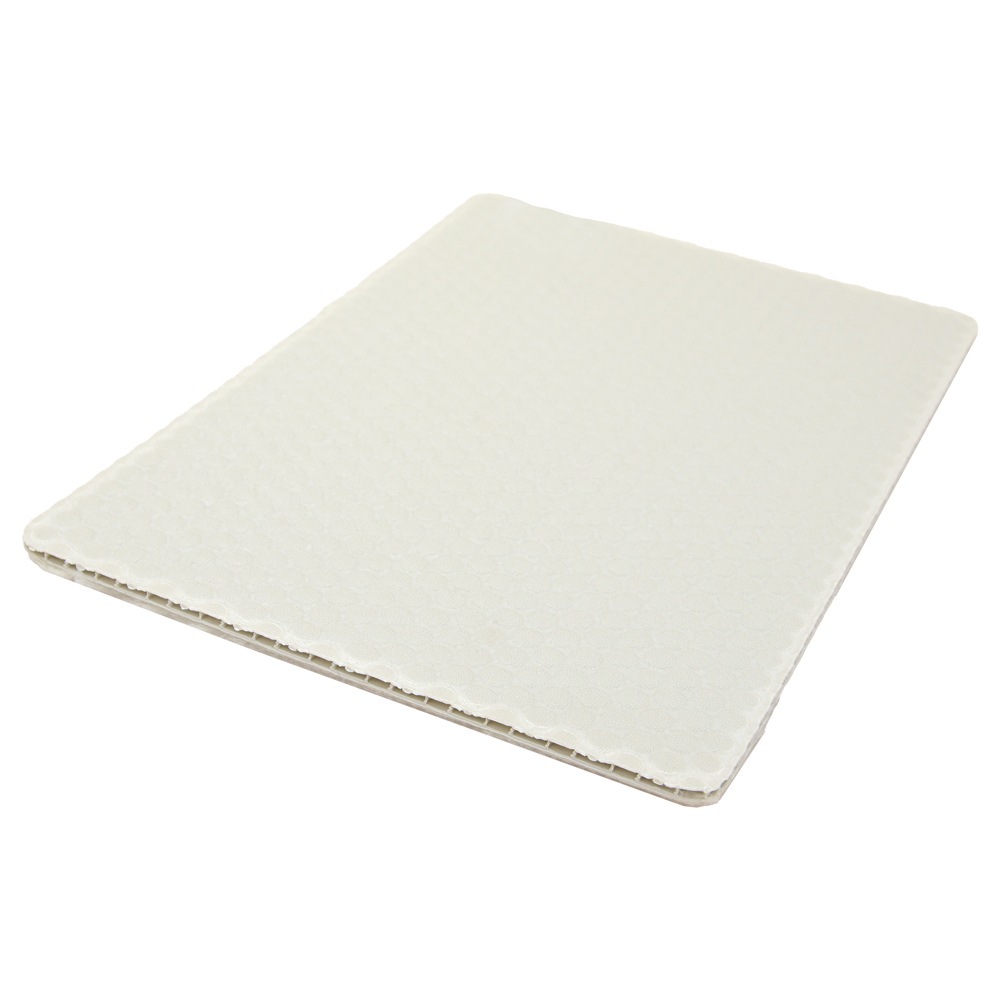
Suppliers of reusable packaging are not usually in the habit of recommending cardboard. That is a shame, because the honest answer to “should we switch this part to plastic?” is sometimes no, and a buyer who hears that from you is far more likely to trust the rest of what you say.
We make and sell polypropylene sheet, so we have an interest. But the switch only pays off under a specific set of conditions, and pretending otherwise just moves the cost somewhere less visible. Here are the places where fibre still wins.
One-way shipments with no return path
The economics of reusable packaging are entirely dependent on getting the packaging back. A layer pad that leaves the factory on a pallet and ends up in a customer’s waste baler has the material cost of plastic with none of the amortisation. If there is no established reverse flow — no backhaul, no pooled system, no captive fleet — single-use fibre is cheaper and honestly greener, because the recycled-content stream for paperboard is mature and the plastic alternative ends up incinerated or landfilled anyway.
This is the first question to ask before any conversion project: not “how many trips will the plastic survive” but “how many trips will it actually make”. The gap between those two numbers kills more reusable packaging business cases than material performance ever does.
Short runs with changing dimensions
Die-cutting plastic sheet needs tooling. It is not expensive at volume, but for a product that changes dimensions every few months, or a project with a two-week window, the tooling and setup time dominate. Corrugated board can be cut on demand from a digital cutter, adjusted between batches at no cost, and ordered in quantities that match the run.
If your SKU count is high and your volumes per SKU are low, plastic’s durability advantage never gets the trip count it needs to pay for itself. Standardising on a few reusable sizes across many SKUs is the usual fix — but that is a redesign project, not a material swap, and it should be scoped as one.
Applications that need to breathe or absorb
Polypropylene does not absorb water. Usually that is the entire point. In a handful of cases it is the problem.
Fresh produce with high respiration rates, chilled shipments where condensation pools in the bottom of a tote, and any load that arrives wet can all end up sitting in free water inside an impermeable tray. Fibre wicks some of it and, crucially, fails visibly when it is saturated — a warehouse operator sees the soft box and pulls it. A plastic tray holding the same water looks fine and the product quietly spoils.
The plastic answer is drainage and ventilation design, and it works well when it is designed in rather than added afterwards. Our produce boxes are vented on the side walls and base for exactly this reason. But if you are moving a wet load in a design that was never engineered for drainage, cardboard is genuinely the safer material.
Where the balance tips clearly to plastic
Three conditions together almost always justify the switch, and they tend to appear as a set:
- A closed or semi-closed loop — captive fleet, regular backhaul, or a customer who returns empties on the same lane
- A wet, oily or abrasive environment where fibre fails in one or two trips
- A load case where dimensional stability matters, such as automated handling or robotic picking
Automated handling is the one people underestimate. Cardboard that has been through a humid container changes dimensions enough to jam a conveyor or defeat a gripper. Plastic holds its tolerance. If the line is automated, material consistency is worth more than the unit price difference.
Running the comparison properly
Compare on cost per trip, not cost per unit. Take the plastic unit price, divide by realistic trip count — not best case, the number your returns data supports — then add washing, repair and the administrative cost of tracking the fleet. Compare that against the fibre unit price multiplied by the number of times you would have to buy it over the same period.
Sometimes plastic wins by a wide margin. Sometimes it loses, and it is better to find that out on a spreadsheet than after a container of trays has landed. If you want a second opinion on a specific part, send us the load case and the lane and we will tell you which way it falls — including when the answer is to keep buying cardboard.