
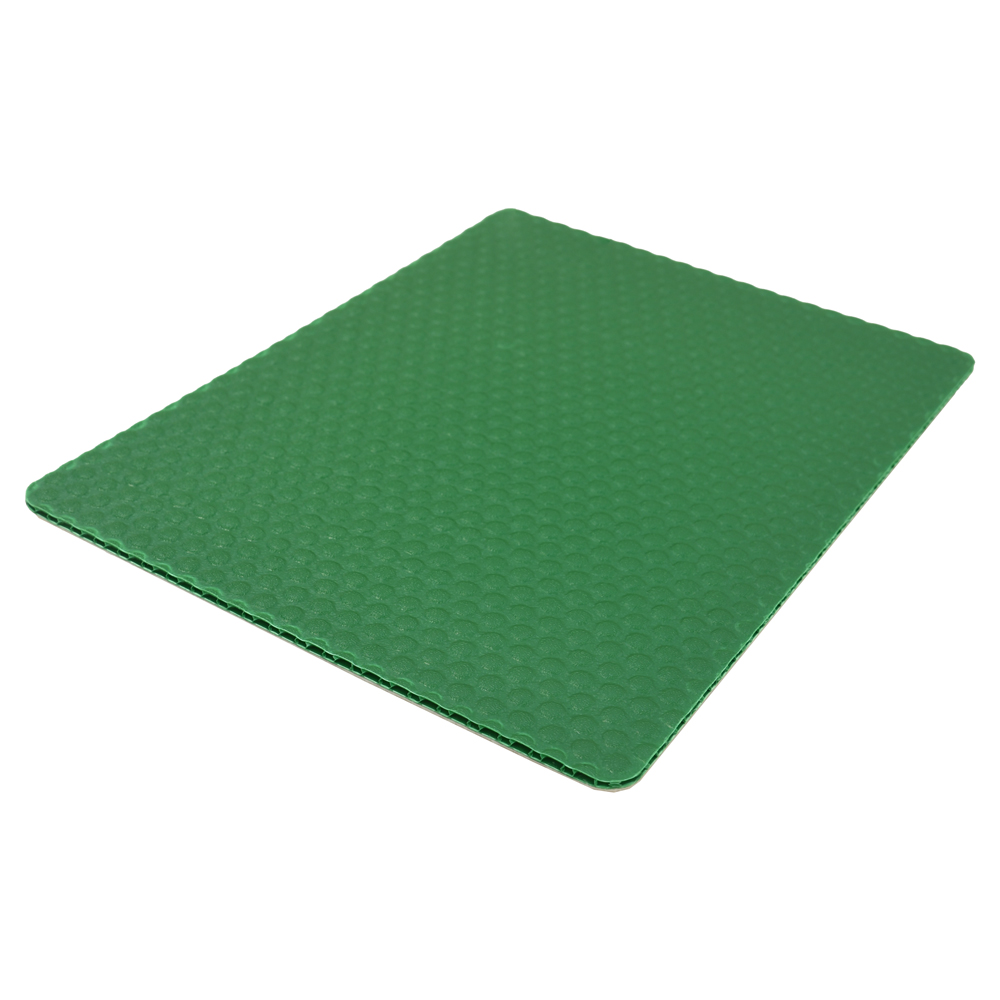
A honeycomb panel that has been in service for a year rarely fails in the middle. It fails at the perimeter — a corner that has gone soft, an edge where the skins have lifted, a strip along one side where the cells have packed with grit and started to crush. The core is almost always fine.
This makes sense once you look at how the panel is built. A PP honeycomb panel is two relatively thin skins bonded to a cell structure. Load travels through the cell walls, which are oriented perpendicular to the skins, and that arrangement is remarkably efficient in compression. But the perimeter exposes the open ends of every cell. It is the one part of the panel where the structure has no skins above and below it, and it is the part that meets the world first.
Three failure modes, three different causes
Crushing at an unsupported edge
If a panel rests on a rack beam with the edge overhanging, the load concentrates on the first few rows of cells rather than distributing through the whole area. Those cells buckle, and once they have buckled the skins above them lose support and dent. The damage creeps inward with every trip.
The fix is almost always geometric rather than material: make sure the support spans the full panel, or add a perimeter frame. Increasing core density to compensate is expensive and only delays the same failure.
Ingress — water, oil, swarf
Open cells are channels. On a wash line, water goes in and does not come out quickly. In a machining environment, swarf and coolant do the same. The consequences are boring but real: added weight, contamination between trips, and in food or electronics applications a hygiene problem that no amount of surface wiping solves.
Sealing the perimeter with an extruded edge profile, a welded lip, or a bonded tape closes the cells and turns the panel into something you can actually wash. Which one to use depends on the cleaning method — a profile survives a high-pressure wash; a tape generally does not.
Delamination starting at a corner
When skins separate it usually starts at a corner and runs along an edge. The common causes are a bond line that was never designed for repeated thermal cycling, and mechanical peeling from a panel being dragged rather than lifted. Cold-chain and outdoor applications see more of this because the differential expansion between skin and core does the work over hundreds of cycles.
Edge sealing helps here too, not because it stops the bond failing but because it takes the peeling load off the bond line.
Choosing an edge treatment
There are four options in common use, and the right one depends far more on the cleaning and handling regime than on the panel itself:
- Open edge. Cheapest and lightest. Acceptable for dry, indoor, low-abuse use — dunnage that stays inside one plant, pallet top sheets, signage.
- Taped or film-sealed edge. Low cost, quick to apply, keeps out dust and light splashes. Not durable under pressure washing or abrasion. Fine for one-piece-flow packaging with a modest trip target.
- Extruded PVC or PP edge profile. Mechanically robust, replaces well, and the standard choice for reusable dunnage in automotive. Adds weight at the perimeter, which is worth modelling if the panel is handled by a robot.
- Welded or folded closed edge. The skins are folded or welded together to close the cells. Cleanest for wash-down and food-contact environments, and the most expensive.
What to put on the drawing
Most edge problems trace back to a drawing that simply did not mention the edge. Three lines are usually enough:
- Edge treatment type, and whether it applies to all four sides or only two
- Corner treatment — a sealed edge with open corners still lets water in
- Cleaning method and temperature the panel must survive
That third point decides more than the other two. A panel destined for a 60°C wash cycle with a detergent needs a welded or profiled edge and a bond line rated for it. A panel that will spend its life dry inside a tier-one plant can stay open and the money is better spent on core density.
A note on repairability
Whichever treatment you choose, ask how it is repaired. Profiles can be cut off and replaced in minutes with a heat gun. Welded edges generally cannot. If your fleet is large and your trip target is in the hundreds, the ability to repair an edge locally is worth more over the life of the asset than a small difference in initial robustness.
Edges are where the panel meets the handling system, the wash line and the rack. Specifying them properly is unglamorous work that determines whether a panel reaches its trip target or gets scrapped at forty.