
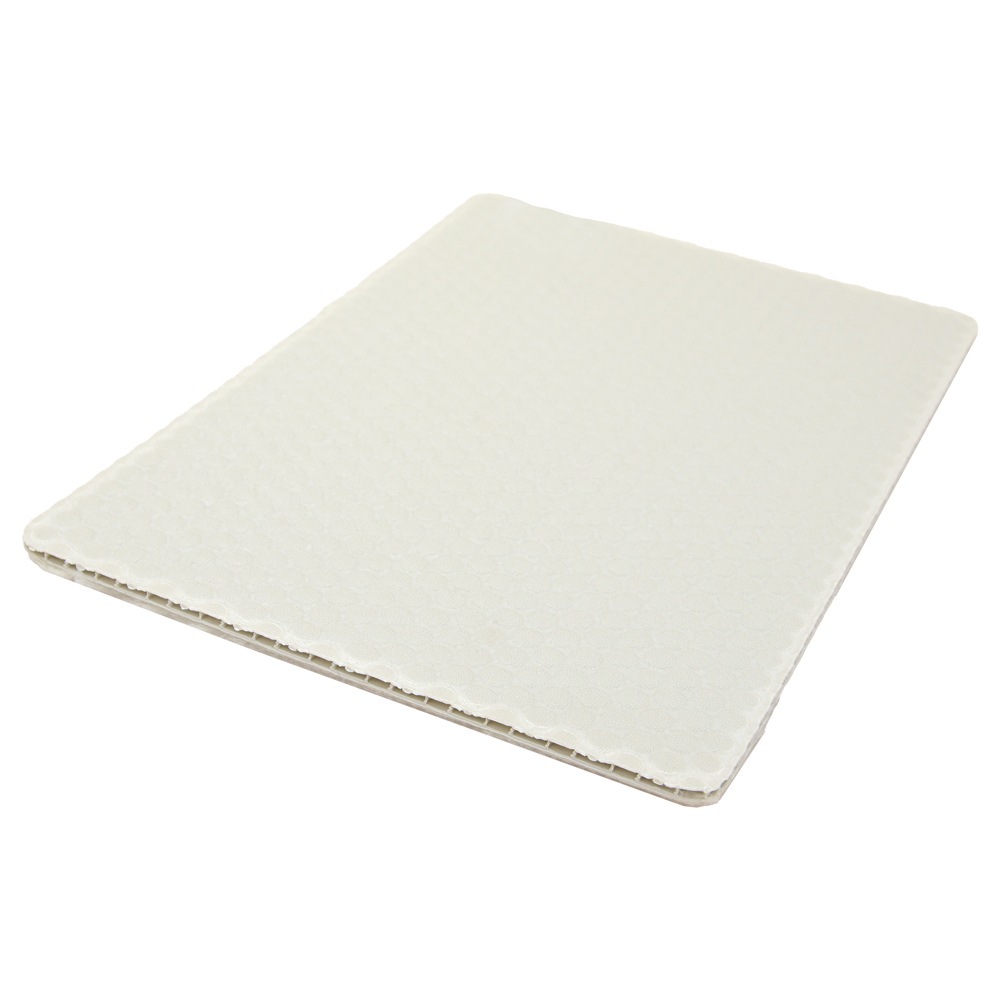
The enquiry usually arrives as a single line: “Need 700 gsm PP corrugated sheet, quote please.” It is a reasonable opening from someone who has bought paperboard for years, where grammage maps fairly cleanly onto stiffness and price. On polypropylene it maps onto almost nothing. Two sheets can both weigh 700 grams per square metre, both be called 4 mm, and behave so differently on a pallet that one survives a year of closed-loop use while the other creases on the second trip.
That gap is not a quality problem. It is a specification problem. GSM is a weight measurement, and weight is an outcome of three other decisions — sheet thickness, flute geometry, and what went into the resin. If you specify the outcome and leave the causes open, you will get quotes that look comparable and perform nothing alike.
What GSM really measures
Grammage is simply mass per unit area. For an extruded PP corrugated sheet it is a function of how much polymer sits in the two skins and the flutes between them, plus any mineral filler or masterbatch that has been added. Nothing about that number tells you where the material was placed.
Placement is what matters mechanically. A sheet with thick skins and widely spaced flutes resists puncture and surface wear well but can buckle in compression along the flute direction. A sheet with the same weight distributed into more, finer flutes resists crushing but has thinner skins that mark more easily under point loads. Same number on the datasheet, different failure mode in service.
Thickness is the number that moves first
Most general-purpose corrugated PP falls somewhere between 2 mm and 12 mm, with 3 mm, 4 mm and 5 mm doing the bulk of industrial work. In practice thickness drives bending stiffness far more sharply than grammage does, because stiffness scales with the square of the distance between the skins. Doubling thickness buys you much more rigidity than adding 20% more resin ever will.
This is why the cheapest way to solve a sagging layer pad is often to move up one thickness step rather than up two GSM steps — less material, better result, and usually a lower unit price than people expect.
Flute direction: the detail that gets missed on drawings
Corrugated sheet is anisotropic. The flutes run in one direction, and bending across them is dramatically easier than bending along them. A box panel cut with the flutes vertical will bulge outward under stacked load; the same panel rotated 90 degrees holds its shape.
On a die-cut blank this is fixed at the tooling stage and effectively invisible afterwards. If you have ever received a batch of bins that all bowed slightly at the same side, this is usually why. Put flute direction explicitly on the drawing, and require the converter to confirm it before tooling. It costs one email and saves a container of rejects.
Additives change the sheet more than GSM does
Four treatments turn up repeatedly in industrial specifications, and each one shifts cost, lead time and mechanical behaviour:
- UV stabilisation. Essential for anything stored outdoors or shipped in open-top containers. Without it, PP chalks and embrittles under sunlight; the sheet may look fine for a season and then crack along a fold.
- Antistatic / conductive masterbatch. Needed for electronics handling, and worth specifying by surface resistivity rather than by name — see our note on reading ESD spec sheets.
- Flame retardant packages. Common in construction and rail interiors. Ask which standard the package was tested against, because “FR” on its own is not a claim.
- Colour masterbatch. Mostly cosmetic, but dark colours absorb more heat in outdoor storage, and carbon black does contribute some UV resistance.
All four add to the grammage without adding much strength. That is another reason GSM is a poor comparator across suppliers: a black UV-stabilised FR sheet and a natural untreated sheet at the same weight are not the same product at all.
What to put in the spec instead
A workable enquiry gives five things, not one:
- Nominal thickness and an acceptable tolerance band
- Grammage range rather than a fixed figure
- Flute direction relative to the finished part
- Surface treatment and, where relevant, the resistivity or flammability standard it must meet
- The job the sheet has to do — stacking height, span, number of trips, cleaning method
That last line is the one buyers leave out and the one that most changes the quote. A sheet used once as a pallet liner and a sheet expected to survive eighty trips through a wash line are different products, and no grammage figure will reconcile them.
When corrugated sheet is the wrong answer
It is worth saying plainly: if the load is concentrated rather than distributed — a heavy metal component resting on small feet, or a rack with point supports — twin-wall sheet will creep and eventually dent where a PP honeycomb panel would shrug it off. Honeycomb carries load through a continuous cell structure instead of parallel flutes, which is exactly why it costs more per square metre. Paying for that only makes sense where the load case demands it.
Specifying well is mostly about admitting which load case you actually have. Once that is clear, GSM becomes a reference point for cost control rather than the thing the whole design hangs on.