
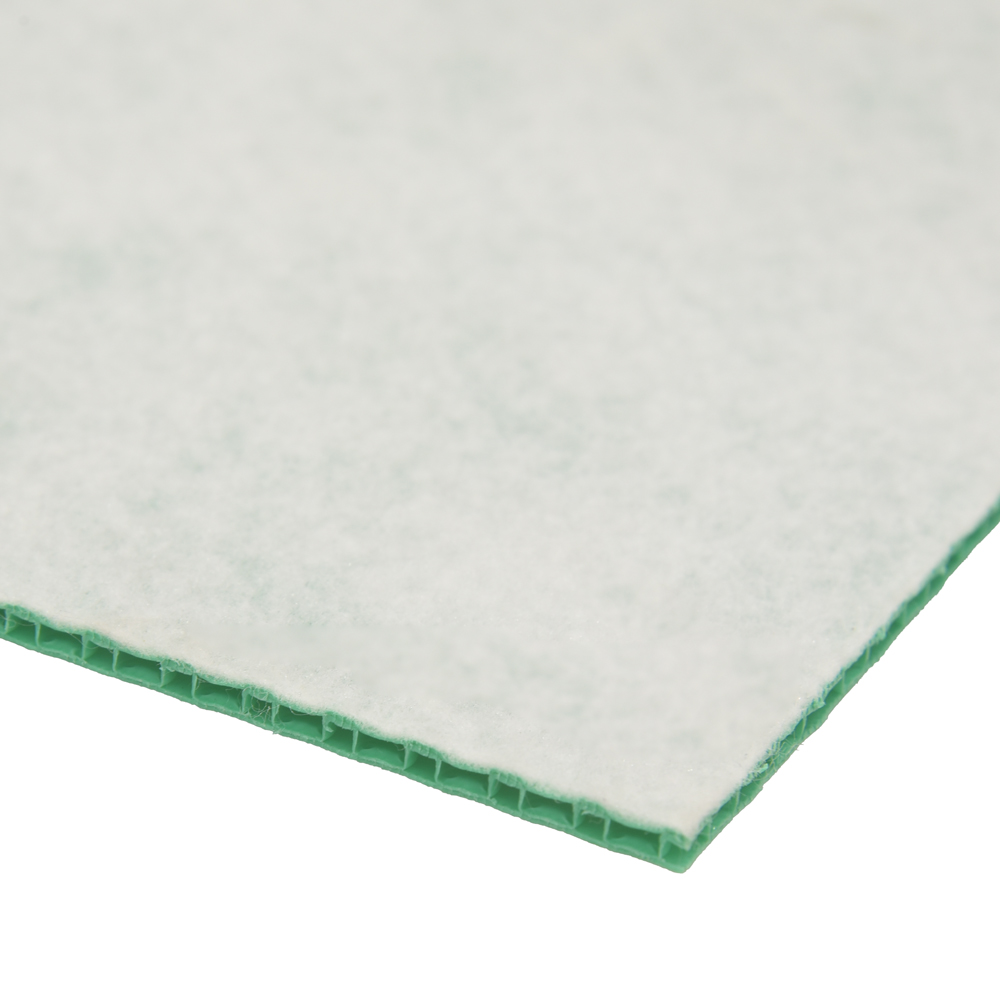
Cut a honeycomb panel and the cut face is a row of open cells. Left like that, the edge does three damaging things over a programme: it takes in water, it holds grit, and the top and bottom skins start to separate from the core under repeated traffic. A sealed edge costs little at manufacture and is the single biggest difference between a panel that survives five phases and one that survives one.
What an open edge does
Capillary action draws standing water into the cells, and once inside it does not dry quickly because there is no airflow through the core. A panel that has taken in water at the edge is heavier, it stains whatever it is laid on, and in freezing conditions the trapped water expands and splits the skins apart. Separately, grit packed into open cells is hard, so the edge becomes an abrasive rather than a bumper.
Delamination starts at the edge
Almost every panel that comes back with the skin lifting from the core started at a cut edge. Traffic running over the edge peels the skin back a little each time, and once there is a lip the lip catches the next wheel and peels further. It is progressive and it is not repairable once it has run more than a short distance. Sealing the edge stops the mechanism rather than the symptom.
How edges get sealed
Three common ways. A welded edge, where the skins are fused together over the core at manufacture – the most durable and the one to specify on panels that will be washed repeatedly. An extruded edge trim fitted after cutting – good, and the practical answer for site-cut panels. Or an edge tape, which is cheapest, works fine on dry internal jobs and lifts if the panel is pressure washed. Each has a place, and the right question is how many wash cycles the panel will see.
Where sealing is unnecessary
An edge that butts against a wall, a column or another panel in a dry internal area sees no water and no traffic and does not need sealing. Sealing every edge on every panel is a real cost on a large order for no benefit in those positions. The sensible specification is: seal exposed edges in traffic routes and wet areas, leave concealed edges open. Say so on the order and it will be priced accordingly.
What to check on delivery
Run a hand along the edges. A properly welded edge is continuous and slightly rounded; a poor one is intermittent and has visible gaps where cells are open. On a first order from any supplier, cut one panel in half and look at the edge quality and at how well the skin is bonded to the core – that single check tells you more about the panel than any datasheet. Incoming checks are listed in incoming inspection for PP honeycomb panels.
How to tell a welded edge from a taped one
A welded edge is the same material as the panel, continuous and slightly proud. A taped edge has a visible line and can be lifted at the corner with a fingernail. Both are legitimate and they cost different amounts; the point is knowing which one is being bought, because a taped edge will not survive repeated pressure washing and a welded one will.
What we can do
We make honeycomb panels with welded or trimmed edges, cut to size so the exposed edges are the ones we seal and the concealed ones are not. Tell us the layout and whether the panels will be washed, and we will specify the edge treatment accordingly rather than sealing everything and charging for it.