
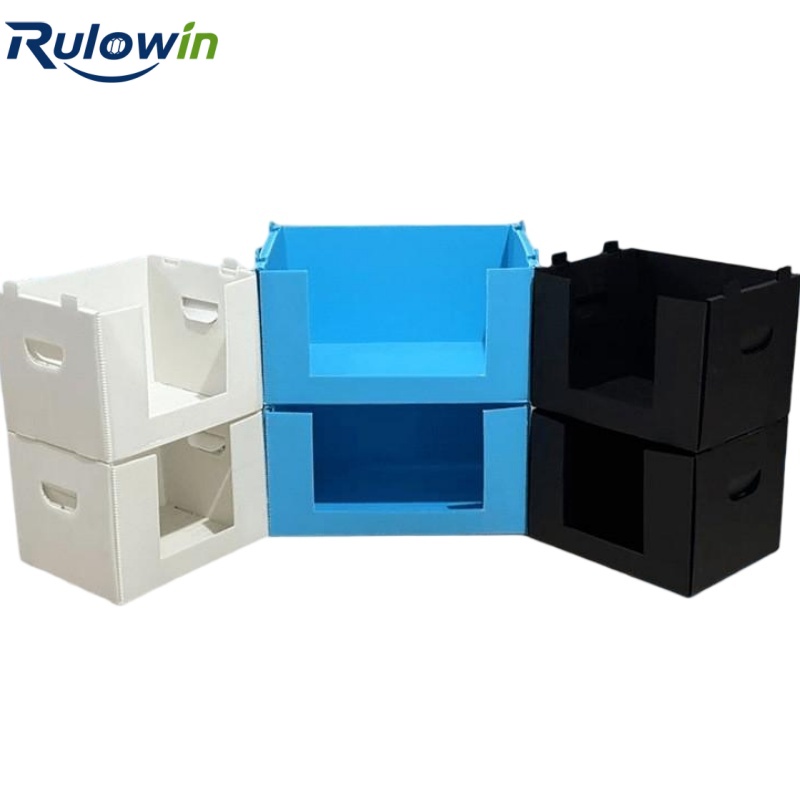
A split at the corner of a picking box is the most common structural failure in returnable packaging, and the response is usually to specify thicker material. That fixes one of the five causes and does nothing for the other four, which is why thicker trays keep splitting.
Cause one: the corner is folded, not joined
A folded corner relies on the material’s fatigue life at the fold. It will eventually crack – this is not a defect, it is the design reaching its intended life. If the corner is folded and heavily cycled, the fix is a joined corner: welded, riveted or mechanically reinforced.
Cause two: the fold line is in the wrong place
If the crease or fold runs through a stress concentration – near a handle root, across a load path, or too close to another fold – cracks appear early and consistently in the same location. The fix is moving the line, not thickening the material. Consistency of location is the diagnostic clue: random failures suggest loading, identical failures suggest geometry.
Cause three: impact at low temperature
Cold polypropylene is less tolerant of impact. Trays that split in a chilled area after handling that never caused trouble at ambient are experiencing this. Look at when failures cluster – seasonally or by shift – which distinguishes it clearly from geometry problems. We covered the mechanism in freezing duty.
Cause four: chemical exposure
Environmental stress cracking needs three things together: a susceptible material, a stress, and a compatible agent. Wipe-down solvents, certain oils and some cleaning agents are the usual agents, and the tray corner is where stress concentrates. Cracks appear without much loading, which is the giveaway – the tray has not been abused but it has cracked anyway.
Cause five: overloading beyond the design
Real, and often overlooked because loads creep upward over time. A tray specified for eight kilograms now regularly carries fourteen because the product mix changed. Check actual weights before assuming anything else – it takes five minutes and rules out the most mundane explanation.
Reading the fracture surface
A fatigue crack is smooth and often shows progressive arrest marks. An overload tear is rough and fibrous. A stress-crack is often multiple, fine and straight, with little deformation. Looking at the break tells you more than looking at the tray, and it costs nothing.
Decide repair or redesign
Repair a tray if the cause was a one-off overload. Redesign if the cause is geometry, temperature or chemistry – repairing gets you the same failure in the same place in a few weeks. And where the cause is that the fold has simply reached its fatigue life, accept it as a consumable and plan replacement rather than fighting it.
Keeping the evidence
Photograph failures before repair or disposal, from two angles, with a note of where and when. After ten examples the pattern is almost always obvious, and the pattern is what identifies the cause – random locations point at loading, identical locations point at geometry.
Keep the broken parts too, at least for a while. A shelf of failed corners is more persuasive than any report when discussing a specification change, and it costs nothing beyond the space.
What we can do
We build corrugated picking boxes with joined corners where cycling warrants it, and we will ask how many trips you expect before quoting. Send a photo of the split from two angles and we will usually be able to tell you which of the five it is – and when it is a geometry problem on a competitor’s part, we will say that too.