
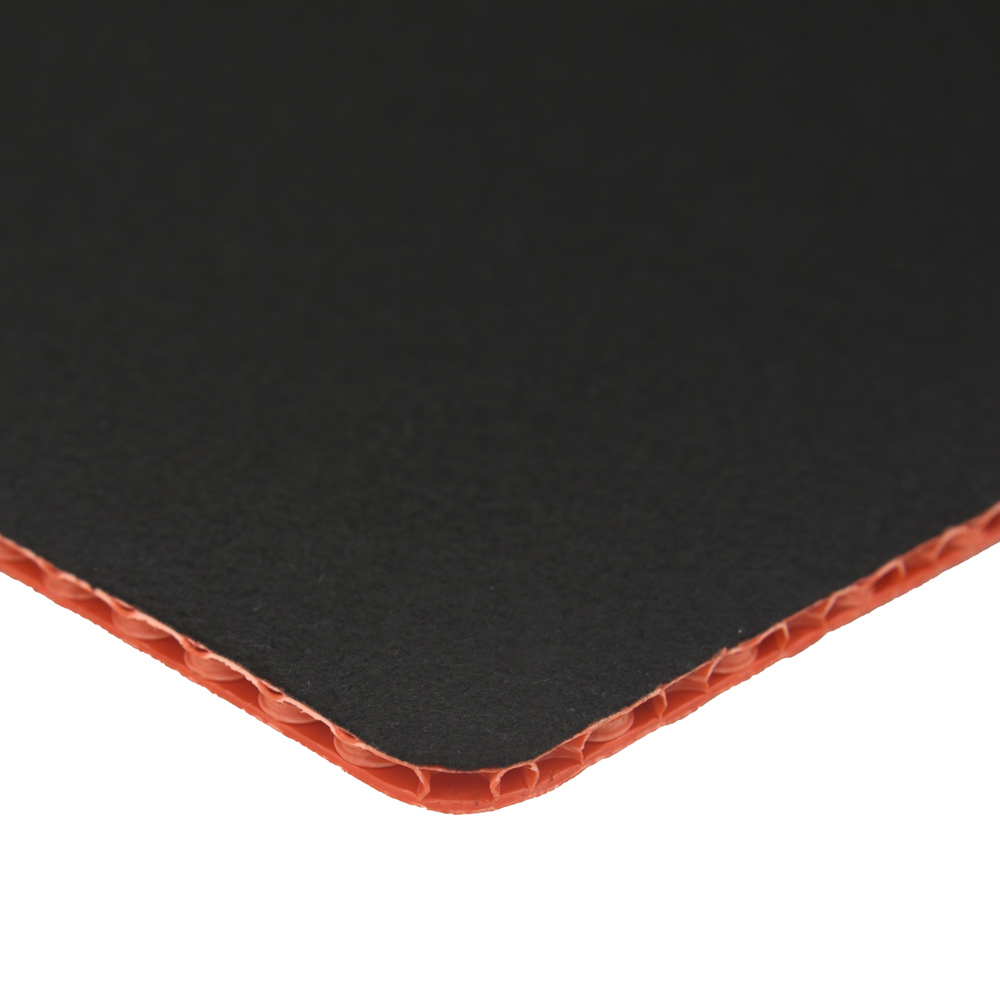
A flat panel that has gone to a shallow dish is one of the two complaints we hear most about honeycomb. The other is crushing, which is easy to tell apart – crushing is local and usually has an obvious cause. Bowing is global, and it has a short list of causes that are worth separating, because one of them is a specification error and one is a handling error.
Cause one: it is spanning
Honeycomb panels are stiff for their weight because of their depth, not because of their face material. That stiffness only exists where the panel is supported. A panel sitting on a pallet with a gap in the middle – a pallet with missing boards, or a load that only bears on two edges – has its whole span working against it.
The fix is either support or thickness. If the load has to span a gap, the panel needs to be thick enough to span it, and that is a calculation we can do from the span and the load. Ordering the same thickness that worked on a fully supported pallet is the usual reason this happens.
Cause two: heat and creep
Polypropylene under sustained load slowly deforms, and the rate rises sharply with temperature. A panel stored loaded in a container in summer, or in a yard in direct sun, will take a set. Unload it and it does not come back. This is creep, and it is not a defect in the panel – it is what the material does.
The tell is that the bow follows the load pattern and the panel was stored loaded and warm. If your panels go out flat and come back curved after a summer in transit, this is your answer, and the fix is a heavier gauge or a shorter dwell under load rather than a different supplier.
Cause three: it was stored flat against a wall
This one is embarrassing because it is free to avoid. A stack of panels leaned against a wall at an angle, or laid flat with weight on one end, will take a curve from its own weight over weeks. Store panels flat on a level surface, or on edge in a rack. Not leaning.
Which one you have
Put the panel on a known flat floor. If it rocks, the bow is a set – heat or storage. If it sits flat and only bows when loaded, it is a spanning problem and the panel itself is fine. That is a two-minute test and it saves replacing panels that are not faulty.
Sometimes the answer is that the panel is genuinely undersized for the job. We wrote about working out what thickness honeycomb panel you need with the actual arithmetic, if you would rather size it properly than buy twice.
Can a bowed panel be flattened?
Sometimes. If the bow is a stored set from heat and there is no delamination or crushing, laying the panel flat under a light distributed load in a warm room for a few days can reduce it. It will not remove it entirely, and the panel will not have its original stiffness.
If the core is crushed anywhere, no – the thickness is gone and loading it will not bring it back. Do not try to flatten a panel with heat. Anything warm enough to make polypropylene pliable is warm enough to destroy the bond between face and core.
What we can do
We supply PP honeycomb panels from light layer sheets up to gauges meant to span. Tell us the span, the load and the storage temperature range and we will size it – and if a cheaper corrugated sheet would do the job, we will say that instead.