
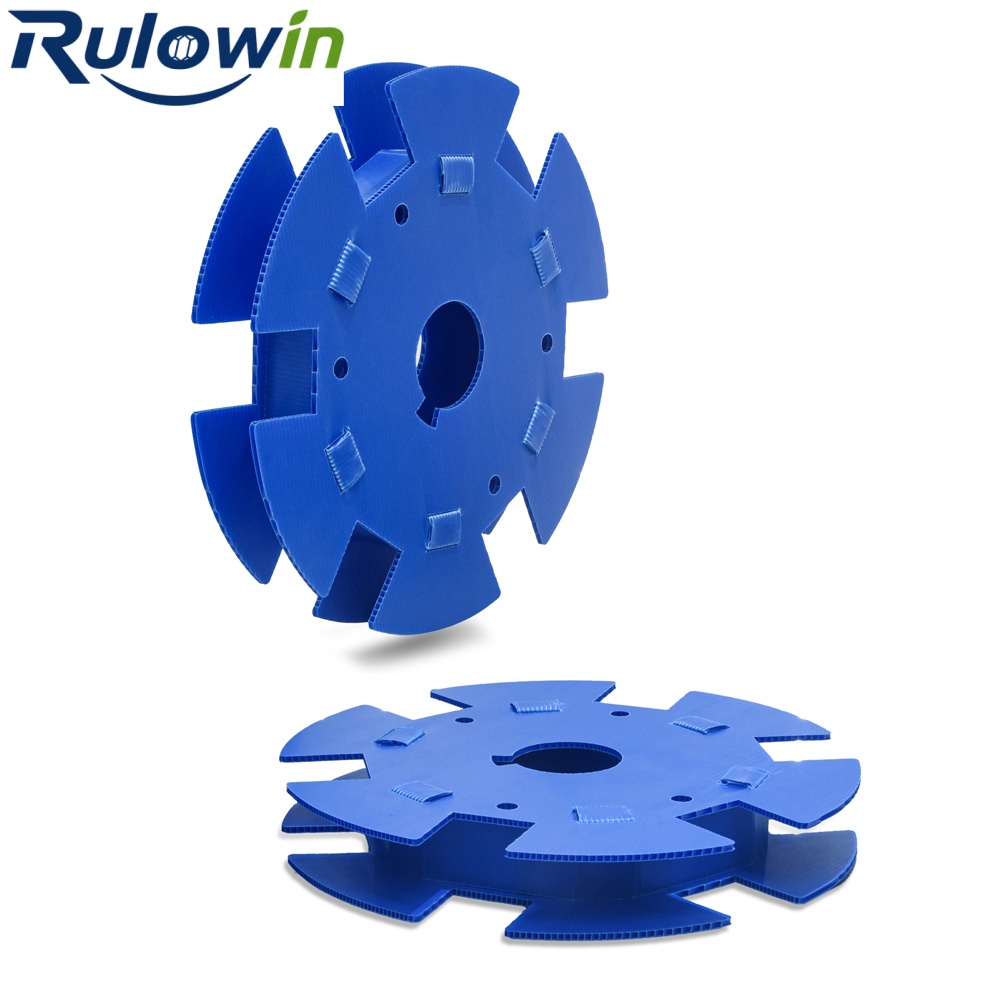
A flange crack that runs outward from the hub is the standard failure mode on a plastic cable reel, and it is not random. The hub is where the flange is geometrically weakest, where the moulding has the most material to cool unevenly, and – most importantly – where the wound cable pushes hardest.
Radial pressure is not uniform
Wound cable presses outward against the flange across its whole face, but the pressure is highest at the innermost wraps. Those wraps are tight, they have the least slack, and they are constrained by everything wound on top of them. As the reel fills, that inner pressure climbs.
So a flange that survives a half-full reel can crack when the same reel is wound to capacity. This is why “it was fine last time” is so common – last time it was not wound as full.
Over-winding and the last few metres
The metres that do the damage are the last ones. If a reel is rated for a certain length at a given cable diameter and you wind past it, the cable starts pressing against the flange near the rim as well, and the flange goes from being loaded in one zone to being loaded everywhere. The crack still starts at the hub, because that is where the section is thinnest, but the cause was at the rim.
If you are reusing reels, check the rating for the cable you are actually putting on, not the cable the reel last carried. A larger-diameter cable fills the same volume in fewer metres, and the reel’s metre rating does not transfer.
Impact, and the cold version
A flange also cracks from a blow – a reel dropped on its edge, or a reel that has fallen off a stack. The difference is visible: an impact crack usually has a single origin point on the outer face and radiates, while a pressure crack tends to start at the hub and follow the radial ribs.
Cold makes both more likely. Reels unloaded outdoors in winter and then handled are more brittle than the same reel at twenty degrees, and the handling practices that are fine in summer start breaking reels in January.
Checking before it fails in service
Look at the hub-to-flange fillet before each reuse. Fine hairlines there are the warning. A reel with visible hairlines at the hub should not be reloaded to capacity; it is fine for a light load and it is not fine for cable that will be tensioned. On the subject of reuse, we have a separate piece on whether plastic cable reels can be reused at all.
Winding tension is the other half
Radial pressure comes from how tightly the cable is wound, not only from how much of it there is. A reel wound at high tension exerts more outward force on the flange than the same length wound slack, and the difference is larger than most people expect.
If you are seeing flange cracks and the length is within rating, look at the winding tension before you look at the reel. Reducing it slightly, or using a controlled-tension winder rather than a fixed-speed one, often resolves cracks that looked like a reel defect.
What we can do
We supply industrial fiber optic cable reels with the hub section reinforced for the fill you specify. Tell us the cable diameter, the length per reel and the maximum tension during winding, and we will size the flange. If you are currently over-winding an existing reel, the honest answer is usually a larger flange, not a stronger one.