
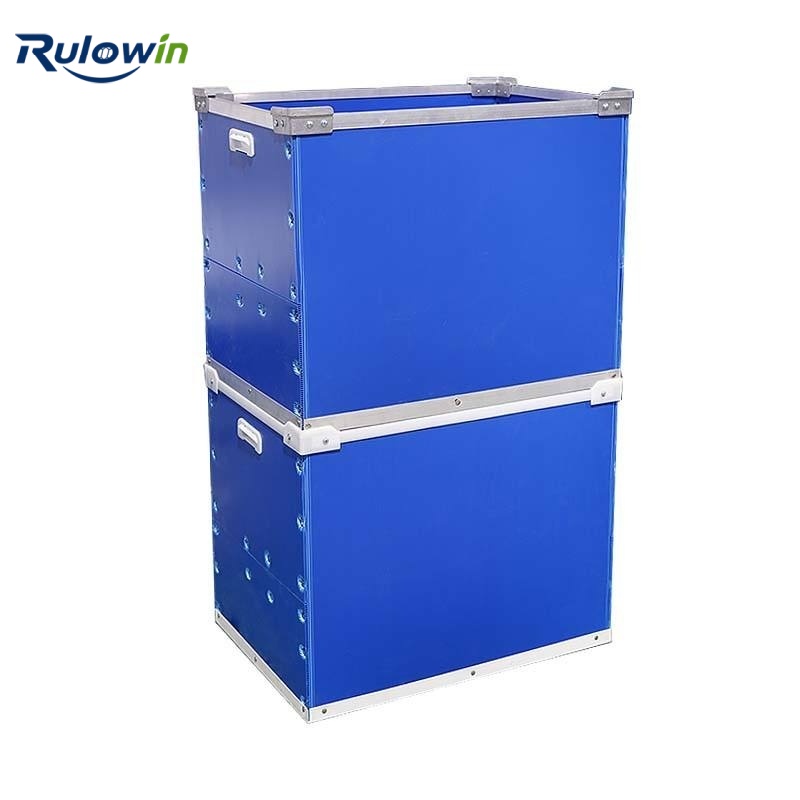
Strapping a pallet of reusable boxes looks like a matter of tightening a band around a load. It is closer to a structural decision. The band applies a large point load wherever it turns a corner, and where it turns that corner determines whether it holds the load together or folds the box.
What the strap is resisting
Two forces. The tendency of the load to spread outwards under its own weight and vibration, and the sideways acceleration in braking and cornering. Both are resisted most effectively at the vertical edges of the load, which is why straps go round corners rather than across faces.
Where it goes wrong
The usual failure is a strap positioned over an unsupported span of wall – across the middle of a long side, or over a gap between boxes. The band then pulls that panel inward, and the load arrives with the strap tight and the box deformed. Where the strap sits over a corner, the wall is braced by the adjacent wall and the load stays square.
Corner protection
Between a steel or polyester band under tension and a corrugated PP corner, the band wins. Corner posts spread the load along the edge rather than into one point and are cheap. Their absence is the most common cause of strap damage on reusable boxes, and it is almost always a procurement omission rather than a design one.
How many straps, and how tight
Two is normally enough for a standard pallet; three where the load is tall or heavy. Tension should be enough that the band cannot be lifted away from the top box by hand, and no more. Over-tensioned bands on a light load do more damage than an under-tensioned one, and the two look identical on a diagram.
Strapping as part of the loop
In a returnable system, strapping is a consumable that gets cut off and thrown away at the far end. That is the argument for a reusable hood or for designing the box to locate without banding at all. Where banding is needed, the strap path belongs on the packing instruction, not in the discretion of whoever is packing that morning.
Common strap positions and what they do
A band around the load at roughly one third and two thirds of the height contains spreading and holds the layers together. A band over the top secures the lid but does little for the stack. A band passing under the load and over the top is the only arrangement that ties the load to the pallet, which matters where the pallet travels with it.
Where only one band can be used, put it at mid-height over the vertical corners. It contains more of the load than a band at the top and it bears on the strongest part of the box.
What a corner gives you
A vertical edge is where two walls meet, and each wall braces the other. A band bearing there loads both panels in compression, which is the direction corrugated PP handles best. The same band across the middle of a face loads one panel in bending, which is the direction it handles worst.
What we can do
We build PP corrugated turnover boxes with reinforced vertical edges so banding has somewhere to bear, and we will mark the strap path on the drawing. Tell us the load and the securing method in use and we will tell you where it fails. The forces the strap is resisting are described in what braking and cornering do to a stack.