
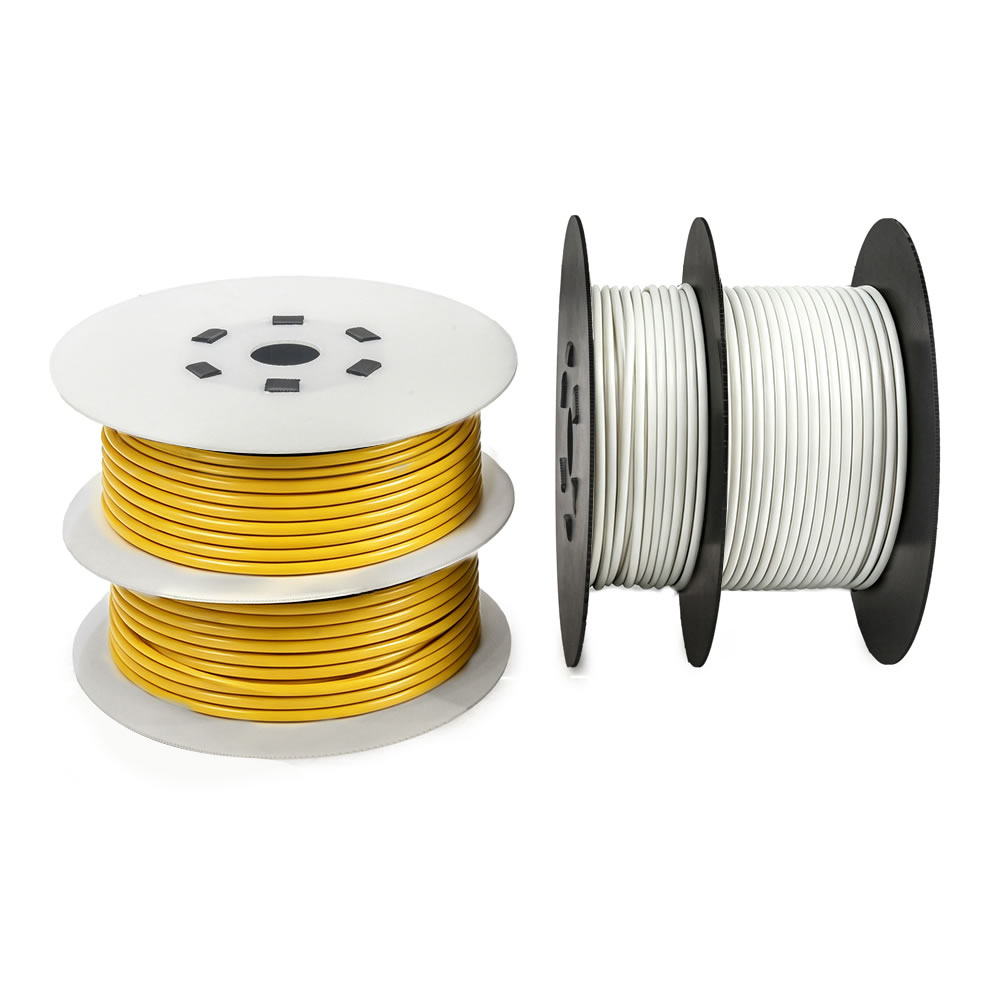
Stick-slip on a payoff is a common complaint and a badly reported one. It shows up as tension variation, as product quality issues, sometimes as an audible squeak, and almost always as suspicion falling on the tension control system. Often the machine is fine and something mechanical is resisting rotation intermittently.
What stick-slip looks like
The spool resists turning, tension builds until it overcomes the resistance, the spool jumps forward, tension collapses, repeat. Depending on frequency this is:
- Audible — squeaking, chirping, grinding
- Visible in the dancer bouncing
- Visible in the product as periodic variation
- Measurable as tension oscillation
Because the symptom is tension oscillation, the first thing adjusted is usually the tension controller, which cannot fix a mechanical cause.
Cause one: the spool is binding on the shaft
The most likely cause. Something is preventing the spool rotating freely:
- Bore too tight or out of round — grips the shaft intermittently rather than continuously
- Shaft damaged — scored, worn, or bent. A bent shaft binds once per revolution, which produces a tell-tale once-per-rev periodicity.
- Dirt or rust between shaft and bore
- Over-clamped — clamped hard enough to distort the bore
Our article on bore fit and wear covers much of this in the context of component life; here the same faults show up as immediate running problems.
Diagnostic: take the spool off, spin it on the shaft by hand with no product. Roughness you can feel is roughness that matters.
Cause two: the spool is rubbing on something
A flange contacting a machine frame, a neighbouring spool, a guide, a guard. It is usually something that got moved and never moved back.
Diagnostic: look for a polished or worn patch on the flange rim or face. Contact leaves evidence, and it is usually obvious once you look for it.
Cause three: it is not seated
A spool that is not square on the shaft will bind once per revolution as it tries to wobble against whatever is holding it. This is easy to mistake for imbalance, which we covered in the balancing article — and the recommended order there applies here too: check seating and shaft condition before assuming anything more exotic.
Cause four: product rather than spool
Sometimes the resistance is at the pack rather than the bearings. Product that has blocked or stuck to itself comes off unevenly, and the resulting pull feels similar to a spool problem. If the squeak or roughness changes as the pack empties, and especially if it changes near the core, suspect the product.
The end-of-spool region is its own set of problems, covered at length in our piece on the last fifty metres.
The squeak itself
Noise is actually useful. A squeak at rotation frequency — once per revolution — means something is wrong at one point, and it is geometric: seating, shaft bend, damaged flange. A continuous grating suggests ongoing contact or contamination. An intermittent chirp suggests stick-slip somewhere in the system.
Operators usually know which it is when asked carefully, and that distinction narrows things faster than measurement does.
What not to do
- Tune out the symptoms. Adjusting the controller to damp a tension oscillation created by a binding bore moves the problem and hides the cause.
- Lubricate indiscriminately. Sometimes correct, sometimes contaminates product, and it treats a symptom.
- Widen the bore “a bit”. This turns a running problem into the permanent fit problem discussed earlier.
Checklist order
Ten minutes, in this sequence: spool off, spin by hand → inspect shaft → check nothing rubs → remount square → run empty → then start looking at anything more complicated.
Most instances resolve at step one or two.
Where the spool is genuinely at fault
Bore dimensional issues and flange geometry that interferes with the machine. Both are things we can address on our hollow board spools if you tell us what the machine interface looks like — and both are far easier to fix at specification than after a thousand spools arrive.