
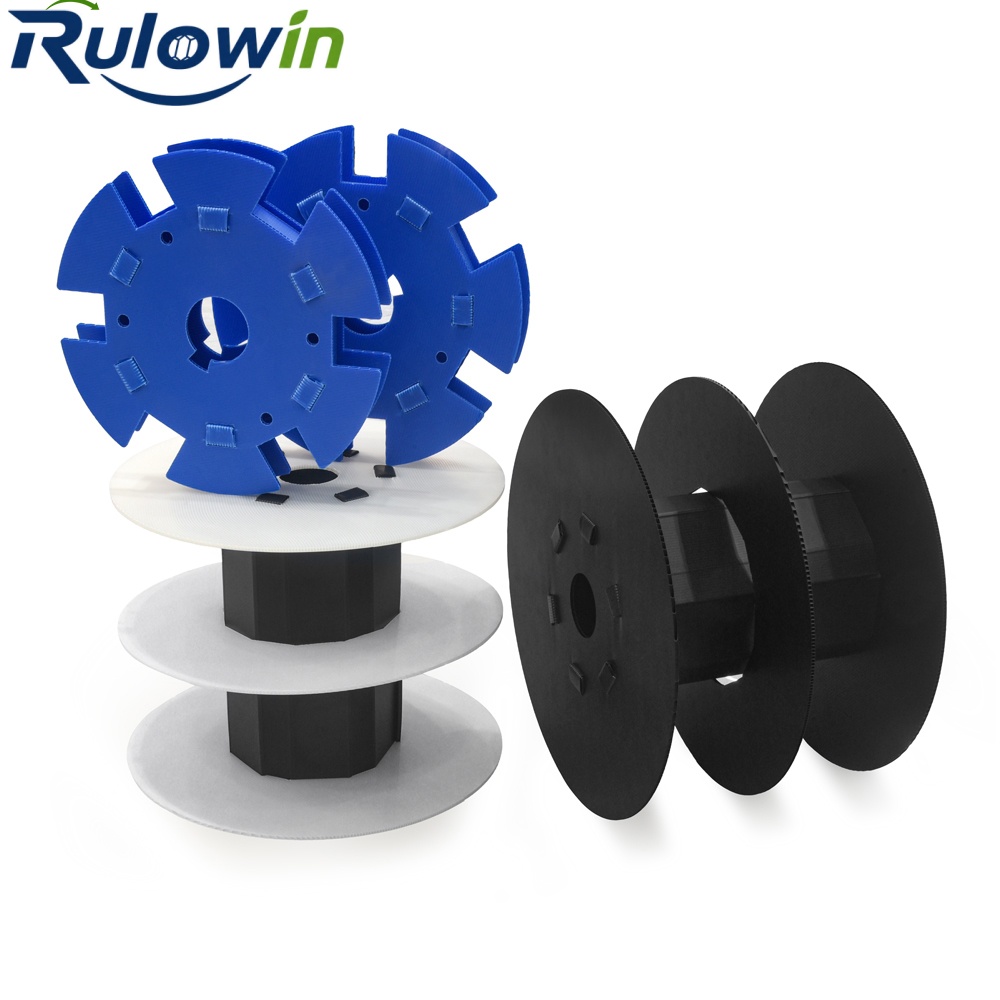
Reel sourcing goes wrong in a predictable way: the order is placed with a cable diameter and a length, the reels arrive, and the flange cracks or the reel wobbles on the stand. Seven questions up front remove almost all of it, and they are quick to ask.
1. What is the hub diameter, and why?
The hub sets the tightest bend the cable will ever see. It should come from your cable’s minimum bend radius. If the supplier asks for that figure, good. If they tell you the hub size without asking, they are quoting a standard reel and the hub is whatever the tooling came out at.
2. What length is the reel rated for, at my cable diameter?
Not at some nominal diameter – at yours. Length rating depends on cable diameter, because the volume between hub and flange is fixed. Over-winding is the single most common cause of flange failure, and it usually starts with a rating quoted for a different cable.
3. What is the bore, to what tolerance?
It has to match your payout spindle. A bore that is slightly loose wobbles, and a wobbling reel produces a periodic tension variation that shows up on sensitive cable. Ask for the tolerance, not just the nominal size.
4. How thick is the flange, and where is it reinforced?
Flange failures start at the hub, where the section is thinnest and the radial pressure from the cable is highest. Ask what has been done about it. A supplier who has thought about this will have an answer in one sentence.
5. What resin, and is it UV-stabilised?
Matters if reels will be stored outdoors. Unstabilised polypropylene chalks and embrittles in sun, and a reel that has gone brittle will crack on the first knock. If your reels live outside, say so.
6. Is it balanced, and to what standard?
An unbalanced reel at speed is a vibration problem and, on fine fiber, a quality problem. Ask whether the reel is balanced and at what rotational speed the balance holds.
7. Can I have a sample before the container?
Always. Fit it to your spindle, wind it, pay it off. Fifteen minutes with a sample tells you more than any data sheet, and a supplier confident in the reel will send one without hesitation.
One more: what happens when something goes wrong
Ask what the process is if a batch arrives damaged or out of specification. A supplier who has an answer – replacement terms, who pays freight, how quickly – has done this before. One who goes quiet has not, and you will find out at the worst possible moment.
Also ask for a contact who can answer a technical question rather than a sales inbox. On reels, the questions that matter – bore tolerance, flange reinforcement, winding tension limits – are engineering questions, and a route to an engineer is worth having before you need it.
And one for yourself: how many do you actually use
Annual consumption is the number that decides the channel and the price, and it is the one most buyers do not have. Go through a year of purchase orders before you start asking suppliers – it takes twenty minutes and it changes the conversation immediately.
What we can do
We supply custom plastic fiber optic cable reels and we answer all seven as a matter of course. Send us the cable specification, target length and bore size and we will come back with a full specification and a sample – including an honest view if a standard reel would do.