
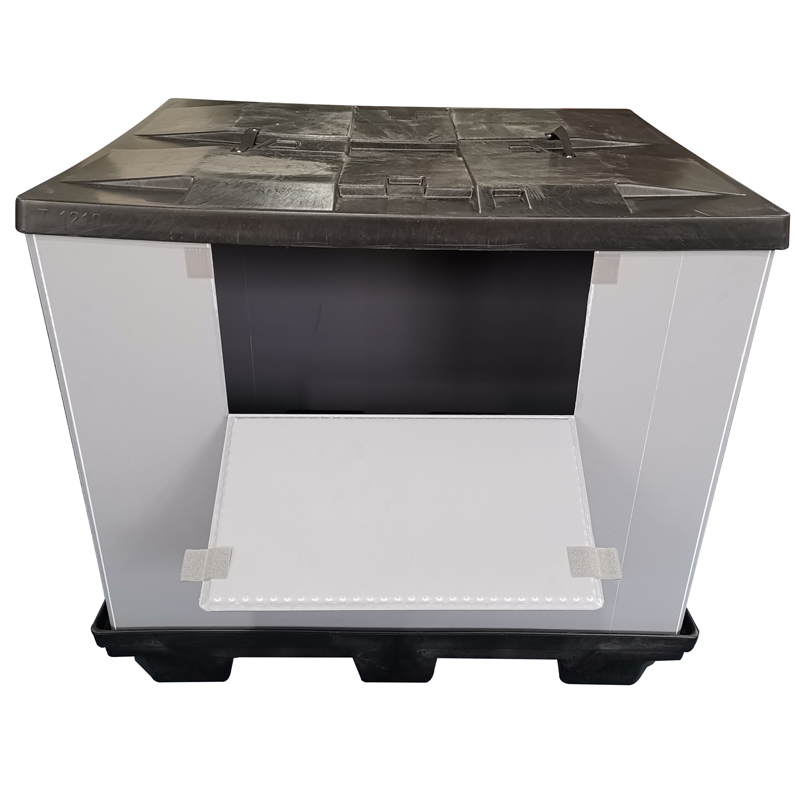
The instinct is to size a sleeve by working out the volume the product occupies and picking a height that contains it. That gives a sleeve that is usually too tall, and the cost of the extra height is paid on every single trip for the life of the sleeve.
Start from the tallest item
The sleeve has to clear the tallest thing you put in it, plus enough clearance that the lid closes without pressing on it. That is the number. Not the average, not the volume – the tallest item.
If your product is uniform, this is easy. If it is mixed, sort by height and decide whether the tall items get their own sleeve size. Two sleeve heights are usually cheaper than one sleeve sized for the worst case, because the tall sleeve gets used for everything and wastes cube on everything.
What the extra height costs
Directly: freight. A sleeve fifty millimetres taller than it needs to be adds volume to every outbound load and to every collapsed return. On a long lane at a decent freight rate, that is real money per year.
Indirectly: stability. A sleeve box with a lot of empty space above the load has its centre of mass low and its walls unloaded, which is fine, but the lid is now unsupported over a gap – and a lid with nothing under the middle is a lid that gets crushed by whatever is stacked on top.
Stacking sets the other constraint
If boxes are double-stacked, the sleeve height determines your total stack height, and total stack height has to clear doorways, mezzanines and racking. Work out the stacked height – two boxes plus the pallet – before fixing the sleeve.
Also check that the sleeve height works out to a sensible number of courses for your product. A sleeve that fits four layers plus a gap that will not take a fifth is a sleeve sized at the worst possible point.
Clearance, and the mistake at the other end
Too tight is a problem too. A lid that presses on the product transfers stack load into the product, which is exactly what a sleeve box exists to prevent. Leave enough that the lid sits on the sleeve, not on the load – typically a small gap, and more if the product compresses or settles in transit.
We went into the lid question in do you need a lid on a pallet sleeve box, because it is tied directly to whether the box gets stacked.
Standard heights, and when to ignore them
Most suppliers have standard sleeve heights, and taking one of them is cheaper than a custom height and arrives faster. Worth checking the standard list before deciding – a standard height that fits within fifty millimetres of your requirement will almost always be the better buy.
The exception is where the load is uniform and tall, and a standard height forces a large void. If you are shipping the same product on the same pallet every day for years, the freight cost of the void dwarfs the premium for a custom sleeve. Work it out rather than assuming.
What we can do
We supply factory-direct pallet sleeve boxes sized to the load rather than to a catalogue. Tell us the pallet footprint, the tallest item, how many courses and whether boxes are stacked, and we will specify the height – and tell you if two heights would serve you better than one.