
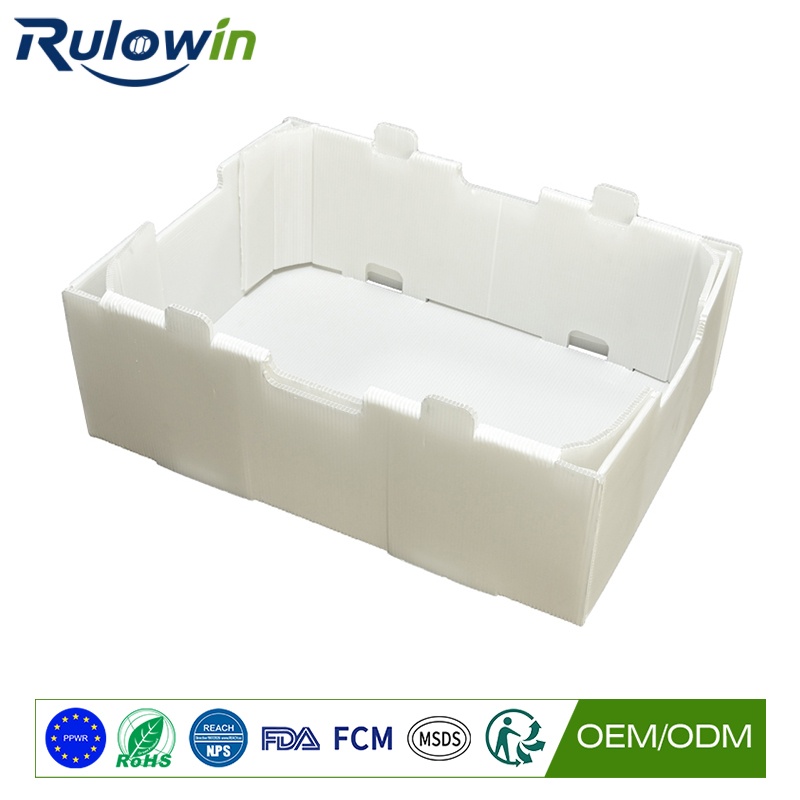
Polypropylene does not absorb water. That is the standard reassurance, and it is true. It is also why people are surprised when a stack of wet boxes performs worse than a dry one. The water is not getting into the material; it is changing the mechanics.
What actually happens
Water adds weight. Produce is mostly water and it is heavy. A box carrying wet product after a wash or a hydro-cool is carrying noticeably more than the same box of dry product, and the stack below it is carrying that too.
Friction changes. A wet rim is slippery. Stacks that rely on friction to stay aligned slide more easily, and once a stack starts leaning the load path moves off the corners and onto the walls.
The surface gets softer locally where water sits against a cut edge or a score line. Capillary action draws water into the flutes at an unsealed edge and it stays there.
Cleaning residue reduces grip. Detergent film on a rim does the same thing as water, sometimes worse.
Where the water gets in
On a corrugated PP box the flutes run through the sheet. Cut edges and any puncture expose them. In a box that is washed, iced or hydro-cooled, water enters at:
- Cut edges at the top rim and around vent holes
- Fold lines where the sheet has been scored and the wall thinned
- Fastener holes and anywhere a staple or clip has pierced the sheet
- Abrasion damage from previous trips
Once inside, water in a flute does not evaporate quickly. It sits, and it adds weight and it carries whatever was on the floor of the wash.
What helps
- Sealed or welded edges on the rim and around cut-outs, which is the single most effective measure
- Drainage – the flutes have to be able to empty, which means the bottom of the box cannot be sealed all the way round
- Designing the rim for wet friction, using a texture or an interlock rather than relying on a flat surface
- Realistic load ratings that assume wet product rather than dry
What does not help much
Thicker sheet. It adds strength dry and wet, but it does not address the friction or the retained water, and it adds cost and weight to a box that is often moved by hand. If wet performance is the problem, edge treatment and drainage are the cheap fixes.
How to check
Weigh a box dry, run it through your normal wash or hydro-cool, let it drain for the time it would normally drain, and weigh it again. The difference is the water your stack is carrying. It is usually more than people expect, and it is a useful number to have before you specify a stack height.
When wet strength is not the issue
It is worth saying that none of this matters for a dry crop in a dry chain. If your boxes never see water beyond a light rinse, the wet condition is not your design case and spending on sealed edges and drainage is money better used elsewhere.
The question is whether water is routine or occasional. Routine exposure – washing every cycle, hydro-cooling, icing – justifies designing for it. Occasional exposure – a box caught in the rain – is usually survivable with a standard box, because PP itself is unaffected and the water drains eventually.
We would rather ask which it is than sell you features you do not need. Plenty of operations run standard boxes for years without trouble because their crop never gets wet.
What we supply
Our produce boxes can be supplied with sealed rims and drainage provisions for washed and hydro-cooled loops. Tell us the wet cycle and we will design for the wet condition rather than quoting a dry-load figure and hoping.